 Preview
 Send
Send Share
Share
 Details

 Download
 Similars
 X-Ray
X-Ray Diaporama
 Stats
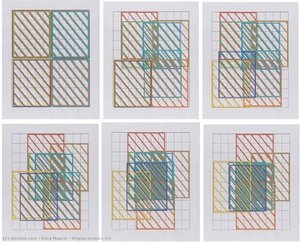
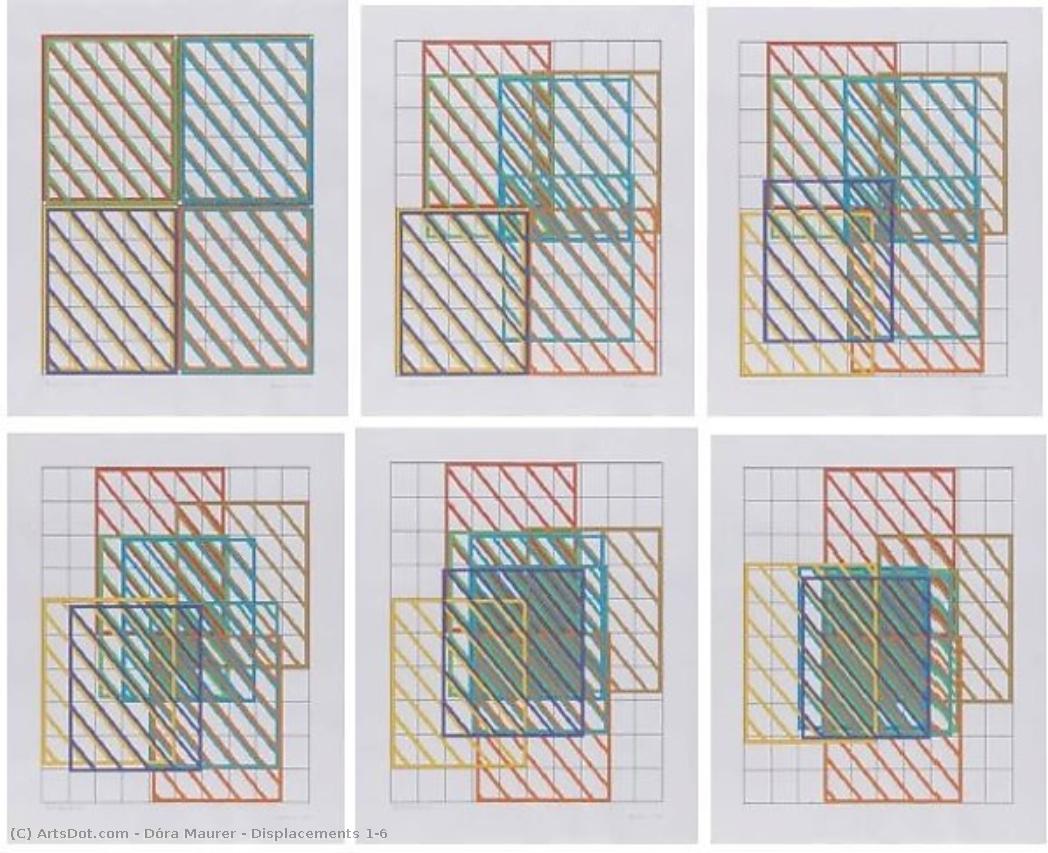
StatsDisplacements 1-6
 1976
1976 61.0 x 50.0 cm
 Read More
Giclée / Art Print
Museum-quality giclée or canvas print with fast production and flexible finish options. ( Buy Hand Made Painting Switch to Digital Image)




































Pick from our preset sizes that match the artwork's original proportions.

You may enter your own dimensions to fit a specific frame or space. If your selected size does not match the original image's proportions, we will either crop the artwork or extend the image with a mirrored or solid-fill edge. A digital mockup will be sent for your approval before production begins.
Please note that the on-screen preview does not reflect the actual cropping or extension. Only the mockup will accurately show the final composition.
While custom sizes are available, we recommend selecting a dimension from the predefined list to preserve the original proportions.
Worldwide Delivery () in 2 weeks instead of standard 4/5 weeks. (8 September)

Free Worldwide Express Shipping

High-Quality Linen Canvas

Full Shipping Insurance

Customs Tax Refund Guarantee

True Color Matching Guarantee

100-Day Return Policy (Defects Only)

100% Money-Back Guarantee

Bulk Discount Offer
 Glass option is only available in size under 110 CM

Displacements 1-6
Giclée / Art Print
Reproduction Size
-


Total Price
$ 63
Related Artworks


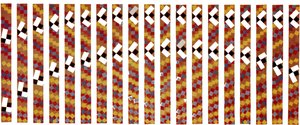



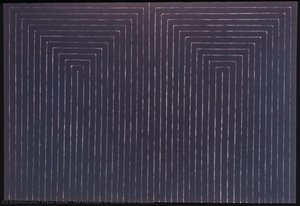
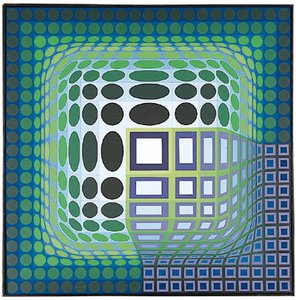
Artist Biography
A Life in Motion: The Pioneering Vision of Dóra Maurer
Dóra Maurer, born in Budapest in 1937, stands as a monumental figure in the landscape of contemporary art, her career spanning over five decades and encompassing an astonishing breadth of media. From the graphic foundations of her early training at the Hungarian Academy of Fine Arts to the avant-garde explorations in film, photography, painting, performance, and sculpture that would define her practice, Maurer’s journey is one of relentless experimentation and intellectual rigor. Her work isn't simply *about* movement; it embodies it, dissects it, and presents it as a series of possibilities for the viewer to contemplate. Emerging into prominence in the 1970s, Maurer navigated a complex political climate, subtly challenging boundaries and perceptions through her innovative approach to art-making. She uniquely experienced both sides of the Iron Curtain, fostering a perspective that blended Eastern European sensibilities with Western conceptual concerns.Early Influences and the Rise of Avant-Garde Expression
Maurer’s initial artistic endeavors centered on graphic arts, but it was in the 1970s that her vision truly began to coalesce. Collaborations with musicians sparked an interest in time-based media – film and photography became crucial tools for investigating the ephemeral nature of experience. This period saw the birth of what would become a defining characteristic of her oeuvre: a fascination with mathematical and complex system processes. She wasn’t interested in depicting movement, but rather in *deconstructing* it, breaking down simple actions into their constituent parts to reveal the underlying structures that govern our perception of time and space. This approach was deeply rooted in the Hungarian neo-avant-garde scene, yet Maurer quickly distinguished herself through her unique blend of geometric abstraction and conceptual inquiry. Her early “quasi-images” – paintings based on theories of perception and color – demonstrated a commitment to exploring the plasticity of visual elements and their ability to evoke dynamic sensations.The Language of Systems: Painting, Photography, and Beyond
Maurer’s art is fundamentally concerned with presenting options—not dictating meaning, but rather offering a framework for viewer interpretation. This philosophy manifests powerfully in her series like “Displacements,” where she employed mathematical grids and color fields to create works that feel both precise and open-ended. The rhythmic shifts and overlaps of color within these paintings aren’t arbitrary; they are the result of a carefully considered system, yet the final effect is one of fluidity and change. Her photographic work extends this exploration, often distorting or transforming images to emphasize the act of seeing itself. She doesn't capture moments but rather investigates how we perceive them. This interest in perception led her into performance art, where she directly engaged with the body as a means of challenging conventional notions of representation and control. Throughout her career, Maurer has seamlessly transitioned between these different media, demonstrating an exceptional versatility and a consistent commitment to her core artistic principles.A Legacy of Teaching and Curatorial Practice
Beyond her own creative practice, Dóra Maurer has dedicated herself to education and the fostering of artistic dialogue. For many years, she was a professor at the Faculty of Fine Arts in Budapest, nurturing generations of artists with her innovative pedagogy. Her commitment extended beyond the classroom; she also served as a curator, organizing exhibitions that showcased emerging talent and challenged established norms. This dual role—artist and educator—highlights Maurer’s belief in the importance of both creative expression and critical thinking. She founded Open Structures Art Society (OSAS) in 2005, further solidifying her commitment to collaborative artistic endeavors.Historical Significance and Enduring Influence
Dóra Maurer's work occupies a unique position within the history of contemporary art. She bridged the gap between concrete art’s formal rigor and conceptual art’s intellectual questioning, creating a body of work that is both visually compelling and profoundly thought-provoking. Her exploration of mathematical systems and viewer perception anticipated many of the concerns that would come to define post-minimalist and process art movements. Recognition came later in her career with major retrospective exhibitions, including a significant show at Tate Modern from 2019 to 2020. Today, Maurer’s influence can be seen in the work of numerous contemporary artists who continue to explore themes of movement, perception, and the relationship between art and science. Her legacy is not simply one of aesthetic innovation but also of intellectual courage—a willingness to challenge conventions and embrace the complexities of the world around her.
dóra maurer
1937 - , Hungary
Quick Facts
- Artistic Movement Or Style: Avant-garde, Conceptual Art
- Date Of Birth: 1937
- Full Name: Dóra Maurer
- Nationality: Hungarian
- Notable Artworks:
- Displacements (a)
- Timing
- Quasi-photos
- Place Of Birth: Budapest, Hungary