 Preview
 Send
Send Share
Share
 Details

 Download
 Similars
 X-Ray
X-Ray Diaporama
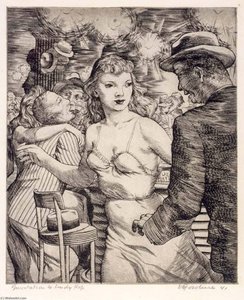
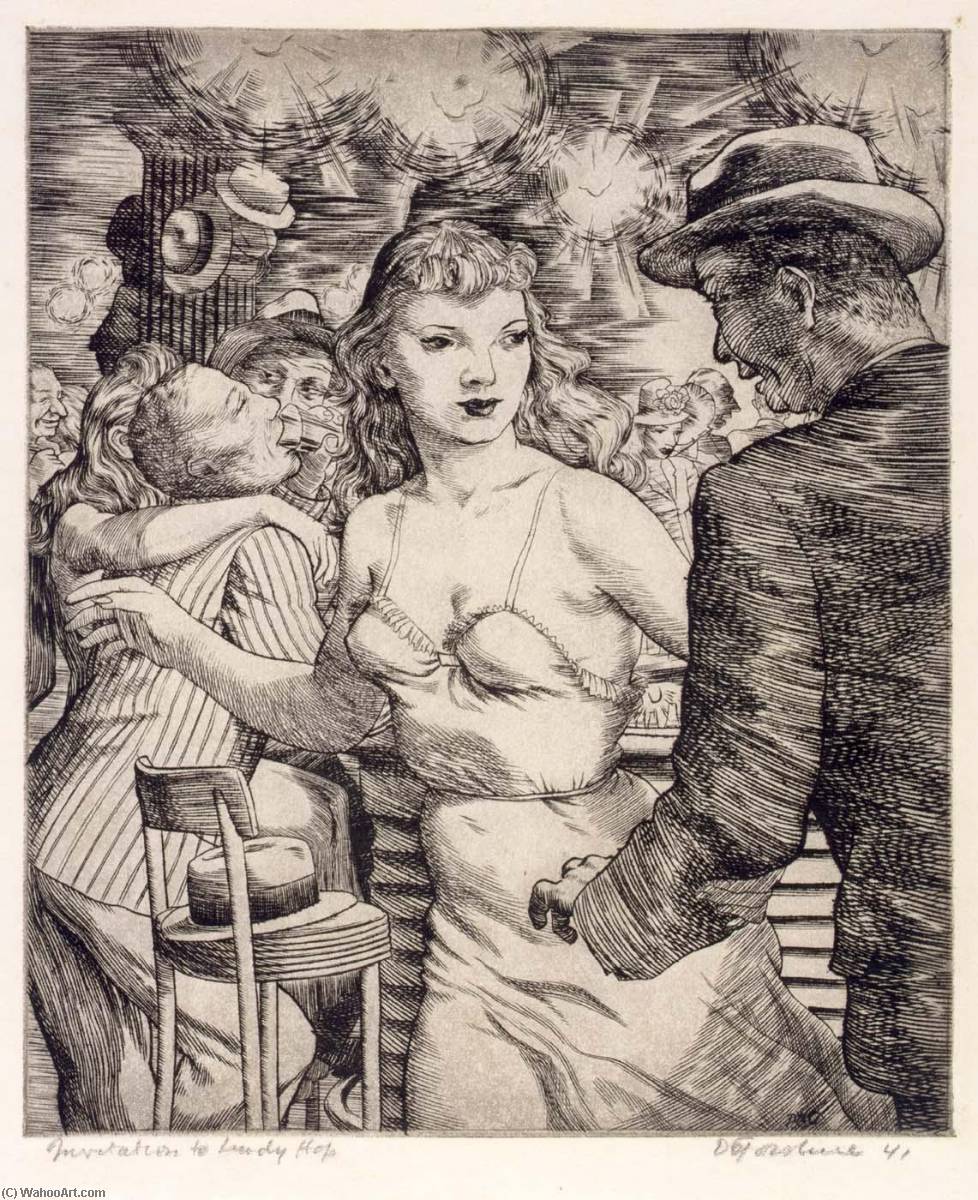
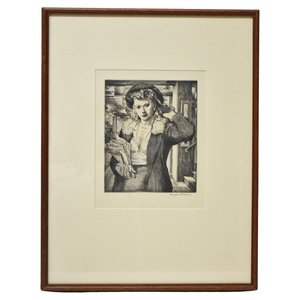
Invitation to Lindy Hop
 1941
1941 19.0 x 16.0 cm
 Read More
Giclée / Art Print
Museum-quality giclée or canvas print with fast production and flexible finish options. ( Buy Hand Made Painting Buy Image)




































Pick from our preset sizes that match the artwork's original proportions.

You may enter your own dimensions to fit a specific frame or space. If your selected size does not match the original image's proportions, we will either crop the artwork or extend the image with a mirrored or solid-fill edge. A digital mockup will be sent for your approval before production begins.
Please note that the on-screen preview does not reflect the actual cropping or extension. Only the mockup will accurately show the final composition.
While custom sizes are available, we recommend selecting a dimension from the predefined list to preserve the original proportions.
Worldwide Delivery () in 2 weeks instead of standard 4/5 weeks. (22 August)

Free Worldwide Express Shipping

High-Quality Linen Canvas

Full Shipping Insurance

Customs Tax Refund Guarantee

True Color Matching Guarantee

60-Day Return Policy (Defects Only)

100% Money-Back Guarantee

Bulk Discount Offer
 Glass option is only available in size under 110 CM

Invitation to Lindy Hop
Giclée / Art Print
Reproduction Size
-


Total Price
$ 63
Related Artworks





Artist Biography
Douglas W. Gorsline: A Weaver of Movement and the Human Psyche
Born in Rochester, New York, in 1913, Douglas W. Gorsline was more than simply a painter; he was an explorer of perception, a translator of movement, and a keen observer of the human condition. His artistic journey, spanning nearly seven decades, reveals a fascinating evolution from early social realism to a strikingly unique style deeply influenced by Cubism, Surrealism, and the groundbreaking work of photographers documenting motion. Gorsline’s legacy lies not just in his individual artworks but also in his innovative approach to depicting reality – capturing fleeting moments, internal states, and the dynamism inherent within both the external world and the human psyche.
Gorsline's early artistic training laid a foundation for his later explorations. He began with a focus on social realism, a movement dedicated to portraying everyday life with honesty and accuracy. This initial grounding provided him with technical skills and an understanding of depicting people within their environments. However, it was during the 1930s that Gorsline’s artistic vision truly began to shift. Exposure to European avant-garde movements – particularly Cubism and Surrealism – proved transformative. He sought ways to represent not just what he *saw*, but also how things *felt*—the energy of a crowd, the disorientation of a city street, the hidden depths of the human mind.
The Influence of Photography and Modernism
A pivotal influence on Gorsline’s work was the pioneering photography of Étienne-Jules Marey and Edweard Muybridge. These photographers meticulously documented movement through sequential images, revealing the underlying mechanics of action. Gorsline recognized in their techniques a way to capture not just a static image but also the *process* of change—the very essence of dynamism. He adopted this approach, incorporating fragmented forms and multiple perspectives reminiscent of Cubism, while simultaneously striving to convey the sensation of movement within his paintings.
The impact of Cubism is readily apparent in Gorsline’s compositions. He frequently employed geometric shapes and fractured planes, challenging traditional notions of perspective and spatial representation. However, unlike some Cubist painters who focused solely on deconstructing form, Gorsline used this technique to create a sense of layered reality—as if the viewer were simultaneously experiencing multiple viewpoints at once. This approach was further enhanced by his exploration of Surrealism, which allowed him to delve into the realm of dreams and subconscious imagery. His paintings often feature distorted figures, unexpected juxtapositions, and symbolic elements that invite interpretation and introspection.
A Unique Artistic Style: Combining Realism with Movement
Gorsline’s artistic style is remarkably distinctive—a synthesis of realism, Cubist fragmentation, and Surrealist symbolism. He wasn't interested in simply replicating reality; he sought to *interpret* it, conveying not just what was visible but also the underlying emotions and experiences associated with a particular scene or subject. His use of color was bold and expressive, often employing vibrant hues to heighten the sense of dynamism and create visual impact.
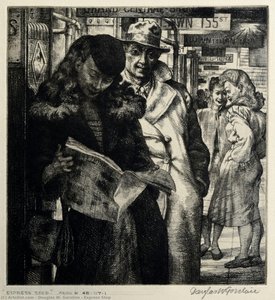
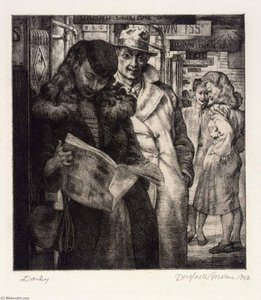
Consider his etching “Daily” (1942), a powerful depiction of New York City subway life. The work is characterized by sharp lines, fragmented forms, and a palpable sense of movement—a testament to Gorsline’s fascination with capturing the energy of urban spaces. Similarly, his paintings frequently feature figures caught in moments of transition or contemplation, their faces reflecting a range of emotions. He masterfully blended these elements to create works that are both visually arresting and psychologically resonant.
Legacy and Recognition
Douglas W. Gorsline’s contributions to American art are significant, though he often worked outside the mainstream artistic circles. His innovative approach to depicting movement and his exploration of the human psyche set him apart from many of his contemporaries. Beyond painting, Gorsline was a prolific illustrator and writer, producing several children's books, including an edition of Thomas Wolfe’s *Look Homeward, Angel*, and his own novel, *Farm Boy*. These works demonstrate his versatility as an artist and his ability to engage with diverse audiences.
His work has been exhibited in galleries across the United States and Europe, and his paintings are held in numerous public collections. The Gorsline Museum, established in France after his death, serves as a testament to his enduring legacy—a space dedicated to preserving and celebrating his unique artistic vision. Douglas W. Gorsline’s art continues to resonate with viewers today, offering a compelling glimpse into the complexities of modern life and the depths of the human experience.
douglas w. gorsline
1913 - 1985 , United States of America
Quick Facts
- Artistic Movement Or Style:
- Cubism
- Surrealism
- Social realism
- Artists Or Movements Influenced By This Artist:
- Cubism
- Surrealism
- Artists Who Influenced This Artist:
- Pab Picasso
- Georges Braque
- Étiène-Jules Marey
- Edweard Muybridge
- Date Of Birth: 1913
- Date Of Death: 1985
- Full Name: Douglas W. Gorsline
- Nationality: American
- Notable Artworks:
- Daily
- The Fiddler
- Place Of Birth: Rochester, USA