 Preview
 Send
Send Share
Share
 Details

 Download
 Similars
 X-Ray
X-Ray Diaporama
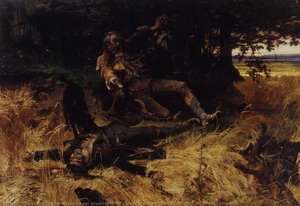
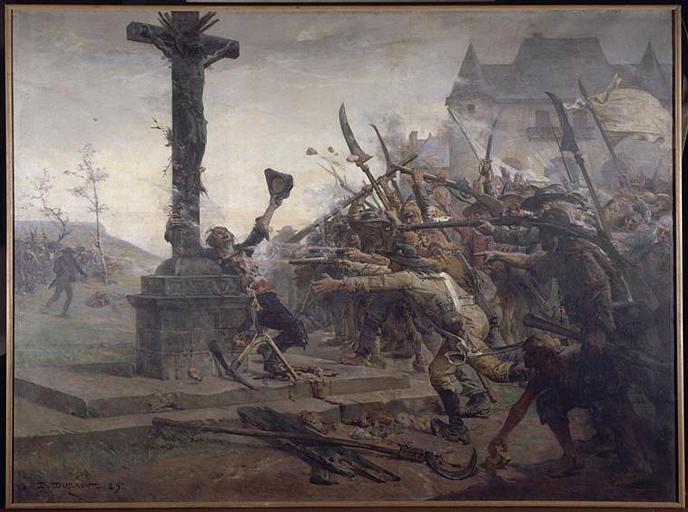
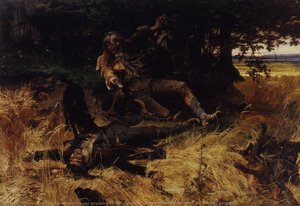
MORT DE SAUVEUR LE HEROS BRETON
 Read More
Hand Made Oil Reproduction
Hand-painted oil on canvas in your size and frame, made to order by our artists. ( Buy Print Buy Image)




































Pick from our preset sizes that match the artwork's original proportions.

You may enter your own dimensions to fit a specific frame or space. If your selected size does not match the original image's proportions, we will either crop the artwork or extend the painting with additional hand-painted elements. A digital mockup will be sent for your approval before production begins.
Please note that the on-screen preview does not reflect the actual cropping or extension. Only the mockup will accurately show the final composition.
While custom sizes are available, we recommend selecting a dimension from the predefined list to preserve the original proportions.
After order, ArtsDot.com team will email client for instructions and provide a mockup preview
Worldwide Delivery () in 3/4 weeks instead of standard 5 weeks. (30 August). No compromise on quality.

Free Worldwide Express Shipping

High-Quality Linen Canvas

Full Shipping Insurance

Customs Tax Refund Guarantee

True Color Matching Guarantee

60-Day Return Policy (Defects Only)

100% Money-Back Guarantee

Bulk Discount Offer
 Glass option is only available in size under 110 CM

MORT DE SAUVEUR LE HEROS BRETON
Reproduction Medium
Reproduction Size
-


Total Price
$ 338
Related Artworks





Artist Biography
The Visionary Brush of Edmond Louis Dupain
In the grand tapestry of nineteenth-century French art, few names evoke the dramatic tension between historical gravity and painterly elegance quite like Edmond Louis Dupain. Born in 1836, a period of profound transition in France, Dupain emerged as a master capable of breathing life into the monumental. His artistry was not merely about the depiction of scenes, but about the orchestration of emotion through scale and light. While his roots can be traced to the artistic lineage of Nantes, it was within the prestigious halls of the École Supérieure des Beaux-Arts in Paris that his true genius began to coalesce. Under the rigorous guidance of luminaries such as Alexandre Cabanel and Jean-Léon Gérôme, Dupain absorbed the disciplined principles of classical composition, yet he possessed a restless spirit that sought to infuse these traditional forms with a burgeoning sense of modern psychological depth.
The trajectory of Dupain’s career was defined by his ability to navigate the complex intersection of history and myth. He was an artist who understood that a canvas could serve as both a window into the past and a mirror for the contemporary soul. His work often featured scenes populated by musketeers, elegant figures accompanied by graceful greyhounds, and mythological subjects that felt vibrantly alive rather than statically ancient. This versatility allowed him to move seamlessly between the genre painting of everyday elegance and the epic demands of state-commissioned murals. His technical prowess was frequently recognized by his peers; by 1875, he had secured a third-class medal, followed by a prestigious first-class medal in 1877, marking his ascent within the influential Salon des artistes français.
A Legacy Carved in Stone and Canvas
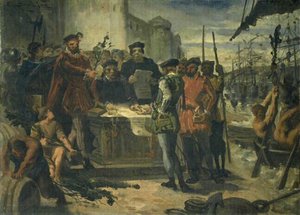
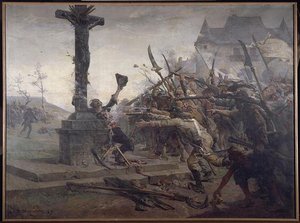
Perhaps the most enduring testament to Dupain’s monumental talent lies in his contribution to the architectural soul of Paris. His most ambitious undertaking—a commission from Napoleon III in 1869—involved the decoration of the Chapel of the Salpêtrière Hospital. Here, Dupain moved beyond the easel to engage with the very bones of the city. In creating the colossal murals “Les Girondins” and “Le Colleone,” he undertook a Herculean task of historical storytelling. These works were not mere decorations; they were profound explorations of political upheaval and human tragedy, capturing the tumultuous debates of the French Revolution with a sense of theatrical grandeur that commanded the viewer's reverence.
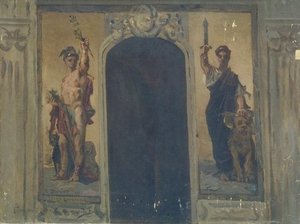
Beyond the walls of the Salpêtrière, Dupain’s influence extended to other significant landmarks of Parisian intellectual life. His ability to complete large-scale works for public institutions was further evidenced by his contribution to the Observatoire de Paris. In 1886, he completed a magnificent painting of Venus that graced the ceiling of the rotunda in the Perrault wing, demonstrating his capacity to marry mythological beauty with the architectural splendor of the Belle Époque. His oeuvre remains a fascinating study in contrasts:
- Historical Narrative: A profound ability to chronicle pivotal moments in French history through sweeping, dramatic compositions.
- Genre and Elegance: A mastery of intimate scenes featuring period costumes, noble animals, and the refined aesthetics of 19th-century life.
- Technical Versatility: The skill to transition from the delicate brushwork required for mythological figures to the robust, structural demands of large-scale mural painting.
- Psychological Depth: An infusion of human emotion into historical subjects, moving beyond mere documentation to capture the internal struggles of his protagonists.
As we look back upon the life of Edmond Louis Dupain, we see an artist who stood at the crossroads of eras. He carried the weight of classical tradition while embracing the dramatic energy of a changing France. His works continue to serve as vital links to a period where art was tasked with the monumental responsibility of shaping national identity and providing spiritual solace through beauty.
Quick Facts
- Artistic Movement Or Style: Romanticism
- Artists Or Movements Influenced By This Artist: ['Romantic Painting']
- Artists Who Influenced This Artist: ['Eugène Delacroix']
- Full Name: Edmond Louis Dupain
- Nationality: French
- Notable Artworks:
- Les Girondins
- Le Colleone
- Place Of Birth: Saint-Louis