 Preview
 Send
Send Share
Share
 Details

 Download
 Similars
 X-Ray
X-Ray Diaporama
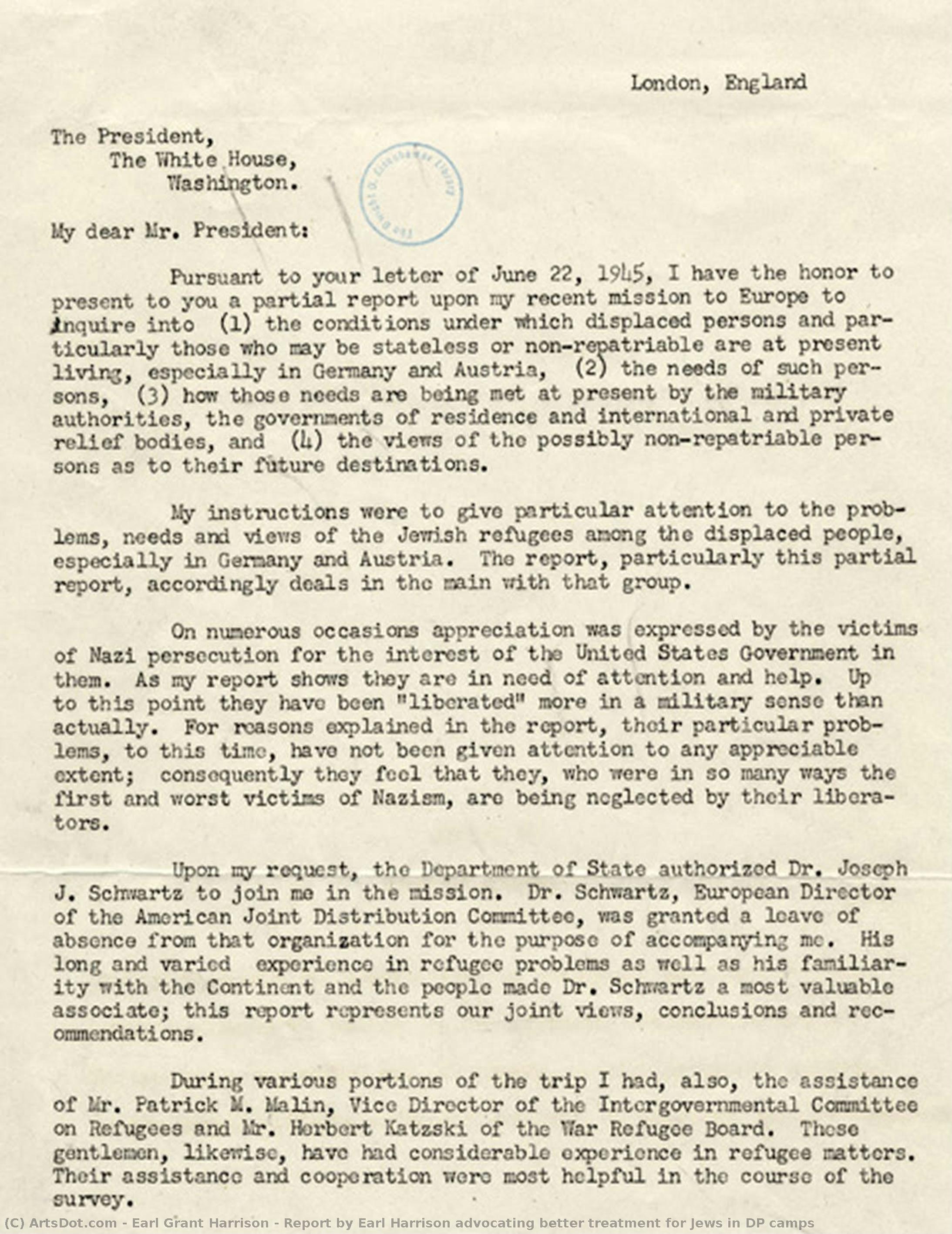
Report by Earl Harrison advocating better treatment for Jews in DP camps


 Read More
Hand Made Oil Reproduction
Hand-painted oil on canvas in your size and frame, made to order by our artists. ( Buy Print Buy Image)




































Pick from our preset sizes that match the artwork's original proportions.

You may enter your own dimensions to fit a specific frame or space. If your selected size does not match the original image's proportions, we will either crop the artwork or extend the painting with additional hand-painted elements. A digital mockup will be sent for your approval before production begins.
Please note that the on-screen preview does not reflect the actual cropping or extension. Only the mockup will accurately show the final composition.
While custom sizes are available, we recommend selecting a dimension from the predefined list to preserve the original proportions.
After order, ArtsDot.com team will email client for instructions and provide a mockup preview
Worldwide Delivery () in 3/4 weeks instead of standard 5 weeks. (26 August). No compromise on quality.

Free Worldwide Express Shipping

High-Quality Linen Canvas

Full Shipping Insurance

Customs Tax Refund Guarantee

True Color Matching Guarantee

60-Day Return Policy (Defects Only)

100% Money-Back Guarantee

Bulk Discount Offer
 Glass option is only available in size under 110 CM

Report by Earl Harrison advocating better treatment for Jews in DP camps
Reproduction Medium
Reproduction Size
-


Total Price
$ 263
Artwork Description
Related Artworks









Artist Biography
The Architect of Justice: The Life and Legacy of Earl Grant Harrison
In the tapestry of twentieth-century American history, few figures weave together the threads of legal rigor and profound humanitarian empathy as seamlessly as Earl Grant Harrison. Born on April 27, 1899, in the industrious Frankford neighborhood of Philadelphia, Harrison was a man shaped by both the grit of his urban upbringing and an unyielding intellectual curiosity. The son of Joseph Layland Harrison, an English immigrant, and Anna MacMullen, a Scotch-Irish actress, he inherited a lineage of diverse cultural perspectives that would later inform his global outlook. His early academic journey at the University of Pennsylvania, where he graduated as valedictorian in 1920, laid the foundation for a life dedicated to the pursuit of truth through the lens of law and social responsibility.
Harrison’s professional ascent was marked by a brilliant legal mind and an unwavering commitment to public service. After earning his honors from the University of Pennsylvania Law School in 1923, he entered the prestigious firm of Saul, Ewing, Remick & Saul, eventually rising to partnership. Yet, his ambitions were never confined to the courtroom. His career was defined by pivotal roles within the United States government, serving as the Director of Alien Registration for the Department of Justice and later as the Commissioner of Immigration and Naturalization. In these capacities, Harrison stood at the epicenter of a world in flux, navigating the complex legal and moral landscapes of an era defined by global conflict and mass migration.
A Voice for the Displaced: The Harrison Report
The true magnitude of Harrison’s historical significance is perhaps most poignantly felt through his role as a humanitarian advocate. As the shadows of World War II receded, leaving behind a continent fractured and millions of souls adrift, Harrison was called upon by President Harry S. Truman to address one of the era's most harrowing crises. Appointed as a Special Envoy, he embarked on an investigation into the conditions of Displaced Persons camps across Europe. What he discovered was a landscape of profound suffering, where Jewish survivors faced not only the trauma of the Holocaust but also the sting of anti-Semitism and neglect within the very camps meant to provide refuge.
< p>The resulting Harrison Report of 1945 became a landmark document in the history of human rights. It was more than a mere administrative summary; it was a searing indictment of the status quo and a clarion call for systemic change. By meticulously documenting the deplorable living conditions and advocating for the creation of separate camps for Jewish refugees, Harrison’s work catalyzed essential governmental action. His advocacy ensured that the plight of the displaced could no longer be ignored by the international community, fundamentally reshaping immigration policy and humanitarian relief efforts in the post-war period.Legacy of Scholarship and Service
Beyond his immediate political and humanitarian impact, Harrison left an indelible mark on the academic world. His tenure as the Dean of the University of Pennsylvania Law School from 1944 to 1948 allowed him to shape the next generation of legal minds, instilling in them a sense of duty that mirrored his own. He viewed the law not merely as a set of rules, but as a dynamic instrument for justice and social progress. This philosophy bridged the gap between the technicalities of legal scholarship and the visceral realities of human suffering.
When Earl Grant Harrison passed away in 1955, he left behind a legacy that transcends the traditional boundaries of a legal career. He remains a symbol of how individual agency, when paired with profound empathy and rigorous intellect, can alter the course of history. His life serves as a testament to the power of documentation and advocacy, reminding us that the pursuit of justice requires both the courage to witness tragedy and the strength to demand reform.
earl grant harrison
1899 - 1955 , United States of America
Quick Facts
- Artistic Movement Or Style: Legal Art History
- Artists Or Movements Influenced By This Artist: ['Displaced Persons']
- Artists Who Influenced This Artist: ['James Walter']
- Date Of Birth: April 27, 1899
- Date Of Death: July 28, 1955
- Full Name: Earl Grant Harrison
- Nationality: American
- Notable Artworks: ['Harrison Report']
- Place Of Birth: Philadelphia, Pennsylvania