

 Preview
 Send
Send Share
Share
 Details

 Download
 Similars
 X-Ray
X-Ray Diaporama
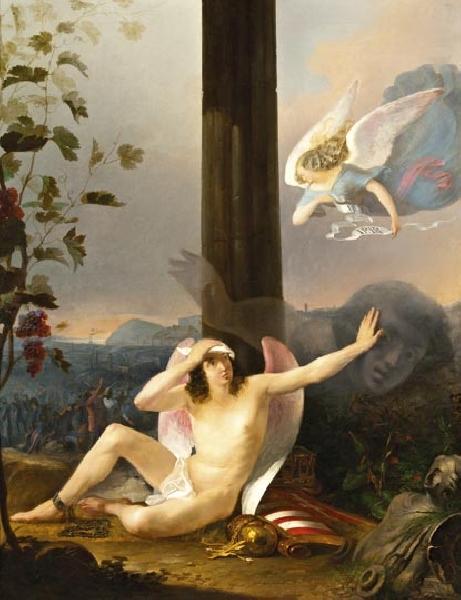
Magyar Rabláncaitól szabaduló ifjú Magyarország
 Romanticism
 1842
1842 111.0 x 88.0 cm
 Read More
Purchase a high-resolution, enhanced digital image, far superior to the online preview.
Each file is meticulously prepared by our in-house specialists using advanced tools and expert manual retouching. We ensure every image has exceptional clarity, precise color accuracy, and fine detail.
The final file is delivered via email within 72 hours, optimized for immediate use in professional, editorial, and print environments. This is the same quality trusted by top-tier design studios, publishers, and galleries.
Digital Image
Download a high-resolution file for personal display, printing, and creative projects. ( Buy Print Buy Hand Made Painting)
Included in Every Digital Image Order
Expert Digital Delivery, Guaranteed
When you choose ArtsDot.com, you're not just getting an image - you're receiving a professionally enhanced digital artwork, crafted with precision and backed by a satisfaction guarantee. Here's everything that comes with your order, automatically:

Fast Email Delivery
Your high-resolution digital image file will be emailed to you within 72 hours of ordering - ready for immediate use.

AI-Enhanced Digital File
Your artwork is professionally optimized using advanced AI tools and manual editing, ensuring maximum detail, clarity, and color accuracy.

Free Lifetime Re-Delivery
Accidentally deleted or lost your file? No worries - we'll resend it to you anytime, free of charge.

No Import Fees - Ever
Enjoy your artwork instantly with zero customs, duties, or delivery fees - digital downloads are always tax-free.

Color Accuracy Guarantee
We ensure your digital image reflects the original colors as closely as possible using professional tools and color management.

60-Day Satisfaction Guarantee
If you're not satisfied with your digital image, we'll revise it or refund 100% within 60 days - no questions asked.

100% Money-Back Guarantee
Not satisfied? Get a full refund within 60 days of receiving your digital file - no questions asked.

Bulk Order Discounts
Buy 3 images, save 10% - Buy 5, save 15% - Buy 10+, save 20%. Great for creative projects, galleries, and agencies.
Related Artworks
Artist Biography
The Soul of the Dutch Canvas: The Life and Legacy of Ede Heinrich
To step into a gallery featuring the works of Ede Heinrich is to enter a world where time slows, allowing the quiet dignity of nineteenth-century life to unfold before the eyes. Born in Haarlem in 1819, Heinrich emerged from a rich Dutch artistic tradition, a period defined by an intense fascination with realism and a profound respect for the tangible textures of existence. His journey was one of meticulous observation, shaped by the prestigious halls of the Koninklijke Academie voor Beeldende Kunsten in Amsterdam. It was here that he encountered the influence of masters like Anton Mauve, whose naturalistic approach encouraged Heinrich to look beyond the surface and capture the very breath of his subjects.
Heinrich’s artistry was never merely about documentation; it was an emotional pursuit. While many of his contemporaries in the Impressionist movement sought to dissolve form into fleeting light, Heinrich remained anchored in the permanence of detail. He possessed a rare ability to render the weight of fabric, the roughness of earth, and the soft glow of candlelight with such precision that his canvases felt almost tactile. His palette was a tribute to the natural world, dominated by deep ochres, mossy greens, and somber browns—tones that lent his work an enduring, grounded quality that resonated with the Victorian era's appreciation for truth and substance.
A Tapestry of Genre and History
The breadth of Heinrich’s oeuvre reflects a mind capable of navigating both the intimate domestic sphere and the grand stage of historical drama. He was a master of the genre scene, finding profound beauty in the mundane rituals of Dutch society. In works such as “The Shepherdess” (1862), one can sense the pastoral peace of the countryside, where the artist uses soft illumination to highlight the contemplative solitude of rural life. These scenes are not merely landscapes; they are psychological portraits of a way of life that was beginning to shift under the tides of modernity.
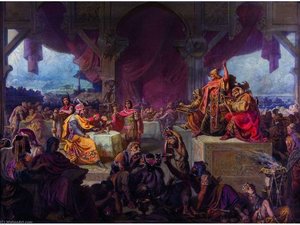
Yet, Heinrich was equally compelled by the weight of history and the drama of the human condition. He possessed a remarkable talent for historical commemoration, breathing life into significant anniversaries and legendary tales through his brush. His painting “Feast of Attila” (1863) showcases this epic capability, moving away from the quietude of Haarlem to present a scene of grandeur and intensity. Whether he was capturing the solemnity of a portrait, such as his depiction of Pieter Willem Valkenburg van Hardenbroeck, or exploring the raw anguish found in works like “Magyar Rabláncaitól szabaduló ifjú Magyarország,” Heinrich’s work consistently sought to find the universal human emotion hidden within specific historical moments.
Enduring Significance in the Artistic Canon
Though Ede Heinrich may not have achieved the widespread celebrity of some of his more radical contemporaries during his lifetime, his contribution to the nineteenth-century artistic landscape remains undeniable. He served as a vital bridge between the classical traditions of Dutch realism and the burgeoning interest in psychological depth that would define later eras. His commitment to accuracy did not come at the expense of feeling; rather, his technical mastery provided the necessary vessel for profound emotional expression.
Today, we look back at Heinrich’s legacy as a testament to the power of observation. His paintings serve as windows into a vanished era, preserving the textures, light, and spirit of a period marked by both stability and significant change. Through his meticulous use of oil paint and his unwavering dedication to his subjects, Ede Heinrich ensured that the quiet stories of the Dutch people and the grand echoes of history would continue to resonate with every generation of art lovers.
ede heinrich
1819 - 1885
Quick Facts
- Artistic Movement Or Style: Romanticism
- Artists Or Movements Influenced By This Artist: ['Gustav Klimt']
- Artists Who Influenced This Artist:
- Johannes Vermeer
- Anton Mauve
- Date Of Birth: 1819
- Date Of Death: 1885
- Full Name: ede heinrich
- Nationality: Dutch
- Notable Artworks:
- The Shepherdess
- Portrait of Willem van Heemskerk
- Place Of Birth: Amsterdam, Netherlands

