 Preview
 Send
Send Share
Share
 Details

 Download
 Similars
 X-Ray
X-Ray Diaporama
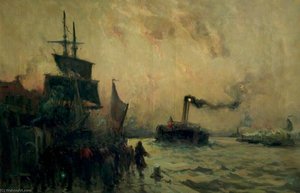
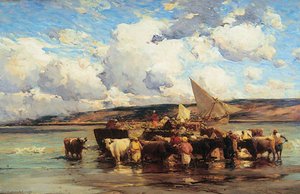
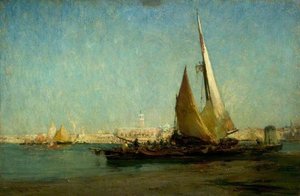
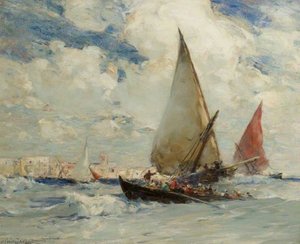
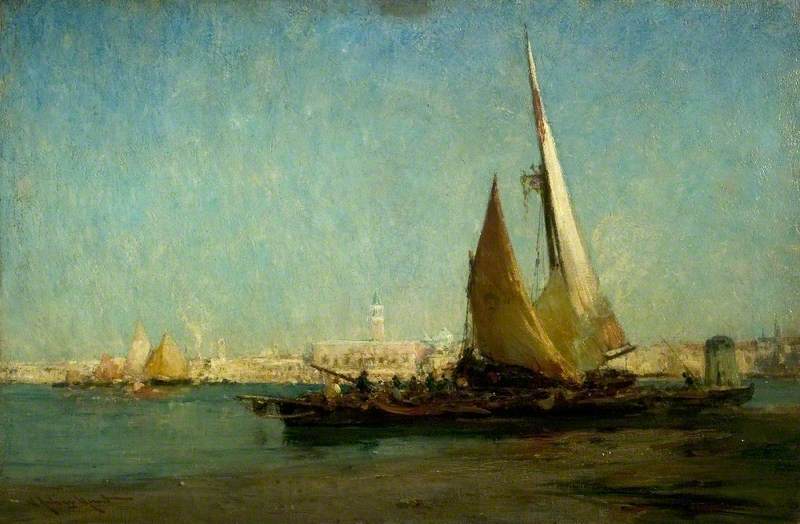
Venice
 51.0 x 76.0 cm
 New Walk Museum - Art Gallery
 Read More
Hand Made Oil Reproduction
Hand-painted oil on canvas in your size and frame, made to order by our artists. ( Buy Print Buy Image)




































Pick from our preset sizes that match the artwork's original proportions.

You may enter your own dimensions to fit a specific frame or space. If your selected size does not match the original image's proportions, we will either crop the artwork or extend the painting with additional hand-painted elements. A digital mockup will be sent for your approval before production begins.
Please note that the on-screen preview does not reflect the actual cropping or extension. Only the mockup will accurately show the final composition.
While custom sizes are available, we recommend selecting a dimension from the predefined list to preserve the original proportions.
After order, ArtsDot.com team will email client for instructions and provide a mockup preview
Worldwide Delivery () in 3/4 weeks instead of standard 5 weeks. (23 August). No compromise on quality.

Free Worldwide Express Shipping

High-Quality Linen Canvas

Full Shipping Insurance

Customs Tax Refund Guarantee

True Color Matching Guarantee

60-Day Return Policy (Defects Only)

100% Money-Back Guarantee

Bulk Discount Offer
 Glass option is only available in size under 110 CM

Venice
Reproduction Medium
Reproduction Size
-


Total Price
$ 388
Related Artworks








Artist Biography
Edmund Aubrey Hunt: Bridging Landscapes and Exotic Horizons
Born in the coastal town of Weymouth, Massachusetts, on February 17th, 1855, Edmund Aubrey Hunt embarked upon a remarkable artistic journey that spanned continents and embraced diverse stylistic approaches. While his American origins initially shaped his formative years, Hunt’s passion for art swiftly propelled him toward Europe, specifically the vibrant hubs of London and Hastings, East Sussex, where he would ultimately reside until his passing in November 1922. His oeuvre stands as a profound testament to an artist deeply attuned to both the serene beauty of rural England and the vibrant, sun-drenched allure of Oriental landscapes—a duality that defines his unique artistic vision.
Hunt’s early training provided him with a rigorous grounding in traditional academic painting techniques. After graduating from college, he briefly entered the prominent architectural firm of Emerson and Fehmer, but the call of the canvas proved irresistible. He sought higher mastery at the prestigious École des Beaux-Arts in Paris, studying for five years under the renowned instructor Jean-Léon Gérôme. This classical foundation allowed him to master the precision of form, yet he would soon find himself transcending these rigid conventions. Gravitating toward the Impressionistic influences championed by masters like Claude Monet and Pierre-Auguste Renoir, Hunt began to prioritize the ephemeral qualities of light and atmosphere over strict anatomical or architectural accuracy.
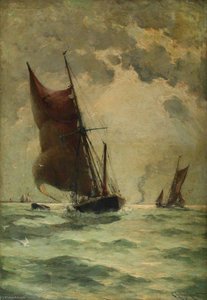
This stylistic evolution is masterfully captured in works such as “A Swim Headed Barge in a Breeze,” where Hunt skillfully depicts the dynamism of a sailing vessel battling turbulent winds. Through the use of impasto texture and sophisticated atmospheric perspective, he exemplifies the Impressionist preoccupation with capturing fleeting moments. His brushwork became increasingly confident and expressive, adding a sense of energy and movement to his maritime scenes. Beyond mere replication of nature, Hunt sought to infuse his canvases with symbolic resonance. Recurring motifs—particularly depictions of rivers and boats—suggested deeper themes of pilgrimage, transformation, and the eternal interplay between humanity and the natural world.
A Journey Through Light and Culture
The trajectory of Hunt’s life was marked by significant personal and geographical shifts that directly informed his creative output. His marriage to Agnes Fitzgibbon in 1878 brought him to London, where he began exhibiting at prestigious venues such as the Royal Academy and the Walker Art Gallery. During this period, his travels through France, the Low Countries, and Italy expanded his visual vocabulary, yet it was his encounter with North Africa that would spark a new chapter in his career. Following his marriage to Maude Chadwick in 1892, Hunt settled in Tangier for ten years, a period of profound inspiration that birthed his celebrated Orientalist works.
In the golden light of Morocco, Hunt perfected a style that blended his academic training with an evocative, impressionistic sensibility. His paintings from this era, such as “Embarking Cattle, Morocco,” capture the rhythmic pulse of rural life and the exotic textures of the landscape. These works are characterized by:
- Dynamic Brushwork: A technique that conveys the heat and movement of the North African environment.
- Luminous Color Palettes: An ability to balance warm, earthy tones with the brilliant light of the Maghreb.
- Cultural Observation: A respectful yet artistic gaze upon the traditions and daily rituals of the region.
Ultimately, Edmund Aubrey Hunt remains a significant figure in late 19th and early 20th-century art, representing a bridge between the structured traditions of the Academy and the emotive freedom of Impressionism. Whether capturing the bustling river scenes of England or the tranquil, sun-soaked vistas of Tangier, his work continues to resonate with a timeless sense of wonder and a deep, spiritual connection to the landscapes he inhabited.
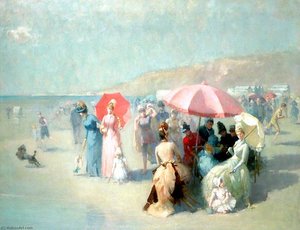
edmund aubrey hunt
1855 - 1922
Quick Facts
- Artistic Movement Or Style: Landscape Painting
- Artists Or Movements Influenced By This Artist: ['Impressionism']
- Artists Who Influenced This Artist: ['George Frederic Watts']
- Date Of Birth: 17 February 1855
- Full Name: Edmund Aubrey Hunt
- Nationality: American
- Notable Artworks:
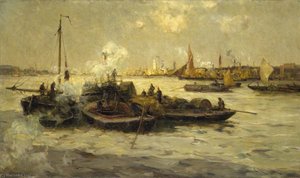
- River Scene with Shipping
- A Swim Headed Barge
- Place Of Birth: Weymouth, Massachusetts