

 Preview
 Send
Send Share
Share
 Details

 Download
 Similars
 X-Ray
X-Ray Diaporama
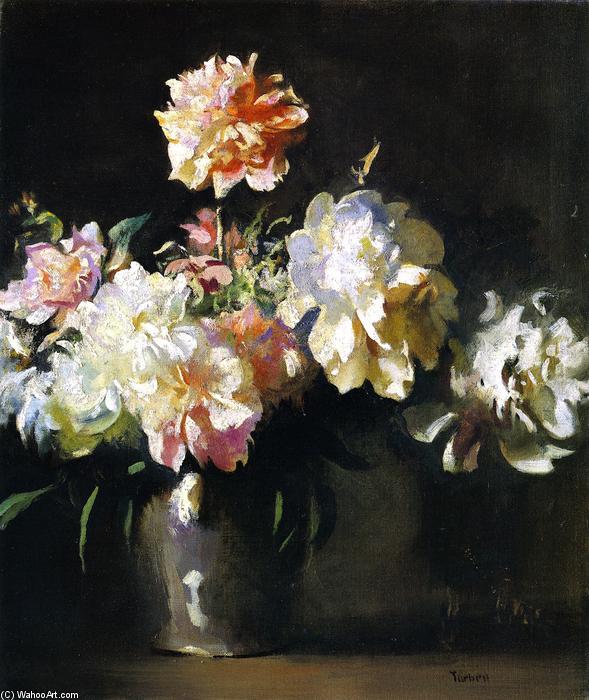
Still LIfe: Vase of Peonies


 Read More
Purchase a high-resolution, enhanced digital image, far superior to the online preview.
Each file is meticulously prepared by our in-house specialists using advanced tools and expert manual retouching. We ensure every image has exceptional clarity, precise color accuracy, and fine detail.
The final file is delivered via email within 72 hours, optimized for immediate use in professional, editorial, and print environments. This is the same quality trusted by top-tier design studios, publishers, and galleries.
Digital Image
Download a high-resolution file for personal display, printing, and creative projects. ( Buy Print Buy Hand Made Painting)
Included in Every Digital Image Order
Expert Digital Delivery, Guaranteed
When you choose ArtsDot.com, you're not just getting an image - you're receiving a professionally enhanced digital artwork, crafted with precision and backed by a satisfaction guarantee. Here's everything that comes with your order, automatically:

Fast Email Delivery
Your high-resolution digital image file will be emailed to you within 72 hours of ordering - ready for immediate use.

AI-Enhanced Digital File
Your artwork is professionally optimized using advanced AI tools and manual editing, ensuring maximum detail, clarity, and color accuracy.

Free Lifetime Re-Delivery
Accidentally deleted or lost your file? No worries - we'll resend it to you anytime, free of charge.

No Import Fees - Ever
Enjoy your artwork instantly with zero customs, duties, or delivery fees - digital downloads are always tax-free.

Color Accuracy Guarantee
We ensure your digital image reflects the original colors as closely as possible using professional tools and color management.

60-Day Satisfaction Guarantee
If you're not satisfied with your digital image, we'll revise it or refund 100% within 60 days - no questions asked.

100% Money-Back Guarantee
Not satisfied? Get a full refund within 60 days of receiving your digital file - no questions asked.

Bulk Order Discounts
Buy 3 images, save 10% - Buy 5, save 15% - Buy 10+, save 20%. Great for creative projects, galleries, and agencies.
Collectible Description
A Moment Frozen in Time: The Elegance of Tarbell’s Peonies
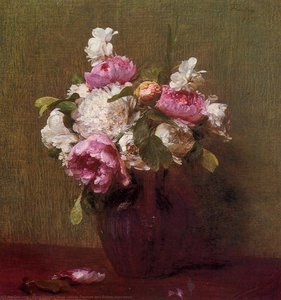
Edmund Charles Tarbell's “Still Life: Vase of Peonies” (1925) isn’t merely a depiction of flowers; it’s an invitation to step into a quiet, contemplative space. This oil painting captures the fleeting beauty of peonies within a vase, rendered with a masterful blend of realism and impressionistic technique that speaks volumes about the artist's understanding of light, texture, and emotion. The scene unfolds against a dramatic, almost velvety black background – a deliberate choice that amplifies the luminosity of the blossoms and creates an atmosphere of hushed intimacy.
Tarbell, a key figure in the American Impressionist movement, possessed a remarkable ability to distill the essence of a subject, imbuing it with a sense of immediacy and feeling. His work often focused on domestic scenes – portraits of family members, glimpses into everyday life – but he approached these subjects with an artist’s eye for detail and a deep appreciation for the subtleties of light and color. Born in Groton, Massachusetts, Tarbell's early training instilled in him a respect for traditional artistic principles, which he skillfully integrated with his own innovative style.
The Language of Flowers: Symbolism and Meaning
Peonies themselves are rich in symbolism, deeply rooted in both Eastern and Western traditions. In Chinese culture, they represent wealth, honor, and prosperity – a testament to their association with imperial gardens and the elite. Western interpretations often link them to romance, beauty, and good fortune, reflecting their vibrant colors and delicate form. Tarbell’s choice to feature these flowers within an ornate silver vase subtly reinforces this dual symbolism, suggesting a harmonious blend of cultures and artistic influences.
The inclusion of the dark background is particularly significant. It's not simply a void; it acts as a stage, drawing all attention to the luminous blossoms and creating a sense of depth and drama. The careful layering of paint – visible brushstrokes that build up texture and form – contributes to this effect, inviting the viewer to examine the painting’s surface closely.
A Masterclass in Technique: Impressionism Revisited
Tarbell's technique is a testament to his command of oil paints. He employs a broken color approach, applying thin layers of paint that blend optically when viewed from a distance. This creates an illusion of shimmering light and movement, capturing the ephemeral quality of the peonies’ petals. The artist’s use of impasto – thick applications of paint – adds tactile richness to the blossoms, emphasizing their velvety texture and inviting touch. Notice how he subtly suggests the folds and curves of the vase through carefully placed highlights and shadows.
The painting's composition is vertically oriented, mirroring the elegant form of the vase and drawing the eye upwards towards the flowers. The shallow perspective creates a sense of intimacy, as if we are standing close to this still life, observing it with quiet admiration. It’s a scene frozen in time—a moment of beauty captured for posterity.
Beyond Reproduction: Understanding the Original
While reproductions offer an accessible way to appreciate Tarbell's work, they can never fully replicate the experience of encountering the original painting. The subtle nuances of color, texture, and light – qualities that are so integral to its impact – are often lost in translation. To truly understand “Still Life: Vase of Peonies,” one must consider it within the context of Tarbell’s broader artistic vision—a vision shaped by his training, his personal life, and his deep appreciation for the beauty of the natural world.
Related Artworks

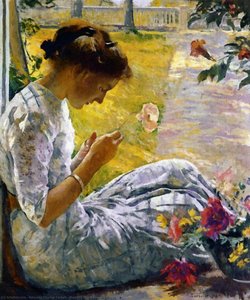
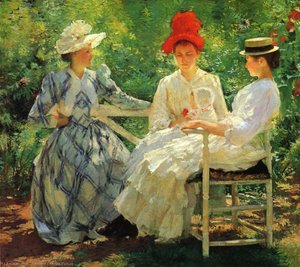
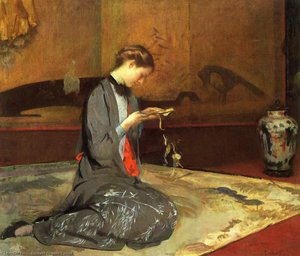
Artist Biography
Early Life and Education
- Born: Groton, United States of America (1862)
- Died: 1938
- Edmund Charles Tarbell was born into a family with deep American roots. His father, Edmund Whitney, passed away when Tarbell was young, leaving his mother, Mary Sophia Fernald, to remarry and raise him and his sister in West Groton, Massachusetts.
- His early artistic training began at the Massachusetts Normal Art School.
- He further honed his skills through an apprenticeship at Forbes Lithographic Company in Boston.
- From 1879 to 1880, he studied under Otto Grundmann at the School of the Museum of Fine Arts in Boston, a pivotal period shaping his artistic foundation.
Artistic Career and Style
- Tarbell's career encompassed illustration, private art instruction, and portrait painting. He married Emeline Souther in 1888, who also studied art.
- His style is characterized as American Impressionism, reflecting a focus on capturing fleeting moments of light and atmosphere.
- He was known for his luminous portraits, intimate domestic scenes, and depictions of Colonial Revival interiors.
- Notable works include Self Portrait, Benjamin Rush, and After the Ball.
- In the Orchard (1891) is considered a defining work, showcasing his ability to portray everyday life with sensitivity and skill.
Membership in "Ten American Painters" and Guild of Boston Artists
- Tarbell was a founding member of the influential group known as “Ten American Painters,” formed in 1897. This collective aimed to promote American art and provide an alternative exhibition venue to established institutions.
- The group included prominent artists like John H. White, Joseph Penway Dodge, and others who shared a commitment to portraying contemporary life with realism and Impressionistic techniques.
- In 1914, he co-founded the Guild of Boston Artists and served as its first president until 1924, further demonstrating his dedication to supporting fellow artists and fostering an artistic community.
Major Achievements and Legacy
- Tarbell's works are held in prestigious collections including the Smithsonian American Art Museum, the Corcoran Gallery of Art, the National Academy of Design, and even the White House.
- His ability to capture the essence of domestic life and portray individuals with warmth and authenticity earned him widespread recognition during his lifetime.
- He is remembered as a significant figure in American Impressionism, contributing to the development of a distinctly American artistic voice.
- Tarbell's influence can be seen in subsequent generations of artists who embraced his focus on everyday subjects and his commitment to portraying life with honesty and sensitivity.
Historical Significance
- As a member of "Ten American Painters," Tarbell played a crucial role in challenging the dominance of European artistic styles and promoting a uniquely American aesthetic.
- His work reflects the changing social landscape of late 19th and early 20th century America, capturing the values and aspirations of a burgeoning middle class.
- Tarbell's legacy extends beyond his individual paintings; he helped to establish Boston as a center for artistic innovation and contributed to the growth of American art on a national stage.
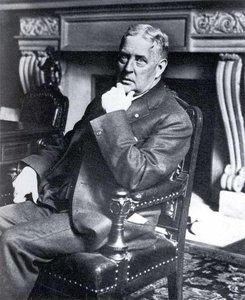
Edmund Charles Tarbell
1862 - 1938 , United States of America
Quick Facts
- Artistic Movement Or Style: American Impressionism
- Date Of Birth: April 26, 1862
- Date Of Death: 1938
- Full Name: Edmund Charles Tarbell
- Nationality: American
- Notable Artworks:
- In the Orchard
- In a Garden
- Girl with Sailboat
- Mercie Cutting Flowers
- Place Of Birth: West Groton, USA

