 Preview
 Send
Send Share
Share
 Details

 Download
 Similars
 X-Ray
X-Ray Diaporama
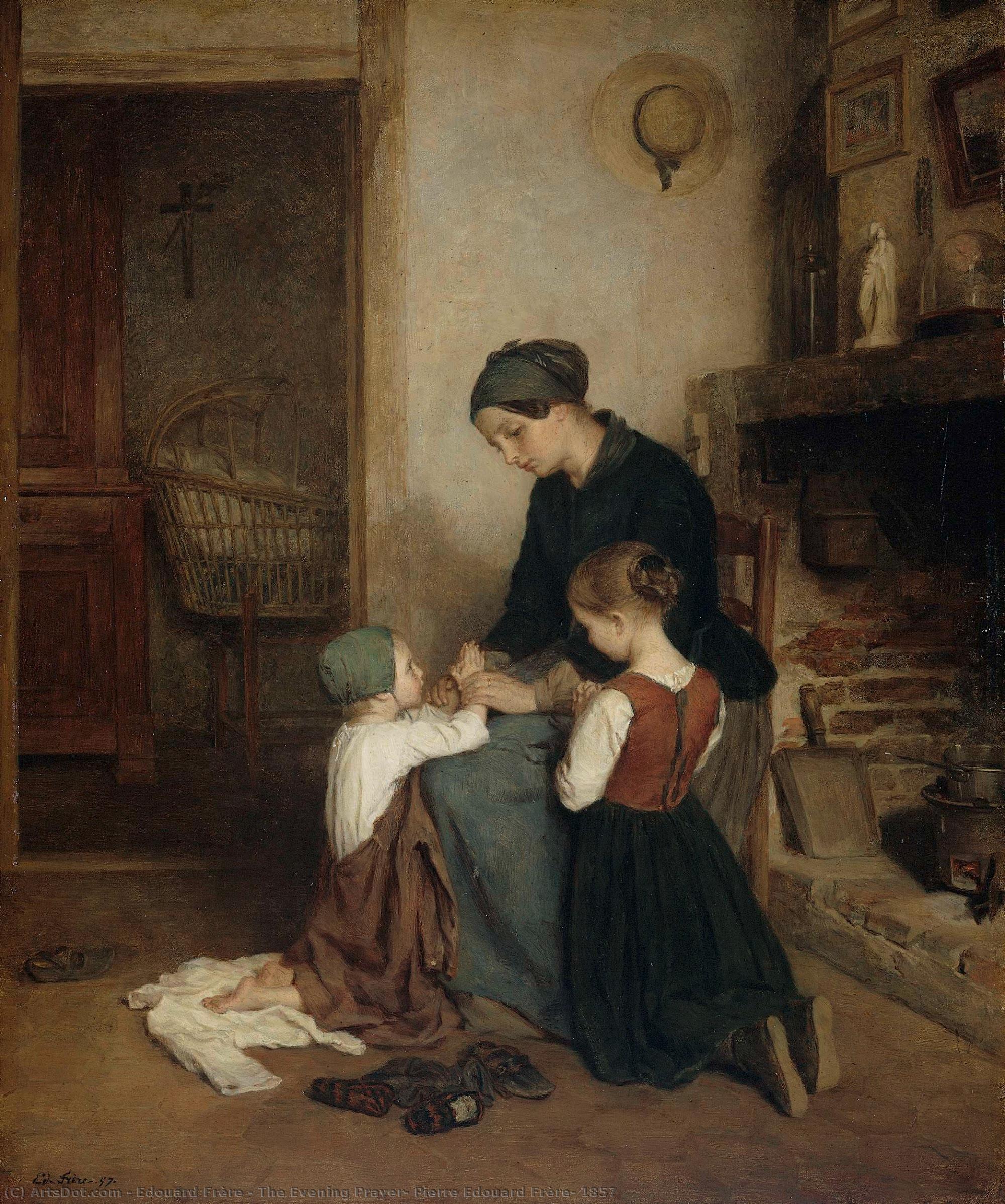
The Evening Prayer, Pierre Edouard Frère, 1857
 1857
1857 47.0 x 39.0 cm
 Read More
Hand Made Oil Reproduction
Hand-painted oil on canvas in your size and frame, made to order by our artists. ( Buy Print Buy Image)




































Pick from our preset sizes that match the artwork's original proportions.

You may enter your own dimensions to fit a specific frame or space. If your selected size does not match the original image's proportions, we will either crop the artwork or extend the painting with additional hand-painted elements. A digital mockup will be sent for your approval before production begins.
Please note that the on-screen preview does not reflect the actual cropping or extension. Only the mockup will accurately show the final composition.
While custom sizes are available, we recommend selecting a dimension from the predefined list to preserve the original proportions.
After order, ArtsDot.com team will email client for instructions and provide a mockup preview
Worldwide Delivery () in 3/4 weeks instead of standard 5 weeks. (24 August). No compromise on quality.

Free Worldwide Express Shipping

High-Quality Linen Canvas

Full Shipping Insurance

Customs Tax Refund Guarantee

True Color Matching Guarantee

60-Day Return Policy (Defects Only)

100% Money-Back Guarantee

Bulk Discount Offer
 Glass option is only available in size under 110 CM

The Evening Prayer, Pierre Edouard Frère, 1857
Reproduction Medium
Reproduction Size
-


Total Price
$ 263
Artwork Description
Related Artworks







Artist Biography
A Life Immersed in the Everyday: Pierre Édouard Frère and the Poetics of Domesticity
Pierre Édouard Frère, born in Paris on January 10th, 1819, and passing away in Écouen on May 23rd, 1886, occupies a unique and cherished position within the pantheon of 19th-century French painting. Though perhaps not as widely celebrated as some of his contemporaries, Frère’s work resonates with a quiet power, offering an intimate and profoundly human glimpse into the lives often overlooked by grand historical narratives. He wasn't concerned with epic battles or mythological allegories; instead, he dedicated himself to capturing the subtle joys, everyday struggles, and simple routines of rural families – a world imbued with warmth, empathy, and a gentle understanding of the human condition. His paintings are not merely depictions of scenes but rather invitations into them, allowing viewers to share in the quiet moments that define a life well-lived.Early Influences and Artistic Formation
Frère’s artistic journey began under the guidance of Paul Delaroche, a prominent academic painter renowned for his meticulously detailed historical compositions. This early training provided him with a solid technical foundation – a mastery of form, perspective, and light that would become hallmarks of his style. However, it was Frère's move to Écouen around 1847 that truly catalyzed his artistic development. He settled into a modest home with his family, establishing not just a residence but also the nucleus of a vibrant artist’s colony. This community, which included his brother Charles-Théodore Frère and later his son, Charles Édouard Frère, fostered an atmosphere of collaboration and mutual inspiration. While Delaroche instilled in him technical precision, it was within this familial and artistic haven that Frère discovered his true calling: the poetics of domestic life. He exhibited regularly at the Salon in Paris from 1842 to 1886, and also at the Royal Academy in London from 1868 to 1885, steadily gaining recognition for his unique vision.The Écouen School and a Distinctive Style
Frère became central to what was known as the École d'Écouen, a group of artists who shared a commitment to Realist depictions of rural life, characterized by warmth, sentimentality, and meticulous detail. Unlike some of their more overtly political Realist counterparts, the Écouen painters focused on portraying the beauty and dignity found within everyday existence. Frère’s paintings exemplify this approach. He specialized in small-scale genre scenes – kitchens bustling with activity, families gathered around a table, children at play – rendered in warm, inviting colors and delicate brushstrokes. His technique wasn't about bold statements or dramatic contrasts; it was about creating an atmosphere of intimacy and tranquility. John Ruskin, the influential art critic, famously praised Frère’s work for its “beauty without consciousness; dignity without pride; lowliness without sorrow; and religion without fear,” a testament to the profound emotional resonance his paintings evoked.Themes and Symbolism in Frère's Oeuvre
While seemingly simple on the surface, Frère’s paintings are rich with subtle symbolism and nuanced observations about human nature. Works like *Good Friday in Notre-Dame Church* (1862) offer poignant reflections on faith, grief, and community, while scenes of family life – such as *Going to School* and *Coming from School* – celebrate the bonds of kinship and the innocence of childhood. He possessed a remarkable ability to capture fleeting moments of tenderness and connection, imbuing his subjects with a sense of authenticity and emotional depth. Even in seemingly mundane depictions of domestic chores, Frère found opportunities to explore themes of labor, resilience, and the quiet dignity of everyday life. His paintings are not merely records of what he saw but rather expressions of how he felt – a deep empathy for the lives of those around him.Legacy and Historical Significance
Pierre Édouard Frère’s influence extends beyond his immediate circle of contemporaries. He helped to popularize genre painting as a legitimate artistic pursuit, demonstrating that beauty and meaning could be found not just in grand historical narratives but also in the everyday lives of ordinary people. His work paved the way for later Impressionist painters who sought to capture the fleeting moments of modern life. Though his name may not be as instantly recognizable as some of his more celebrated peers, Frère’s paintings continue to captivate audiences with their warmth, intimacy, and profound emotional resonance. He remains a testament to the power of art to illuminate the beauty and dignity found within the simplest aspects of human existence – a legacy that continues to inspire artists and viewers alike.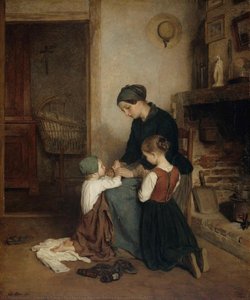
Quick Facts
- Artistic Movement Or Style: Realism/Impressionism
- Artists Or Movements Influenced By This Artist: ["École d'Écouen"]
- Artists Who Influenced This Artist: ['Paul Delaroche']
- Date Of Birth: January 10, 1819
- Date Of Death: May 23, 1886
- Full Name: Pierre Édouard Frère
- Nationality: French
- Notable Artworks:
- Good Friday in Notre-Dame Church
- A Girl
- The Evening Prayer
- Place Of Birth: Paris, France