 Preview
 Send
Send Share
Share
 Details

 Download
 Similars
 X-Ray
X-Ray Diaporama
Wedding
 Painting
- Düsseldorf School
 1838
1838- 19th Century
 610.0 x 130.0 cm
 Kunstpalast
 Read More
Hand Made Oil Reproduction
Hand-painted oil on canvas in your size and frame, made to order by our artists. ( Buy Print Buy Image)




P118B $10

P118H $10

P118W $10

P438Z $10

P508JH $12

P508YH $12

P805H $10

P805Z $10

P919BZ $10

P919G $10

P919XJ $10

P959ZH $10

P968JZ $12

W106C $8

W218G $10

W218JH $8

W218Y $10

W307PJ $10

W316G $10

W316PJ $8

W316Y $10

W398PJ $8

W4111J $10

W500HY $15

W500JH $15

W692G $12

W849H $8

W940BG $15

W953PJ $8




Pick from our preset sizes that match the artwork's original proportions.

You may enter your own dimensions to fit a specific frame or space. If your selected size does not match the original image's proportions, we will either crop the artwork or extend the painting with additional hand-painted elements. A digital mockup will be sent for your approval before production begins.
Please note that the on-screen preview does not reflect the actual cropping or extension. Only the mockup will accurately show the final composition.
While custom sizes are available, we recommend selecting a dimension from the predefined list to preserve the original proportions.
After order, ArtsDot.com team will email client for instructions and provide a mockup preview
Worldwide Delivery () in 3/4 weeks instead of standard 5 weeks. (29 August). No compromise on quality.

Free Worldwide Express Shipping

High-Quality Linen Canvas

Full Shipping Insurance

Customs Tax Refund Guarantee

True Color Matching Guarantee

60-Day Return Policy (Defects Only)

100% Money-Back Guarantee

Bulk Discount Offer
 Glass option is only available in size under 110 CM

Wedding
Reproduction Medium
Reproduction Size
-


Total Price
$ 263
A Vision of Classical Harmony
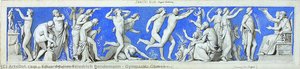
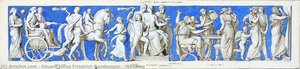
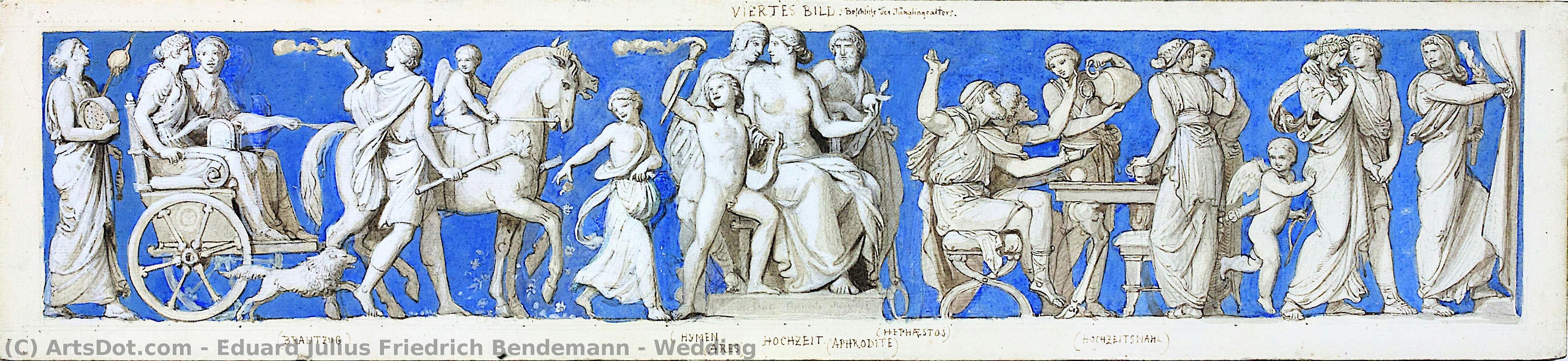
In the sweeping expanse of Eduard Julius Friedrich Bendemann’s "Wedding," we are transported to an era where the boundaries between the mortal and the divine blur into a singular, rhythmic dance. Created in 1838, this remarkable work serves as a fragment of a much larger vision—a frieze originally intended for the grand ballroom of the Dresden Schloss. The painting captures a moment of profound ceremonial grace, rendered in a striking palette of ethereal white against a deep, celestial blue. This deliberate color choice does more than merely decorate; it creates a luminous, sculptural effect, as if the figures were carved from fine marble and set against the infinite twilight of the heavens. For the discerning collector or interior designer, this piece offers a rare sense of architectural grandeur, bringing the dignified weight of 19-century German Romanticism into a contemporary space.
The composition is a masterclass in the Düsseldorf School style, characterized by its meticulous attention to anatomical precision and theatrical storytelling. Bendemann, under the profound influence of Wilhelm von Schadow, utilizes a technique that mimics the appearance of a low-relief sculpture. The figures move with a choreographed elegance, embodying the Greek ideal of life as a continuous cycle of motion and contemplation. As one’s eyes wander across the 610 x 130 cm expanse, they encounter a lively procession: men and women in poised stances, horses adding a sense of dynamic energy, and even subtle, unexpected elements that breathe life into the scene. The interplay between the stark, bright figures and the saturated blue ground creates a visual vibration that is both calming and invigorating.
Beyond its aesthetic splendor, "Wedding" is steeped in deep historical and symbolic resonance. It represents an era of Decorative Classicism, where artists sought to revive the nobility of Roman and Greek models to express universal truths about the human condition. The subject matter—a wedding—is not merely a social event but a symbol of union, continuity, and the sacred transition of life stages. Bendemann weaves a narrative that moves from birth through youth and victory, culminating in the matrimonial bond. This cyclical theme provides an emotional depth that transcends time, making the artwork an evocative centerpiece for any collection. It invites the viewer to pause and reflect on the beauty of tradition and the enduring strength of human connection.
For those seeking to infuse their surroundings with a sense of historical prestige and artistic sophistication, a high-quality reproduction of this masterpiece offers an unparalleled opportunity. The sheer scale and the rhythmic flow of the composition make it an ideal choice for large-scale installations in grand halls or curated galleries. Owning such a piece is not merely about decoration; it is about hosting a dialogue with history, bringing the refined elegance of the 19th-century German academy into the heart of the modern home.
Related Artworks



Artist Biography
Eduard Bendemann: A Düsseldorf School Pioneer
Eduard Julius Friedrich Bendemann (1811 – 1889) stands as a prominent figure within the Düsseldorf School of Painting, an influential movement that championed academic realism and dramatic storytelling during the Romantic era. Born in Berlin to a family steeped in artistic tradition—his father was a banker and his mother descended from another banking lineage—Bendemann’s upbringing instilled in him a deep appreciation for visual art and nurtured his innate talent for capturing human emotion through meticulous observation and skillful technique. His formative years were spent under the tutelage of Wilhelm von Schadow, arguably Düsseldorf's most celebrated painter, whose teachings profoundly shaped Bendemann’s artistic sensibilities. Schadow’s emphasis on anatomical accuracy, tonal gradation, and theatrical presentation served as a cornerstone for Bendemann’s subsequent oeuvre. This influence is palpable in his paintings, which consistently strive to convey profound psychological depth alongside breathtaking visual splendor. Bendemann's artistic journey commenced with a dedication to studying anatomy and drawing—skills deemed essential for achieving the desired level of realism—before enrolling at Schadow’s academy in Düsseldorf. It was here that he honed his craft and began collaborating closely with fellow artists, fostering an environment conducive to experimentation and innovation within established conventions. Notably, Bendemann's artistic partnership with Franz Xavier Groß depicted biblical scenes, demonstrating a shared commitment to portraying religious narratives with dramatic intensity. Bendemann’s stylistic hallmark is undeniably the Düsseldorf School’s characteristic approach: bold colors juxtaposed against subdued tonal backgrounds, creating an illusion of depth and atmosphere. He skillfully employed chiaroscuro—the interplay of light and shadow—to sculpt figures and imbue his canvases with palpable emotion. His compositions are dynamic and theatrical, mirroring the grandeur of historical events or the solemnity of religious iconography. Among Bendemann’s most celebrated works include “Childhood,” “Wedding,” and “Gymnastic Games”—scenes rendered in meticulous detail that exemplify the Düsseldorf School's commitment to capturing fleeting moments of human experience with remarkable sensitivity. These paintings, currently housed in museums like Kunstpalast Düsseldorf and Bayerisches Nationalmuseum, offer invaluable insights into Bendemann’s artistic vision and his contribution to the broader artistic landscape of 19th-century Germany. His legacy continues to inspire artists today, cementing his place as a pivotal figure in German art history.- Notable Collaborations: Franz Xavier Groß
- Influences: Wilhelm von Schadow
- Style Characteristics: Bold Colors, Dramatic Composition, Chiaroscuro Technique
Major Achievements & Recognition
Bendemann’s artistic reputation grew steadily throughout his career, earning him recognition as a respected teacher and mentor at Düsseldorf Academy of Art. He instilled in his students the principles of academic realism and dramatic storytelling—values that would define the Düsseldorf School's aesthetic for decades to come. Furthermore, Bendemann’s paintings achieved considerable acclaim during his lifetime, securing commissions from prominent patrons and establishing him as one of Germany’s foremost artists. His works were exhibited extensively throughout Europe, garnering critical praise and bolstering his artistic stature.Museum Collections
Bendemann's artwork finds its home in prestigious institutions across Germany, including Kunstpalast Düsseldorf and Bayerisches Nationalmuseum. These collections provide invaluable opportunities for scholars and enthusiasts alike to appreciate Bendemann’s artistic legacy firsthand. Visitors can examine masterpieces such as “Childhood,” “Wedding,” and “Gymnastic Games”—testaments to his unparalleled skill and dedication—and gain a deeper understanding of the Düsseldorf School's aesthetic ideals.Further Exploration
For more comprehensive information on Eduard Bendemann’s life, work, and artistic contributions, consult Wikipedia (Wikipedia) or delve into the Düsseldorf School of Painting on Wikipedia.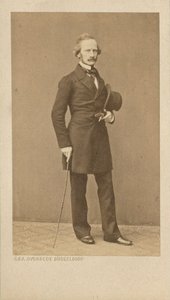
eduard julius friedrich bendemann
1811 - 1889 , Germany
Quick Facts
- Artistic Movement Or Style: Düsseldorf School
- Artists Who Influenced This Artist: ['Wilhelm Schadow']
- Date Of Birth: December 3, 1811
- Date Of Death: December 27, 1889
- Full Name: Eduard Julius Friedrich Bendemann
- Nationality: German
- Notable Artworks:
- Childhood
- Wedding
- Gymnastic Games
- Place Of Birth: Berlin, Germany
Related Articles

White on Canvas: 10 Masterpieces & Timeless Elegance for Your Home Decor
Explore 10 iconic white paintings by Monet, Whistler & Rothko! Discover the stories behind these serene masterpieces and their impact on art history. Find museum-quality reproductions for your home decor at .
Slate Blue Masterpieces: 10 Iconic Paintings & Timeless Home Decor Ideas
Immerse yourself in the captivating world of slate blue! Explore 10 iconic paintings by Monet, Van Gogh & Renoir. Discover their stories, techniques & find museum-quality art reproductions for your home at .

Beyond the Guest Book: Unique Wedding Keepsakes Through Custom Artwork
Elevate your wedding memories with unique custom artwork! Discover personalized paintings & prints that capture the magic of your special day. Expert guidance, premium quality, lasting keepsakes.

Love on Canvas: Choosing the Perfect Artistic Style for Your Wedding Portrait
Discover the perfect artistic style for your wedding portrait! Explore realism, impressionism & more. Commission a timeless heirloom with expert guidance. Learn from .
Beyond Photographs: Commissioning Bespoke Paintings of Wedding Venues for Unforgettable Keepsakes
Transform your wedding venue into timeless art! Discover the beauty of bespoke paintings & commissions with 's expert artists. Create a unique, luxurious keepsake.