 Preview
 Send
Send Share
Share
 Details

 Download
 Similars
 X-Ray
X-Ray Diaporama
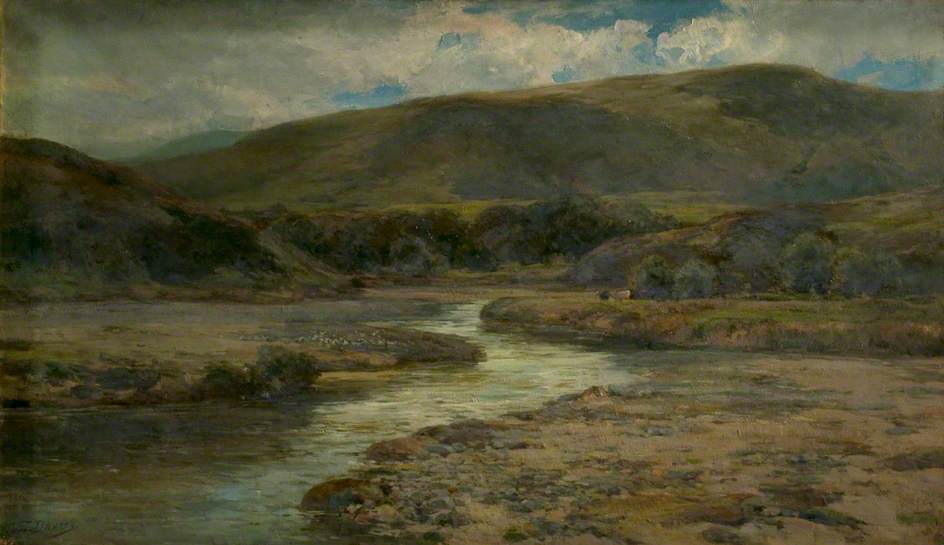
Landscape, near Peel, Isle of Man
 89.0 x 152.0 cm
 New Walk Museum - Art Gallery
 Read More
Giclée / Art Print
Museum-quality giclée or canvas print with fast production and flexible finish options. ( Buy Hand Made Painting Buy Image)




































Pick from our preset sizes that match the artwork's original proportions.

You may enter your own dimensions to fit a specific frame or space. If your selected size does not match the original image's proportions, we will either crop the artwork or extend the image with a mirrored or solid-fill edge. A digital mockup will be sent for your approval before production begins.
Please note that the on-screen preview does not reflect the actual cropping or extension. Only the mockup will accurately show the final composition.
While custom sizes are available, we recommend selecting a dimension from the predefined list to preserve the original proportions.
Worldwide Delivery () in 2 weeks instead of standard 4/5 weeks. (28 August)

Free Worldwide Express Shipping

High-Quality Linen Canvas

Full Shipping Insurance

Customs Tax Refund Guarantee

True Color Matching Guarantee

60-Day Return Policy (Defects Only)

100% Money-Back Guarantee

Bulk Discount Offer
 Glass option is only available in size under 110 CM

Landscape, near Peel, Isle of Man
Giclée / Art Print
Reproduction Size
-


Total Price
$ 63
Related Artworks










Artist Biography
The Architect of Molecular Innovation: The Dual Legacy of George Edward Davis
In the grand, sweeping tapestry of the nineteenth century—an era where the soot of the Industrial Revolution collided with the burgeoning light of scientific inquiry—few figures cast a shadow as profound yet specialized as George Edward Davis. To understand Davis is to witness a rare convergence of two seemingly disparate worlds: the tactile, emotive realm of fine art and the rigorous, invisible architecture of chemical engineering. While his contemporaries were often preoccupied with capturing the fleeting light of the English or American landscape on canvas, Davis sought to map the very flows of matter itself, bridging the gap between the aesthetic appreciation of nature and the mathematical precision of modern industry.
Born in 1850, Davis’s early life was defined by a transition from traditional craft to scientific mastery. His journey began not with a paintbrush, but with the scent of leather and glue during an apprenticeship in bookbinding at the age of fourteen. This early immersion in the meticulous details of physical form provided a foundational discipline that would later inform his scientific observations. Driven by an insatiable curiosity, he moved toward higher learning at the Slough Mechanics Institute and the prestigious Royal School of Mines in London. It was here that the artist’s eye began to merge with the engineer’s intellect, as he developed a fascination with the molecular structures that underpin our physical reality.
A Revolutionary Vision: Stereoscopic Projection and Scientific Realism
Davis’s most significant contribution to the visual record of his time was his ability to redefine how we perceive industrial progress. In 1893, he published “The Handbook of Chemical Engineering,” a work that transcended the standard technical manual of the period. Rather than relying on flat, two-dimensional topographical sketches, Davis employed a revolutionary technique: stereoscopic projection. By utilizing twin cameras positioned at slight intervals, he captured scenes of factories, refineries, and laboratories with a profound sense of depth and three-dimensionality.
This method was far more than a mere technical gimmick; it was a philosophical statement. Through these stereoscopic images, Davis aimed to educate the viewer on the complex, layered realities of modern industry, elevating scientific illustration to a form of high realism. His work allowed the observer to step into the heart of the machine, noticing the subtle gradations of light reflecting off steel and the intricate textures of industrial processes. In doing so, he fundamentally reshaped the perception of landscape painting, proving that the "industrial landscape" possessed a beauty and a structural complexity worthy of the most rigorous artistic scrutiny.
The Enduring Impression of a Visionary
Though his name may not always occupy the same immediate spotlight as titans like John Singer Sargent, the historical significance of George Edward Davis lies in his role as a pioneer of interdisciplinary vision. He stood at the threshold of a new age, where the boundaries between the observer and the observed were being redrawn by technology. His ability to apply the sensitivity of an artist to the precision of a chemist allowed him to document a world in transition—a world moving from the organic rhythms of nature toward the structured complexity of the chemical age.
The legacy of Davis remains etched in both the annals of science and the history of visual documentation. His life serves as a testament to the idea that true innovation often occurs at the intersection of different disciplines. Whether through his evocative watercolors of New England coastlines or his groundbreaking stereoscopic engineering diagrams, Davis reminded us that to truly see the world, one must possess both the heart of an artist and the mind of an architect.

Quick Facts
- Artistic Movement Or Style: Regionalist Art Style
- Artists Who Influenced This Artist: ['John Singer Sargent']
- Date Of Birth: (1850)
- Date Of Death: (1907)
- Full Name: George Edward Davis
- Nationality: American
- Notable Artworks:
- Wolf Point
- Mrs. Edward Davis and her Son, Livingston
- Mrs. Edward L. Davis and Her Son Livingston
- Place Of Birth: Philadelphia, Pennsylvania