 Preview
 Send
Send Share
Share
 Details

 Download
 Similars
 X-Ray
X-Ray Diaporama
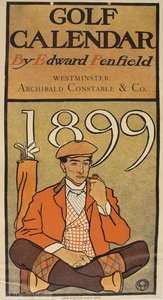
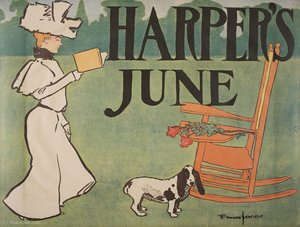
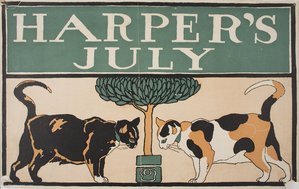
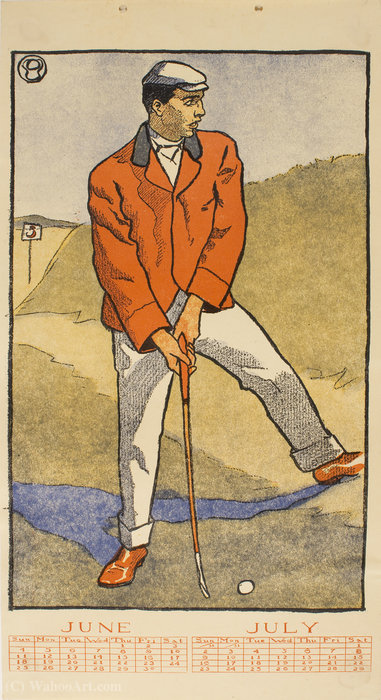
'June, July (Golf Calendar)', (45 x 24 CM) (1899)
 Read More
Hand Made Oil Reproduction
Hand-painted oil on canvas in your size and frame, made to order by our artists. ( Buy Print Buy Image)




































Pick from our preset sizes that match the artwork's original proportions.

You may enter your own dimensions to fit a specific frame or space. If your selected size does not match the original image's proportions, we will either crop the artwork or extend the painting with additional hand-painted elements. A digital mockup will be sent for your approval before production begins.
Please note that the on-screen preview does not reflect the actual cropping or extension. Only the mockup will accurately show the final composition.
While custom sizes are available, we recommend selecting a dimension from the predefined list to preserve the original proportions.
After order, ArtsDot.com team will email client for instructions and provide a mockup preview
Worldwide Delivery () in 3/4 weeks instead of standard 5 weeks. (16 August). No compromise on quality.

Free Worldwide Express Shipping

High-Quality Linen Canvas

Full Shipping Insurance

Customs Tax Refund Guarantee

True Color Matching Guarantee

60-Day Return Policy (Defects Only)

100% Money-Back Guarantee

Bulk Discount Offer
 Glass option is only available in size under 110 CM

'June, July (Golf Calendar)', (45 x 24 CM) (1899)
Reproduction Medium
Reproduction Size
-


Total Price
$ 263
Related Artworks



Artist Biography
The Architect of the American Poster
In the vibrant, burgeoning landscape of late 19th-century America, a new visual language was being written upon the streets and in the pages of the nation's most prestigious periodicals. At the heart of this revolution stood Edward Penfield, an artist whose name has become synonymous with the birth of modern graphic design. Often revered as “the father of the American poster,” Penfield possessed a singular ability to distill complex emotions and social narratives into striking, simplified forms. His work did not merely decorate; it communicated, bridging the gap between fine art and mass media with an elegance that captured the very spirit of the Golden Age of Illustration.
Born on June 2nd, 1866, in Brooklyn, New York, Penfield was destined for a life shaped by aesthetic precision. He was the son of Josiah B. Penfield, a respected architect, and this familial connection to structural design likely instilled in him an early mastery of spatial relationships and balance. His formal training at the prestigious Art Students League in New York City brought him into contact with the era's most influential mentors, including George de Forest Brush. It was during these formative years that Penfield began to move away from the dense, academic realism of his predecessors, instead looking toward a more streamlined future where bold outlines and uncluttered backgrounds could command the viewer's attention amidst the urban chaos.
A Master of the Printed Page
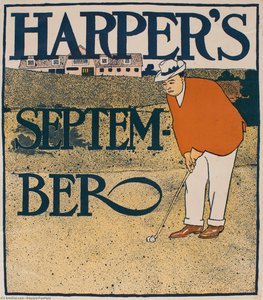
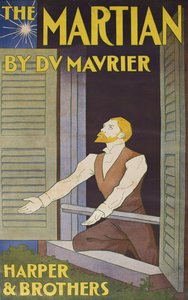
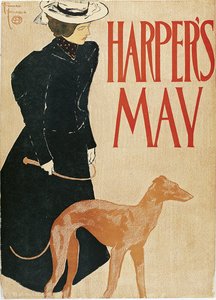
The true zenith of Penfield’s career arrived through his transformative relationship with Harper’s Magazine. Serving as the publication's Art Director, he utilized the advancements in color printing technology to create a series of monthly posters that became cultural landmarks. Unlike the swirling, overly ornate flourishes of the European Art Nouveau movement seen in the works of contemporaries like Will Bradley, Penfield developed a more restrained and uniquely American aesthetic. He drew profound inspiration from the flat planes and strong silhouettes of Japanese woodblock prints, as well as the masterful compositions of French masters such as Henri de Toulouse-Lautrec and Jules Chéret.
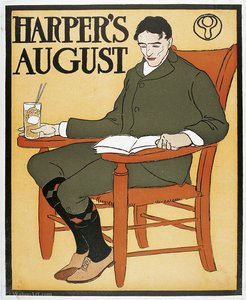
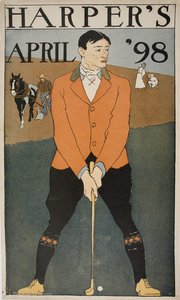
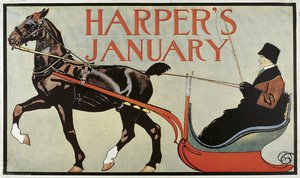
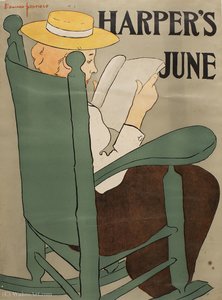
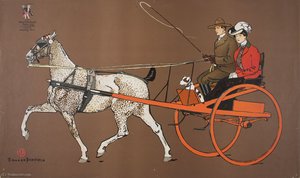
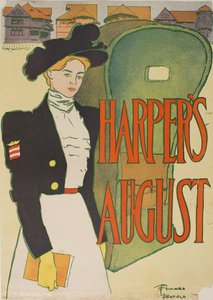
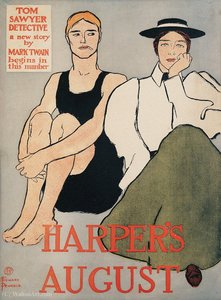
His signature style—characterized by a deliberate reduction of detail and an assertive use of linework—allowed his subjects to resonate with immediate clarity. Whether depicting a gentleman lost in quiet contemplation in "Harper's August" or capturing the rhythmic energy of a horse-drawn carriage in "Heller ^ Bachrach," Penfield’s work embodied a sense of refined leisure and modern vitality. His ability to synthesize diverse stylistic influences into a cohesive, accessible brand for Harper’s helped establish the magazine as a visual authority, making his posters not just advertisements, but collectible pieces of art that graced the walls of homes across the country.
Legacy and Lasting Influence
Though his tenure at Harper's concluded in 1901, Penfield’s creative momentum never waned. He continued to shape the visual landscape through prolific work for other major publications like Scribner's and Collier's, as well as designing covers for numerous books and commercial advertisements. His influence extended far beyond the printed page, leaving an indelible mark on the evolution of graphic design. By proving that simplicity could be more powerful than complexity, he paved the way for the minimalist movements of the 20th century.
Today, the significance of Edward Penfield lies in his role as a pioneer who democratized art. Through his posters, high art was no longer confined to the hushed galleries of museums but was brought directly to the public eye, integrated into the very fabric of daily life. His legacy remains visible in every modern design that prioritizes clarity, impact, and the beauty of the essential line.
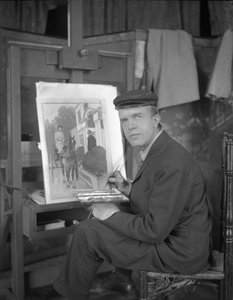
Edward Penfield
1866 - 1925 , United States of America
Quick Facts
- Artistic Movement Or Style: Golden Age Illustration; Simplified illustration
- Date Of Birth: June 2, 1866
- Date Of Death: 1925
- Full Name: Edward Penfield
- Nationality: American
- Notable Artworks:
- Harper's August
- 'March, April (Golf Calendar)', "Heller ^ Bachrach"], "Artists who influenced this artist": ["George de Forest Brush"], "Artists or movements influenced by this artist": ["Alphonse Mucha", "Théophile Steinlen"] }
- Place Of Birth: Brooklyn, United States