Preview
 Send
Send Share
Share
 Details

 Download
 Similars
 X-Ray
X-Ray Diaporama
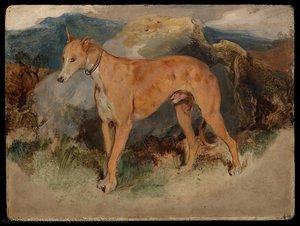
A Deerhound
 1826
1826 31.0 x 41.0 cm
 Read More
Giclée / Art Print
Museum-quality giclée or canvas print with fast production and flexible finish options. ( Buy Hand Made Painting Buy Image)




































Pick from our preset sizes that match the artwork's original proportions.

You may enter your own dimensions to fit a specific frame or space. If your selected size does not match the original image's proportions, we will either crop the artwork or extend the image with a mirrored or solid-fill edge. A digital mockup will be sent for your approval before production begins.
Please note that the on-screen preview does not reflect the actual cropping or extension. Only the mockup will accurately show the final composition.
While custom sizes are available, we recommend selecting a dimension from the predefined list to preserve the original proportions.
Worldwide Delivery () in 2 weeks instead of standard 4/5 weeks. (28 August)

Free Worldwide Express Shipping

High-Quality Linen Canvas

Full Shipping Insurance

Customs Tax Refund Guarantee

True Color Matching Guarantee

60-Day Return Policy (Defects Only)

100% Money-Back Guarantee

Bulk Discount Offer
 Glass option is only available in size under 110 CM

A Deerhound
Giclée / Art Print
Reproduction Size
-


Total Price
$ 63
Related Artworks









Artist Biography
A Life Immersed in the Natural World: Edwin Henry Landseer
Edwin Henry Landseer, born in London on March 7, 1802, was destined for a life inextricably linked to the animal kingdom. His father, Samuel Landseer, was an engraver and portrait painter, but it was his mother, Jane Butterfield, who initially nurtured Edwin’s prodigious talent. She encouraged him to sketch animals from a young age, recognizing a remarkable gift for capturing their essence. The family's early struggles were alleviated by the patronage of Francis Chantrey, the renowned sculptor, who provided financial support and mentorship. This allowed Landseer access to formal training at the Royal Academy Schools, though his true education came through meticulous observation of animals – initially those in London menageries and later, during extensive trips to Scotland. His early works were often small, detailed studies, demonstrating a precocious skill that quickly garnered attention. He wasn’t merely *depicting* animals; he was attempting to understand their anatomy, behavior, and even their emotional states. This dedication set him apart from many of his contemporaries who focused on idealized representations rather than realistic portrayals.From Sporting Scenes to Sentimental Narratives
Landseer’s artistic development unfolded in stages. He began with sporting scenes – hunting dogs, horses, and game birds – popular subjects amongst the British gentry. However, he soon moved beyond these conventional themes, driven by a desire for greater emotional depth and narrative complexity. His Scottish landscapes became increasingly prominent, serving as dramatic backdrops for his animal studies. The Highlands, with their rugged beauty and wild inhabitants, profoundly influenced his artistic vision. He wasn’t simply painting picturesque views; he was using the landscape to evoke feelings of solitude, majesty, and the power of nature. This shift coincided with a growing public fascination with Romanticism, which emphasized emotion, imagination, and the sublime. Landseer skillfully integrated these elements into his work, creating paintings that resonated deeply with Victorian sensibilities. He became particularly renowned for his depictions of deer – majestic stags in dramatic poses, often imbued with a sense of melancholy or vulnerability. Works like “The Dying Deer” (1839) exemplify this trend, transforming the animal subject into a vehicle for exploring themes of mortality and loss.Royal Patronage and National Recognition
Landseer’s talent did not go unnoticed by Queen Victoria and Prince Albert, who became his most devoted patrons. He was appointed Animal Painter to both William IV and Queen Victoria in 1837, a position that solidified his status as the leading animal artist of his time. This royal connection provided him with access to exclusive subjects – the royal kennels, Windsor Great Park, and even the Queen’s beloved pets. He produced numerous portraits of the royal family alongside their animals, further enhancing his reputation and popularity. Beyond portraiture, Landseer undertook ambitious public commissions, including monumental sculptures for Trafalgar Square in London. His four bronze lions guarding Nelson's Column became iconic symbols of British power and national pride. This foray into sculpture demonstrated his versatility as an artist and his ability to translate his understanding of animal anatomy into three-dimensional form. He was knighted in 1850, a rare honor for an artist at the time, reflecting the immense esteem in which he was held by Victorian society.Influences and Artistic Style
Landseer’s artistic influences were diverse. He admired the works of earlier masters like Peter Paul Rubens and Anthony van Dyck, particularly their ability to capture texture and light. He also drew inspiration from the landscapes of Claude Lorrain and the dramatic compositions of J.M.W. Turner. However, Landseer developed a distinctive style that was uniquely his own. His paintings are characterized by meticulous detail, realistic anatomy, and a masterful use of chiaroscuro – the contrast between light and shadow. He possessed an exceptional ability to render fur, feathers, and muscle with astonishing accuracy.- Realism & Detail: A commitment to accurately portraying animal forms.
- Romantic Sensibility: Infusing his work with emotion and narrative depth.
- Chiaroscuro Mastery: Utilizing dramatic lighting effects to create mood and atmosphere.