 Preview
 Send
Send Share
Share
 Details

 Download
 Similars
 X-Ray
X-Ray Diaporama
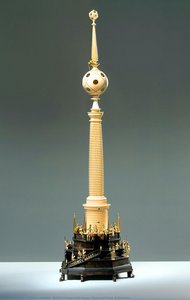
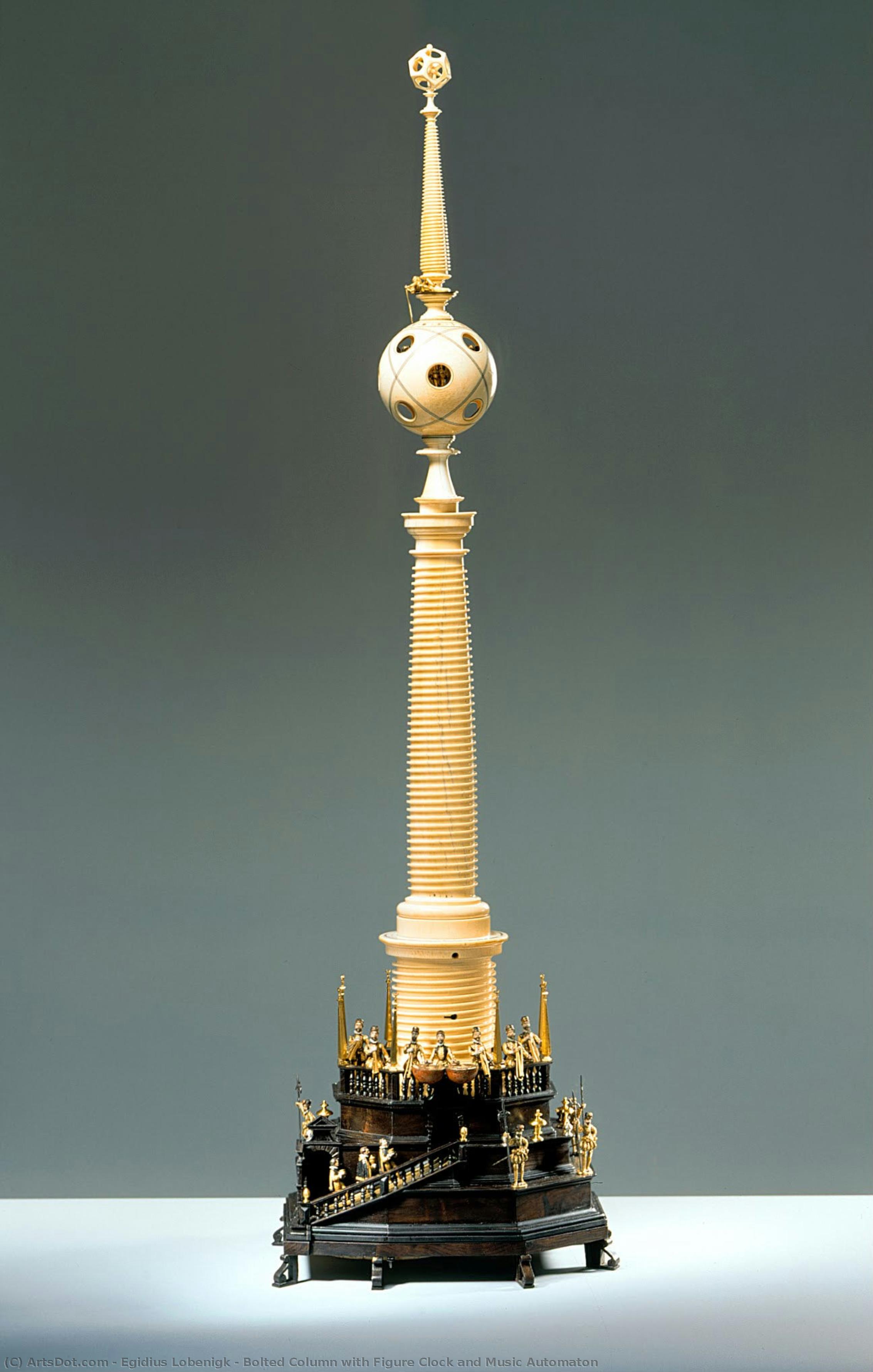
Bolted Column with Figure Clock and Music Automaton


 Read More
Giclée / Art Print
Museum-quality giclée or canvas print with fast production and flexible finish options. ( Buy Hand Made Painting Buy Image)




































Pick from our preset sizes that match the artwork's original proportions.

You may enter your own dimensions to fit a specific frame or space. If your selected size does not match the original image's proportions, we will either crop the artwork or extend the image with a mirrored or solid-fill edge. A digital mockup will be sent for your approval before production begins.
Please note that the on-screen preview does not reflect the actual cropping or extension. Only the mockup will accurately show the final composition.
While custom sizes are available, we recommend selecting a dimension from the predefined list to preserve the original proportions.
Worldwide Delivery () in 2 weeks instead of standard 4/5 weeks. (25 August)

Free Worldwide Express Shipping

High-Quality Linen Canvas

Full Shipping Insurance

Customs Tax Refund Guarantee

True Color Matching Guarantee

60-Day Return Policy (Defects Only)

100% Money-Back Guarantee

Bulk Discount Offer
 Glass option is only available in size under 110 CM

Bolted Column with Figure Clock and Music Automaton
Giclée / Art Print
Reproduction Size
-


Total Price
$ 63
Related Artworks







Artist Biography
The Architect of Ivory: The Visionary Artistry of Egidius Lobenigk
In the grand tapestry of the early Baroque era, few names resonate with the mathematical elegance and sculptural precision of Egidius Lobenigk. Born around 1595 in the culturally vibrant city of Cologne, Germany, Lobenigk was far more than a mere artisan; he was a pioneer who dared to bridge the gap between fine art and complex geometry. His work represents a singular moment in history where the delicate medium of ivory was transformed into a playground for mathematical wonder, challenging the very boundaries of what sculptural form could achieve.
Lobenigky’s journey began in the meticulous workshops of Cologne, where he underwent rigorous training in the art of ornamental turning. It was here that he apprenticed under Hans Wecker, a master whose influence would ripple through the decades. This early exposure to the disciplined world of turning instilled in Lobenigk a profound respect for symmetry and structural integrity. Through this lineage, he connected himself to a tradition of craftsmanship that valued both aesthetic beauty and technical perfection, laying the groundwork for his later, more radical experiments with nested solids and complex polyhedrons.
A Royal Commission and the Dresden Revolution
The trajectory of Lobenigk’s career shifted dramatically when his extraordinary talents caught the eye of Augustus II, Elector Saxon. Invited to join the prestigious Dresden court, Lobenigk was granted a rare opportunity: the mandate to transform the royal turning room into a laboratory for artistic and scientific innovation. This appointment was not merely a change in location but a fundamental shift in his creative mission. Under the patronage of the Dresden court, he moved away from traditional decorative motifs toward a pursuit of geometric harmony.
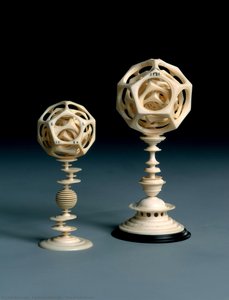
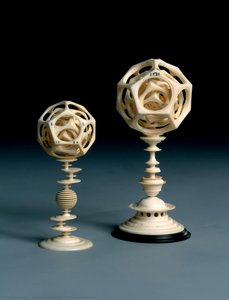
His work during this period became a mesmerizing dialogue between art and mathematics. He sought to capture the essence of perfection through the creation of intricate ivory structures that seemed to defy the physical limitations of their material. His most profound achievement, the celebrated "Two Polyhedrons," stands as a testament to this era. These works, characterized by their nested, interlocking shapes, exemplify his ability to manipulate ivory into forms that are both intellectually stimulating and visually breathtaking. In these pieces, the artist achieved a sense of mathematical sublime, where every edge and vertex serves a greater purpose in a larger, harmonious whole.
Legacy of Geometric Perfection
The historical significance of Egidius Lobenigk lies in his ability to elevate ivory carving from a decorative craft to a sophisticated medium of intellectual expression. While many of his contemporaries focused on the emotive and fluid lines of the Baroque, Lobenigk looked toward the eternal truths of geometry. His legacy is found in the way he forced the viewer to contemplate the relationship between space, volume, and form.
Today, his contributions are remembered through several key artistic milestones:
- The Mastery of Material: His ability to execute incredibly fine, precise cuts in ivory without compromising the structural integrity of the piece.
- Mathematical Innovation: The introduction of complex polyhedral forms into the repertoire of European sculpture.
- Courtly Influence: The transformation of the Dresden court into a global center for high-precision artistic experimentation.
Though his active years were concentrated in a specific historical window, the echoes of Lobenigk’s precision can be felt in the evolution of decorative arts and scientific modeling. He remains a singular figure—a sculptor who used the tools of a turner to carve out a permanent place for geometry within the heart of fine art.
egidius lobenigk
1595 - , Germany
Quick Facts
- Artistic Movement Or Style: Early Modern Art
- Artists Or Movements Influenced By This Artist: ['Renaissance art']
- Artists Who Influenced This Artist: ['George Wecker']
- Full Name: Egidius Lobenigk
- Nationality: German
- Notable Artworks: ['Two polyhedrons']
- Place Of Birth: Cologne