 Preview
 Send
Send Share
Share
 Details

 Download
 Similars
 X-Ray
X-Ray Diaporama
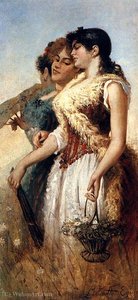
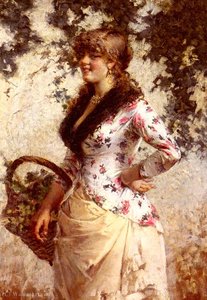
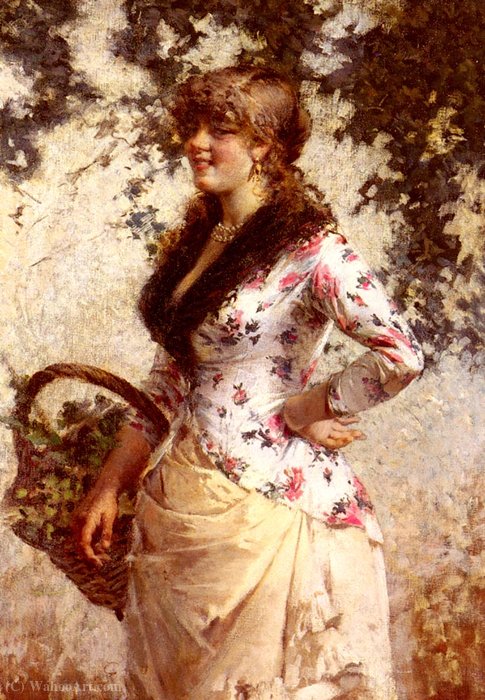
A young woman in a vineyard
 Read More
Giclée / Art Print
Museum-quality giclée or canvas print with fast production and flexible finish options. ( Buy Hand Made Painting Buy Image)




































Pick from our preset sizes that match the artwork's original proportions.

You may enter your own dimensions to fit a specific frame or space. If your selected size does not match the original image's proportions, we will either crop the artwork or extend the image with a mirrored or solid-fill edge. A digital mockup will be sent for your approval before production begins.
Please note that the on-screen preview does not reflect the actual cropping or extension. Only the mockup will accurately show the final composition.
While custom sizes are available, we recommend selecting a dimension from the predefined list to preserve the original proportions.
Worldwide Delivery () in 2 weeks instead of standard 4/5 weeks. (28 August)

Free Worldwide Express Shipping

High-Quality Linen Canvas

Full Shipping Insurance

Customs Tax Refund Guarantee

True Color Matching Guarantee

60-Day Return Policy (Defects Only)

100% Money-Back Guarantee

Bulk Discount Offer
 Glass option is only available in size under 110 CM

A young woman in a vineyard
Giclée / Art Print
Reproduction Size
-


Total Price
$ 63
Related Artworks

Artist Biography
The Soul of Venice: The Life and Art of Egisto Lancerotto
In the winding, sun-drenched alleys and mist-covered canals of late 19th-century Venice, few artists captured the rhythmic pulse of daily life with as much intimacy and psychological depth as Egisto Lancerotto. Born in 1847 in the quiet town of Noale, Lancerotto’s destiny was inextricably linked to the Venetian lagoon. As a young boy, his world expanded from the provincial outskirts to the vibrant, sensory explosion of Venice itself, following his father’s administrative transfer to the city. This early immersion into the serenissima provided him with an inexhaustible well of inspiration, fostering a lifelong fascination with the textures, characters, and hidden emotions found within the Venetian social fabric.
Lancerotto’s artistic journey was forged within the prestigious halls of the Accademia di Belle Arti in Venice. Here, he underwent rigorous formal training under a lineage of masters, including Napoleone Nani, Michelangelo Grochitti, and Federico Moja. However, it was the mentorship of Pompeo Marino Molmenti that would ultimately define his creative compass. From Molmenti, Lancerotto inherited a commitment to a realist approach—a style that demanded not only technical precision in capturing light and form but also an acute sensitivity to the human condition. This pedagogical foundation allowed him to move beyond mere imitation, enabling him to imbue his subjects with a profound sense of lived experience.
From Grand Narratives to the Intimacy of the Campiello
The evolution of Lancerotto’s oeuvre is a testament to his versatility and his deepening connection to his surroundings. His early career was marked by an ambitious pursuit of large-scale historical compositions. These works were characterized by a theatrical grandeur, utilizing elaborate period costumes and dramatic, chiaroscuro-inflected lighting to recount tales of heroism and historical spectacle. A notable example of this era is his monumental depiction of the Siege of Florence, a piece that showcases his ability to synthesize meticulous detail with an epic, narrative sweep.
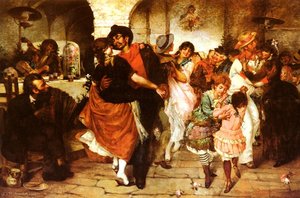
As his career matured, however, Lancerotto’s gaze turned inward, away from the grand stages of history and toward the humble, beating heart of Venice. He became a master of the genre scene, finding profound beauty in the campiello—the small, communal courtyards that serve as the soul of Venetian neighborhoods. His brush began to celebrate the overlooked: the weathered face of a gondolier, the quiet dignity of a porter, or the lively, boisterous energy of street festivities. In works such as Ballo Mazurka, one can witness his mastery of thick impasto and vibrant light, capturing the joyous, chaotic essence of Venetian revelry with an almost tactile quality.
A Lasting Legacy of Venetian Realism
Lancerotto’s significance lies in his ability to act as a visual chronicler of a vanishing era. He possessed a rare, keen discernment for the "Venetians of the street," capturing the spectrum of society from the elegant and refined to the rugged and working class. His paintings do more than document faces; they capture desires, instincts, and appetites, offering a window into the social psyche of the late 19th century.
Throughout his decades of productivity, Lancerotto’s work was exhibited in the most prestigious venues of Europe, from the Salon of Paris to the exhibitions in Milan, Turin, and Rome. His contributions to the art world include:
- Mastery of Genre Painting: Redefining the depiction of Venetian daily life through a lens of emotional realism.
- Technical Versatility: A seamless transition from large-scale historical narratives to intimate, character-driven portraits and landscapes.
- Cultural Preservation: Creating an enduring visual record of the traditions, costumes, and social structures of Venice before the modern era transformed them.
When Egisto Lancerotto passed away in Venice in 1916, he left behind a body of work that remains a vital touchstone for anyone seeking to understand the true spirit of the Venetian lagoon. His paintings continue to resonate, offering a timeless invitation to wander through the streets of a city captured forever in his evocative, masterful strokes.
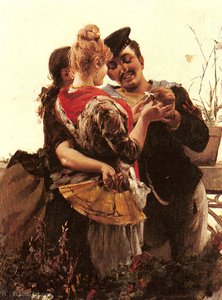
egisto lancerotto
1847 - 1916
Quick Facts
- Artistic Movement Or Style: Academic
- Artists Who Influenced This Artist:
- Napoleone Nani
- Michelangelo Grigoletti
- Federico Moja
- Pompeo Marino Molmenti
- Date Of Birth: 1847-08-21
- Date Of Death: 1916-05-31
- Full Name: Egisto Lancerotto
- Nationality: Italian
- Notable Artworks:
- Ballo Mazurka
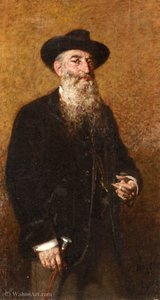
- A portrait of a distinguished italian gentleman
- Place Of Birth: Noale, ITA