 Preview
 Send
Send Share
Share
 Details

 Download
 Similars
 X-Ray
X-Ray Diaporama
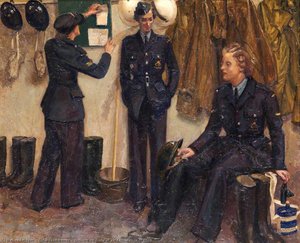
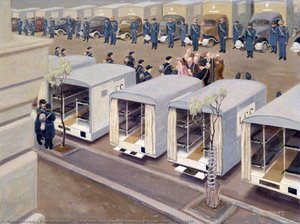
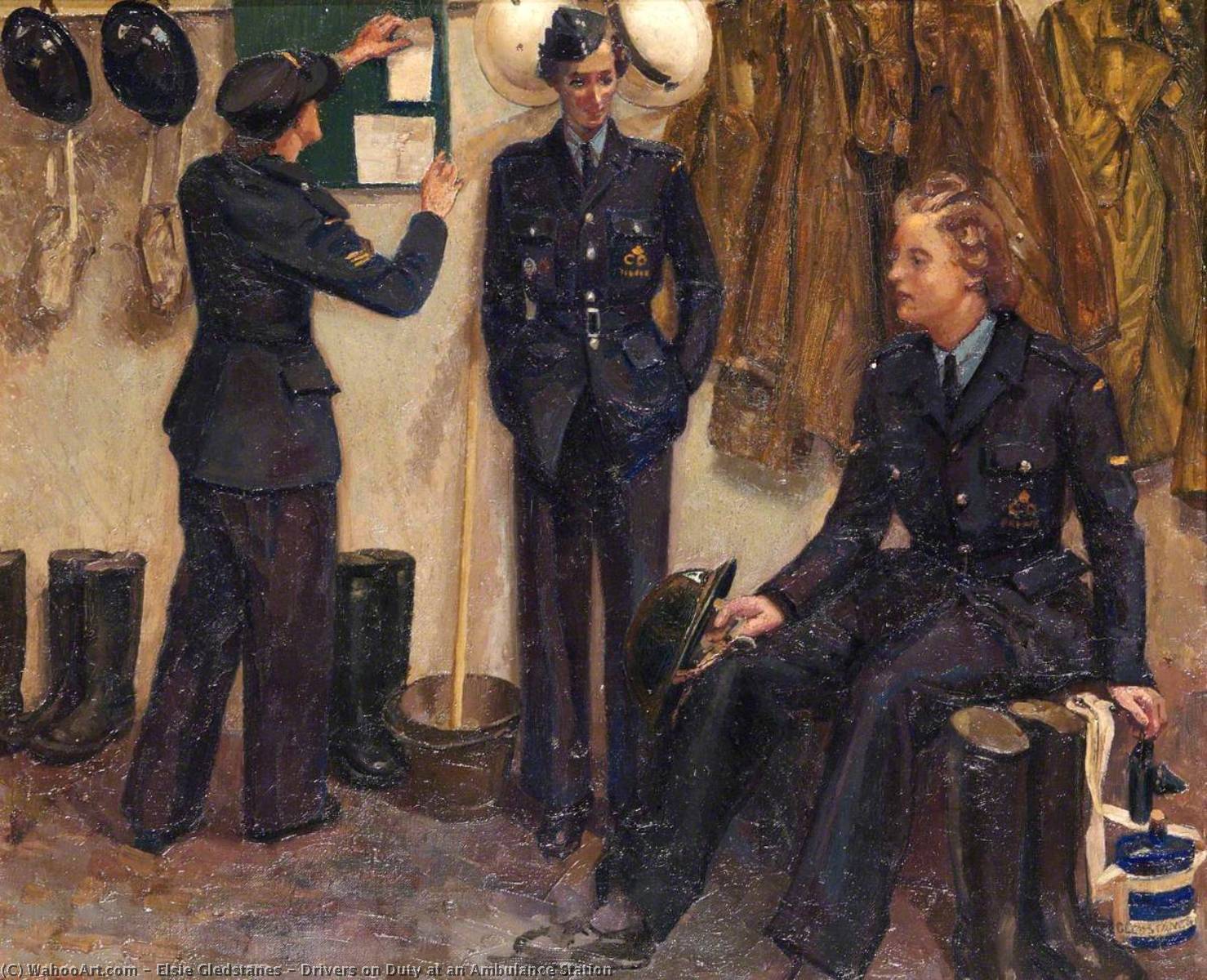
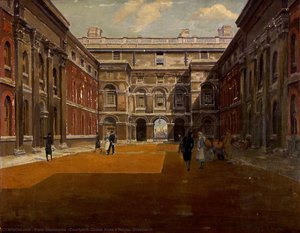
Drivers on Duty at an Ambulance Station
 1940
1940 51.0 x 61.0 cm
 Read More
Hand Made Oil Reproduction
Hand-painted oil on canvas in your size and frame, made to order by our artists. ( Buy Print Buy Image)




































Pick from our preset sizes that match the artwork's original proportions.

You may enter your own dimensions to fit a specific frame or space. If your selected size does not match the original image's proportions, we will either crop the artwork or extend the painting with additional hand-painted elements. A digital mockup will be sent for your approval before production begins.
Please note that the on-screen preview does not reflect the actual cropping or extension. Only the mockup will accurately show the final composition.
While custom sizes are available, we recommend selecting a dimension from the predefined list to preserve the original proportions.
After order, ArtsDot.com team will email client for instructions and provide a mockup preview
Worldwide Delivery () in 3/4 weeks instead of standard 5 weeks. (27 August). No compromise on quality.

Free Worldwide Express Shipping

High-Quality Linen Canvas

Full Shipping Insurance

Customs Tax Refund Guarantee

True Color Matching Guarantee

60-Day Return Policy (Defects Only)

100% Money-Back Guarantee

Bulk Discount Offer
 Glass option is only available in size under 110 CM

Drivers on Duty at an Ambulance Station
Reproduction Medium
Reproduction Size
-


Total Price
$ 263
Related Artworks









Artist Biography
The Visionary Brush of Elsie Gledstanes
In the quiet, evocative strokes of Elsie Gledstanes, one finds a profound intersection of personal duty and artistic observation. Born in 1891 in Ealing, Middlesex, Gledstanes emerged as a painter whose work did more than merely capture light; it documented the shifting social fabric of Britain during the tumultuous decades of the early twentieth century. Her journey began with a rigorous pursuit of excellence, traveling to the vibrant art centers of Paris before returning to London to refine her craft at prestigious institutions such as the Slade School of Fine Art, the Byam Shaw School of Art, and the Vicat Cole School. These formative years provided her with a technical foundation that allowed her to move seamlessly between mediums, mastering oils, pastel, tempera, and, most notably, the delicate nuances of watercolour.
Gledstanes’s artistry was never static, evolving alongside the world she inhabited. While her landscapes often breathed with a sense of quiet contemplation, it was her ability to imbue figure groups and portraits with a deep, human dignity that truly set her apart. She possessed an innate talent for visual storytelling, using subtle tonal gradations and precise brushwork to reveal the inner character of her subjects. Whether she was depicting women in moments of domestic repose or capturing the stoic strength of those on wartime duty, her canvases served as windows into the emotional landscapes of her era.
A Witness to War and Resilience
The trajectory of Gledstanes’s life and work was irrevocably shaped by the two World Wars, periods that transformed her from a traditional portraitist into a vital chronicler of female resilience. During the First World War, she served in the Women's Royal Naval Service, an experience that undoubtedly deepened her connection to the women she would later immortalize on canvas. In the Second World War, her service continued in different capacities as an auxiliary ambulance driver and a driver for the Women's Legion. These roles placed her at the very heart of the wartime effort, providing her with unparalleled access to the faces of courage and the grit of everyday survival.
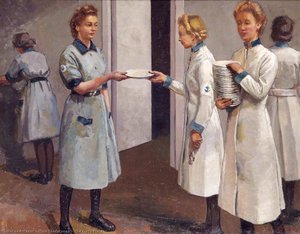
Her paintings from this period are far more than mere historical records; they are poignant social commentaries. In works such as “The Dirty Plate,” which depicts a woman serving at the Royal Docks, Gledstanes captures the unglamorous yet essential labor of the home front with immense compassion. Her ability to find beauty in the mundane and strength in the weary is a hallmark of her wartime output. Many of these significant sketches and portraits are now preserved within the Imperial War Museum and the Royal Air Force Museum, ensuring that her tribute to the women of the Royal Navy and the Women's Legion remains an indelible part of British heritage.
Legacy and Artistic Mastery
Beyond the battlefield and the docks, Gledstanes established a dual existence as both a London-based professional and a painter inspired by the rugged beauty of Wales. By establishing studios in both the bustling metropolis and at Prenteg near Porthmadog, she expanded her repertoire to include landscapes that reflected the serene, enduring spirit of the natural world. This versatility allowed her to participate in the most prestigious art circles of her time, regularly exhibiting her watercolours at the Royal Academy, the Royal Society of British Artists, and the Society of Women Artists.
The historical significance of Elsie Gledstanes lies in her unique ability to marry technical mastery with a profound sense of empathy. She did not merely paint what she saw; she painted how it felt to live through an age of unprecedented change. Her legacy is found in the dignity she afforded to her subjects—the women of the navy, the laborers of the docks, and the quiet figures of the English countryside. Through her eyes, we see a world defined by both the shadows of conflict and the enduring light of human perseverance.
elsie gledstanes
1891 - 1982
Quick Facts
- Artistic Movement Or Style: Slade School of Fine Art
- Artists Or Movements Influenced By This Artist: ['Royal Academy']
- Artists Who Influenced This Artist: ['']
- Date Of Birth: 1891
- Date Of Death: 1982
- Full Name: Elsie Gledstanes
- Nationality: British
- Notable Artworks:
- The Dirty Plate
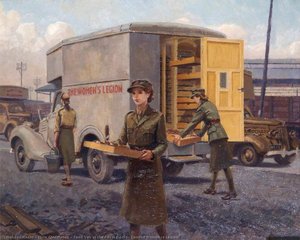
- Food Van at the Royal Docks, London Women's Legion
- Place Of Birth: Ealing, Middlesex