 Preview
 Send
Send Share
Share
 Details

 Download
 Similars
 X-Ray
X-Ray Diaporama
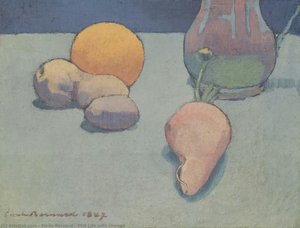
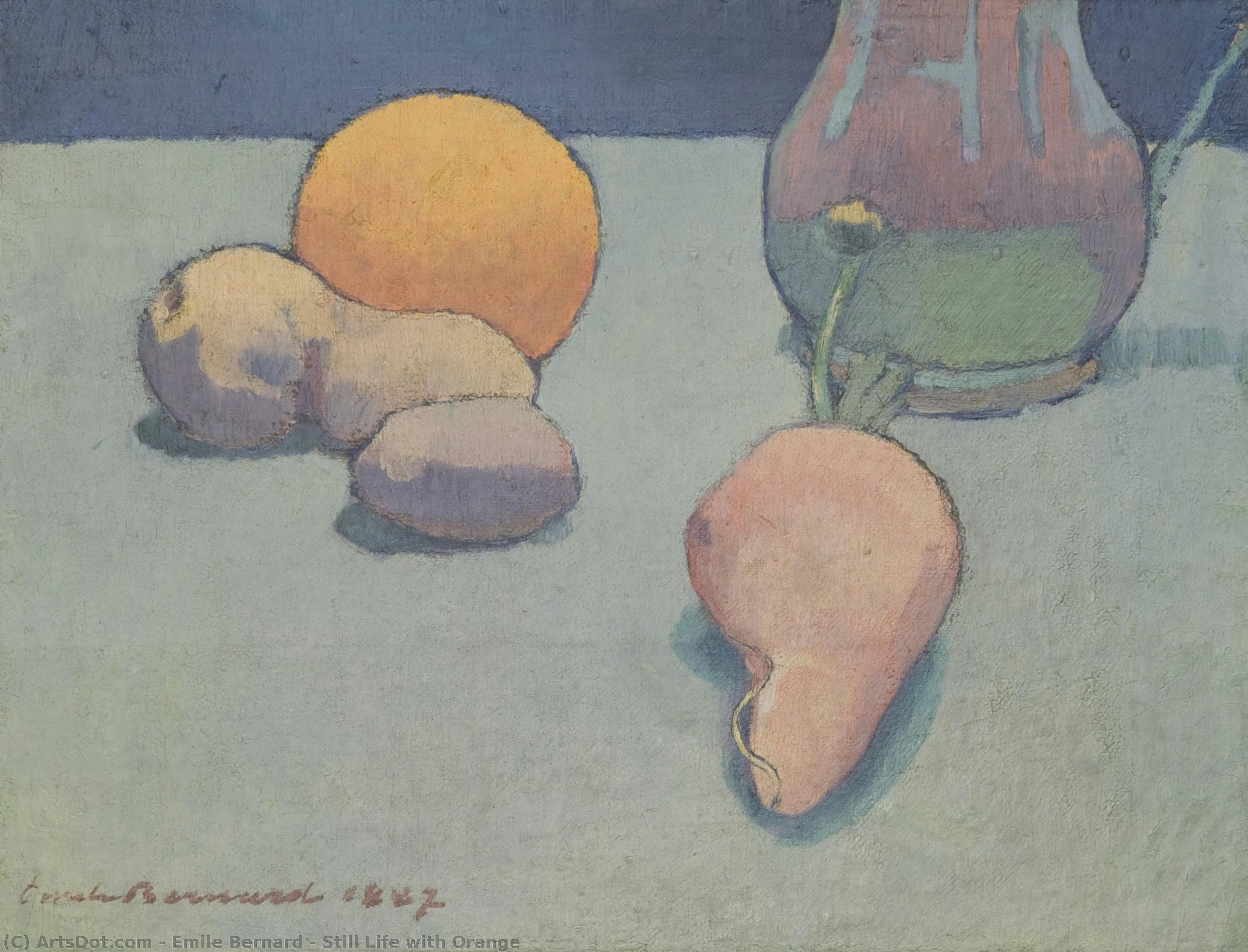
Still Life with Orange


 Read More
Hand Made Oil Reproduction
Hand-painted oil on canvas in your size and frame, made to order by our artists. ( Buy Print Buy Image)




P118B $10

P118H $10

P118W $10

P438Z $10

P508JH $12

P508YH $12

P805H $10

P805Z $10

P919BZ $10

P919G $10

P919XJ $10

P959ZH $10

P968JZ $12

W106C $8

W218G $10

W218JH $8

W218Y $10

W307PJ $10

W316G $10

W316PJ $8

W316Y $10

W398PJ $8

W4111J $10

W500HY $15

W500JH $15

W692G $12

W849H $8

W940BG $15

W953PJ $8




Pick from our preset sizes that match the artwork's original proportions.

You may enter your own dimensions to fit a specific frame or space. If your selected size does not match the original image's proportions, we will either crop the artwork or extend the painting with additional hand-painted elements. A digital mockup will be sent for your approval before production begins.
Please note that the on-screen preview does not reflect the actual cropping or extension. Only the mockup will accurately show the final composition.
While custom sizes are available, we recommend selecting a dimension from the predefined list to preserve the original proportions.
After order, ArtsDot.com team will email client for instructions and provide a mockup preview
Worldwide Delivery () in 3/4 weeks instead of standard 5 weeks. (17 August). No compromise on quality.

Free Worldwide Express Shipping

High-Quality Linen Canvas

Full Shipping Insurance

Customs Tax Refund Guarantee

True Color Matching Guarantee

60-Day Return Policy (Defects Only)

100% Money-Back Guarantee

Bulk Discount Offer
 Glass option is only available in size under 110 CM

Still Life with Orange
Reproduction Medium
Reproduction Size
-


Total Price
$ 263
Artwork Description
Still Life with Orange – A Study in Breton Minimalism
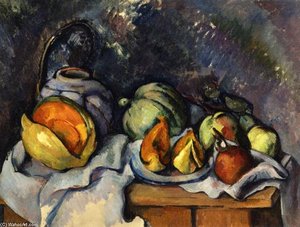
Émile Bernard’s “Still Life with Orange” stands as a testament to the burgeoning Synthetism movement within Post-Impressionism, capturing not merely an arrangement of fruit but also a profound distillation of Breton landscape and spiritual contemplation. Painted circa 1897, this unassuming canvas—currently housed in private collections—offers a deceptively simple visual experience that belies its complex artistic intentions. Bernard’s fascination with the rugged beauty of Brittany profoundly shaped his aesthetic sensibilities, prioritizing clarity of form and tonal harmony over detailed representation.Composition and Technique: Breton Influence
The painting's core is dominated by a vase brimming with oranges—a deliberate choice reflecting Bernard’s desire to convey an idealized vision of rural life. Unlike Impressionistic explorations of fleeting light, Bernard employs a technique rooted in Synthetism, favoring flattened planes of color and reduced brushstrokes. The muted palette – predominantly ochre, umber, and crimson – eschews the vibrancy characteristic of earlier movements, mirroring the subdued hues found in Breton landscapes. This restrained approach isn’t merely stylistic; it embodies Bernard's belief that art should strive for a spiritual resonance, capturing essence rather than surface appearance. Notice how the vase itself seems to merge seamlessly with its surroundings, furthering this sense of unity and tranquility.Symbolism: Beyond Mere Fruit
Beyond its formal qualities lies a rich tapestry of symbolism. The oranges themselves represent fertility and renewal—themes central to Breton folklore and Bernard’s personal spirituality. Their placement within the vase suggests an altar-like arrangement, elevating them beyond mere decorative objects. Furthermore, the dark background serves as a counterpoint to the luminous oranges, emphasizing their brilliance and highlighting the artist's preoccupation with tonal contrast. The subtle inclusion of a single apple—positioned slightly off-center—introduces a note of melancholy, perhaps hinting at the transience of beauty and life itself.Historical Context: Synthetism’s Quiet Revolution
Bernard’s “Still Life with Orange” emerged during a period of artistic experimentation following Vincent van Gogh's influence. Synthetism, championed by Bernard alongside Cézanne and Boch, rejected Impressionistic optical realism in favor of expressive color harmonies and simplified forms—a reaction against the perceived superficiality of its predecessor. This movement sought to capture not just what was seen but what was felt—a quest for spiritual truth expressed through visual language. It represents a crucial step away from Impressionism's preoccupation with capturing fleeting moments, toward a more enduring exploration of inner experience and artistic contemplation.Emotional Impact: Tranquility and Reflection
Ultimately, “Still Life with Orange” succeeds in conveying a palpable sense of serenity and introspection. The painting invites viewers to pause and contemplate the beauty of simplicity—a virtue Bernard championed throughout his career. Its muted colors and carefully considered composition foster a meditative state, mirroring the artist’s own engagement with Breton landscapes and spiritual traditions. It's a piece that speaks volumes about Bernard’s artistic vision: an unwavering commitment to capturing essence and conveying emotion through understated elegance – a timeless reminder of the power of art to inspire contemplation and elevate the spirit.Related Artworks
Artist Biography
Émile Bernard: A Post-Impressionist Pioneer
Early Life and Education
- Born: April 28, 1868, in Lille, France.
- Émile Henri Bernard’s early life was shaped by his sister's illness, leading to him being raised primarily by his grandmother, who ran a laundry in Lille. This supportive environment fostered his artistic inclinations.
- In 1878, the family relocated to Paris, where Bernard attended the Collège Sainte-Barbe.
- He began formal art studies at the École des Arts Décoratifs and later joined the Atelier Cormon in 1884. Here, he experimented with Impressionism and Pointillism.
- His expressive tendencies led to a suspension from the École des Beaux-Arts, prompting a formative journey through Brittany on foot.
Artistic Development and Influences
- Bernard’s artistic development was significantly influenced by his travels in Brittany, where he encountered local traditions and landscapes that deeply resonated with him.
- Key Relationship: A pivotal moment came in August 1886 when he met Paul Gauguin in Pont-Aven. This encounter sparked a close artistic friendship and profoundly impacted both artists’ styles.
- Bernard's style played a crucial role in shaping Gauguin’s mature work, particularly his exploration of symbolism and flattened forms.
- He also associated with Vincent van Gogh, forming part of the “School of Petit-Boulevard” alongside Anquetin and Toulouse-Lautrec.
Key Artistic Movements
- Cloisonnism: Bernard is considered a pioneer of Cloisonnism, a style characterized by bold, flat shapes separated by dark contours – reminiscent of stained glass.
- Synthetism: He also played a key role in the development of Synthetism, which emphasized the creation of art based on subjective experience and symbolic meaning rather than direct observation of nature.
- These movements represented a departure from Impressionism, focusing instead on structure, symbolism, and emotional expression.
Notable Works
- La Grandmère (1887): A poignant portrait of his grandmother, showcasing the artist’s early mastery of expressive form and color. This work is considered one of his most iconic pieces.
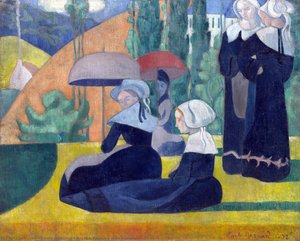
- Numerous Breton landscapes capturing the essence of rural life in Brittany.
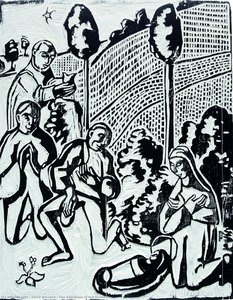
- Religious works such as “The Adoration of the Shepherds” demonstrating his exploration of symbolic themes.
Literary Contributions and Historical Significance
- Beyond painting, Bernard was a prolific writer, producing plays, poetry, and art criticism. His writings provide valuable first-hand insights into the development of modern art during his time.
- Legacy: Émile Bernard’s contributions to Post-Impressionism, particularly his role in shaping Cloisonnism and Synthetism, left a lasting impact on the course of modern art.
- His work paved the way for subsequent movements like Fauvism and Expressionism, influencing generations of artists to explore subjective expression and symbolic representation.
- He died in 1941, leaving behind a body of work that continues to be celebrated for its originality and artistic innovation.
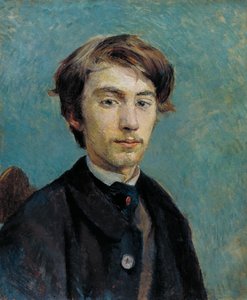
Émile Bernard
1868 - 1941 , France
Quick Facts
- Birth Date: April 28, 1868
- Birth Place: Lille, France
- Death Date: 1941
- Influenced: ['Paul Gauguin']
- Movement:
- Post-Impressionism
- Cloisonnism
- Synthetism
- Name: Émile Bernard
- Nationality: French
- Notable Works: ['La Grandmère']
Related Articles

Cézanne's Masterpieces: 25 Iconic Artworks to Transform Your Space
Journey through 25 iconic artworks by Paul Cézanne – a master of Impressionism and Post-Impressionism. Explore his landscapes, still lifes, and the stories behind these timeless masterpieces. Discover museum-quality reproductions & curated decor at ArtsDot.com.
Beyond Impressionism: Exploring the Emotional Depth of Post-Impressionist Painting
Explore the profound emotional depth & innovative techniques of Post-Impressionism with ArtsDot. Discover Cézanne, Van Gogh, Gauguin & more – and their lasting impact on modern art.
Post-Impressionism's 10 Defining Masterpieces: Art for Your Home |
Journey through Post-Impressionism's 10 defining masterpieces – Van Gogh, Monet & more. Explore iconic paintings, art history & find museum-quality reproductions for your home at . Discover all masterpieces online!
The Bountiful Still Life: Symbolism & Artistic Representation of Fruit Across Art History
Explore the rich history of still life painting & the symbolism of fruit across art movements. Discover masterpieces from Caravaggio to Cézanne with ArtsDot – expert guidance & museum-quality reproductions.
Beyond Light & Color: Impressionism vs. Post-Impressionism for the Discerning Collector
Explore the nuances of Impressionism & Post-Impressionism with . Expert insights for collectors on style, investment, and acquiring museum-quality reproductions.