 Preview
 Send
Send Share
Share
 Details

 Download
 Similars
 X-Ray
X-Ray Diaporama
 Stats
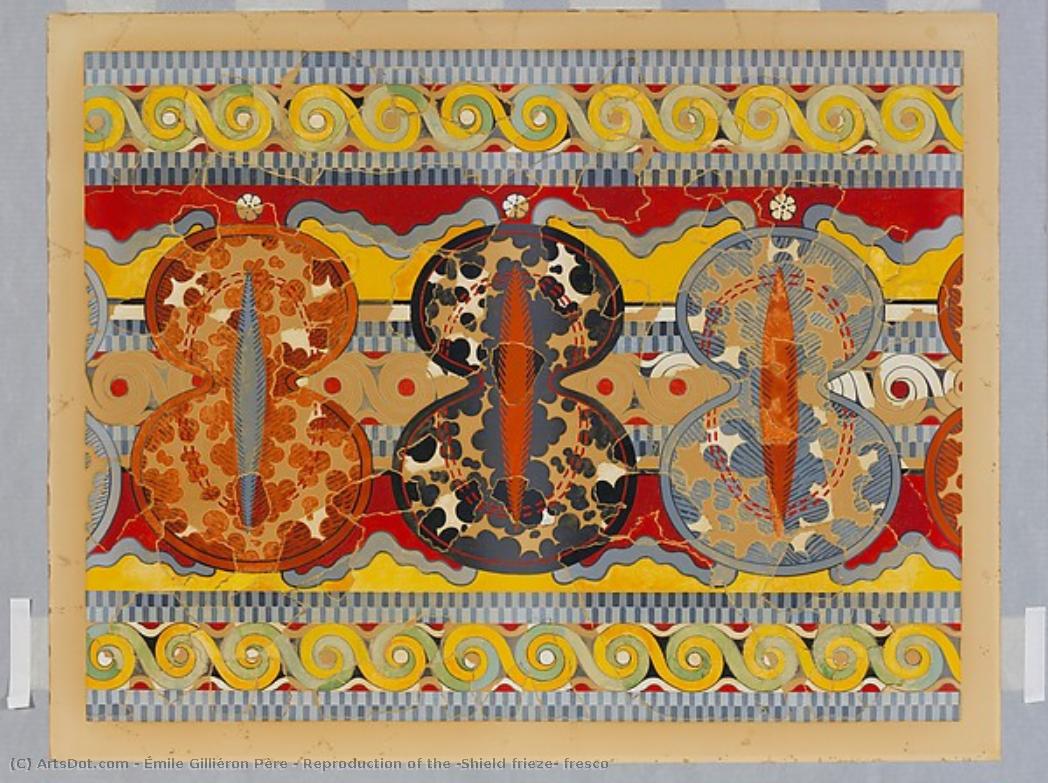
StatsReproduction of the "Shield frieze" fresco
 1325
1325 100.0 x 81.0 cm
 Read More
Hand Made Oil Reproduction
Hand-painted oil on canvas in your size and frame, made to order by our artists. ( Switch to Print Switch to Digital Image)




































Pick from our preset sizes that match the artwork's original proportions.

You may enter your own dimensions to fit a specific frame or space. If your selected size does not match the original image's proportions, we will either crop the artwork or extend the painting with additional hand-painted elements. A digital mockup will be sent for your approval before production begins.
Please note that the on-screen preview does not reflect the actual cropping or extension. Only the mockup will accurately show the final composition.
While custom sizes are available, we recommend selecting a dimension from the predefined list to preserve the original proportions.
After order, ArtsDot.com team will email client for instructions and provide a mockup preview
Worldwide Delivery () in 3/4 weeks instead of standard 5 weeks. (9 September). No compromise on quality.

Free Worldwide Express Shipping

High-Quality Linen Canvas

Full Shipping Insurance

Customs Tax Refund Guarantee

True Color Matching Guarantee

100-Day Return Policy (Defects Only)

100% Money-Back Guarantee

Bulk Discount Offer
 Glass option is only available in size under 110 CM

Reproduction of the "Shield frieze" fresco
Reproduction Medium
Reproduction Size
-


Total Price
$ 263
Related Artworks




Artist Biography
The Linguistic Cartographer: Unveiling the Life and Work of Émile Gilliéron
Émile Gilliéron, a name perhaps less familiar than those of his Impressionist contemporaries, nevertheless occupies a pivotal position in the intellectual landscape of late 19th and early 20th century France. Born in 1855 in Mâcon, Burgundy, Gilliéron wasn’t a painter wielding brushstrokes on canvas, but a philologist armed with a meticulous ear and an insatiable curiosity for the living language spoken across his homeland. His life's work – a monumental linguistic survey of France – fundamentally reshaped our understanding of dialectology, geography, and even national identity. Gilliéron’s early education instilled in him a deep appreciation for classical languages, but it was during his time as a secondary school teacher that he became acutely aware of the vast discrepancies between the standardized French taught in classrooms and the vibrant, often unintelligible, vernaculars spoken by the people he encountered. This realization sparked a lifelong quest to document and analyze these regional variations, believing they held keys to understanding France’s history, culture, and the very evolution of language itself. He wasn't merely cataloging words; he was mapping the soul of a nation through its speech.A Revolution in Linguistic Methodology: The *Atlas Linguistique de la France*
Gilliéron’s most enduring legacy is undoubtedly the *Atlas Linguistique de la France* (ALF), an ambitious project begun in 1897 and completed posthumously in 1968. Prior to the ALF, dialectology was largely a historical-comparative discipline, reconstructing proto-languages from written sources. Gilliéron pioneered a radically different approach: direct fieldwork. He dispatched teams of investigators – often young teachers – across France, equipped with standardized questionnaires designed to elicit responses to over 1500 carefully chosen questions covering all aspects of daily life, from agricultural practices and domestic routines to folklore and local customs. The investigators didn’t simply record the words themselves; they meticulously noted pronunciation, intonation, and even the social context in which each utterance was made. This emphasis on *real* speech, as opposed to literary representations, marked a turning point in linguistic research. The resulting atlas – a vast collection of maps illustrating the geographical distribution of thousands of linguistic features – wasn’t just a scientific document; it was a breathtaking visual representation of France's cultural diversity. It revealed that language wasn’t a homogenous entity imposed from above, but a complex mosaic shaped by local conditions and historical contingencies.Influences and Intellectual Context: From Historical Philology to Regionalism
Gilliéron’s work emerged at a crucial juncture in French intellectual history. The late 19th century witnessed a growing interest in regional identities, fueled by the rise of nationalism and anxieties about centralization. While Gilliéron himself wasn't explicitly a political activist, his research resonated deeply with those advocating for greater recognition of France’s diverse cultures. He drew heavily from the methods of historical geography, recognizing that linguistic boundaries often reflected ancient administrative divisions, migration patterns, and trade routes. His intellectual debt to scholars like Paul Vidal de la Blache, a pioneer in human geography, is undeniable. Furthermore, Gilliéron’s meticulous attention to detail and his emphasis on empirical observation aligned with the broader positivist movement of the era. However, he transcended simple empiricism by recognizing that language wasn't merely a passive reflection of external factors; it was an active force shaping perceptions and constructing social realities. He understood that each dialect embodied a unique worldview, a particular way of experiencing and interpreting the world.Major Achievements and Lasting Impact: Beyond the Atlas
The *Atlas Linguistique de la France* remains Gilliéron’s most celebrated achievement, but his contributions extended far beyond this monumental project. He developed a sophisticated theory of linguistic boundaries – “lines of isoglosses” – demonstrating that dialects weren't separated by abrupt divisions, but rather by gradual transitions and overlapping zones of influence. He also pioneered the study of onomastics – the investigation of place names – revealing how toponyms could provide valuable insights into historical settlement patterns and cultural landscapes.- His work challenged the prevailing notion of a unified French language, exposing its inherent regional variations.
- He laid the foundations for modern sociolinguistics, recognizing the social factors that influence linguistic behavior.
- The ALF served as a model for similar linguistic surveys conducted across Europe and beyond.