 Preview
 Send
Send Share
Share
 Details

 Download
 Similars
 X-Ray
X-Ray Diaporama
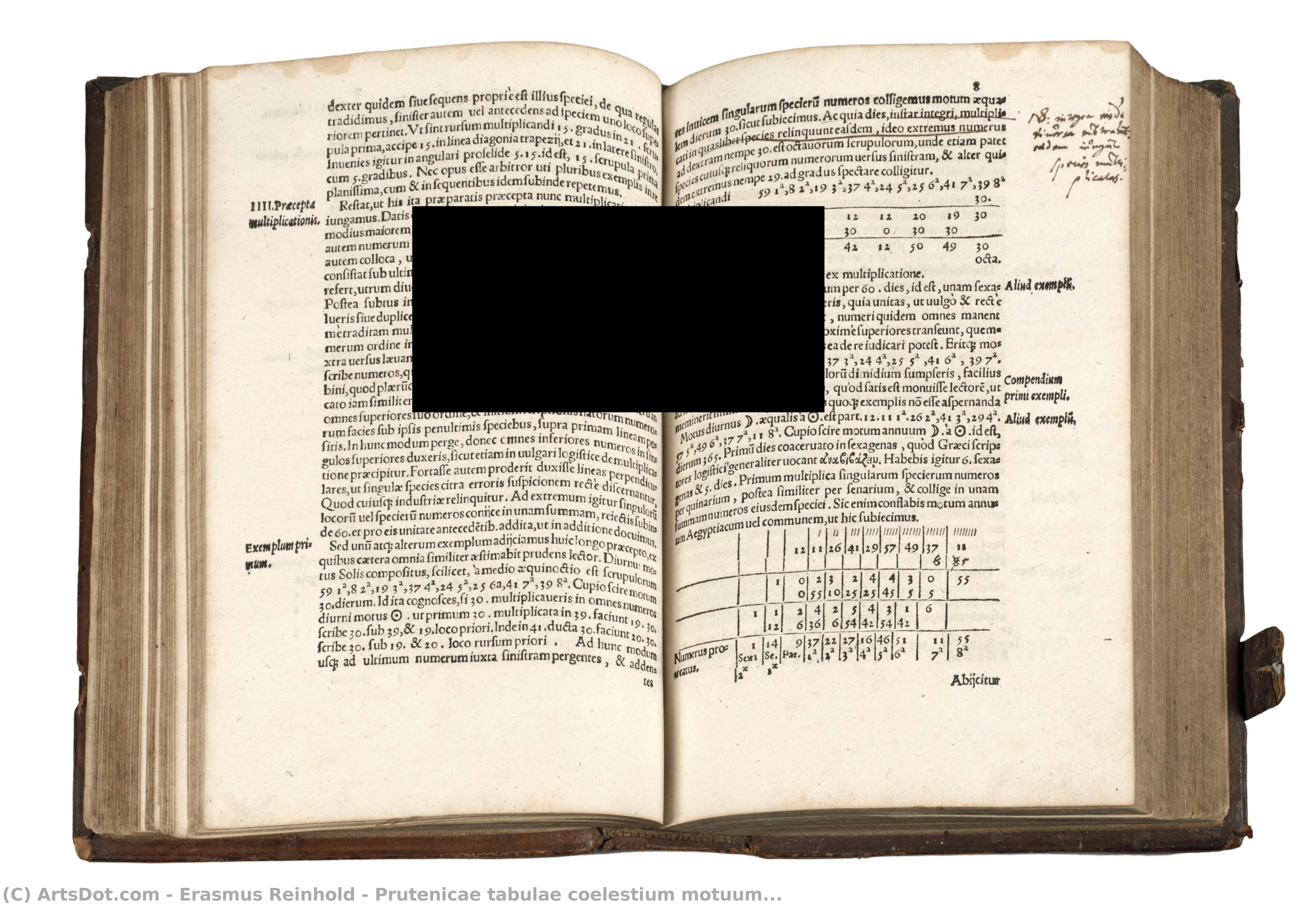
Prutenicae tabulae coelestium motuum
 1551
1551 22.0 x 17.0 cm
 Nicolaus Copernicus Museum
 Read More
Giclée / Art Print
Museum-quality giclée or canvas print with fast production and flexible finish options. ( Buy Hand Made Painting Buy Image)




































Pick from our preset sizes that match the artwork's original proportions.

You may enter your own dimensions to fit a specific frame or space. If your selected size does not match the original image's proportions, we will either crop the artwork or extend the image with a mirrored or solid-fill edge. A digital mockup will be sent for your approval before production begins.
Please note that the on-screen preview does not reflect the actual cropping or extension. Only the mockup will accurately show the final composition.
While custom sizes are available, we recommend selecting a dimension from the predefined list to preserve the original proportions.
Worldwide Delivery () in 2 weeks instead of standard 4/5 weeks. (22 August)

Free Worldwide Express Shipping

High-Quality Linen Canvas

Full Shipping Insurance

Customs Tax Refund Guarantee

True Color Matching Guarantee

60-Day Return Policy (Defects Only)

100% Money-Back Guarantee

Bulk Discount Offer
 Glass option is only available in size under 110 CM

Prutenicae tabulae coelestium motuum
Giclée / Art Print
Reproduction Size
-


Total Price
$ 63
Related Artworks









Artist Biography
A Life Dedicated to Astronomical Precision: The World of Erasmus Reinhold
Erasmus Reinhold, born in the small Thuringian town of Saalfeld, Germany, in 1511, stands as a pivotal figure bridging the gap between traditional Ptolemaic astronomy and the burgeoning heliocentric theories of Nicolaus Copernicus. Though not a revolutionary himself, his influence resonated deeply throughout 16th-century Europe, primarily through his dedication to pedagogical excellence and the creation of remarkably accurate astronomical tables – the *Prutenicae Tabulae*. Reinhold’s life unfolded during a period of intense intellectual ferment, where established cosmological models were being challenged by new observations and mathematical frameworks. He wasn't merely an observer of this shift; he actively shaped its trajectory, becoming known as the most influential astronomical pedagogue of his generation. His early education under Jacob Milich at the University of Wittenberg laid a strong foundation in mathematics and astronomy, leading to his appointment as professor of higher mathematics in 1536 – a role that encompassed applied mathematics, with astronomy taking central stage. He quickly rose through the academic ranks, becoming dean of the arts faculty (1540-1541) and later rector of the university (1549-1550), establishing what became known as the “Wittenberg school” of astronomers.The Prutenic Tables: A Synthesis of Tradition and Innovation
Reinhold’s most enduring legacy lies in his *Prutenicae Tabulae*, published in 1551 with financial support from Duke Albert of Brandenburg Prussia. These tables weren't a radical departure from existing astronomical knowledge, but rather a meticulous refinement of it. He incorporated Copernicus’s parameters for planetary motions into the established geocentric framework, creating ephemerides – predictions of celestial positions – that were significantly more accurate than their predecessors, such as the Alphonsine Tables. This seemingly paradoxical approach—adopting Copernican calculations within a Ptolemaic worldview—highlights Reinhold's complex relationship with the new cosmology. He recognized the mathematical utility of Copernicus’s work but remained hesitant to embrace heliocentrism fully, citing physical and theological concerns. The *Prutenicae Tabulae* became an essential tool for astronomers across Europe, facilitating more precise observations and calculations. They were reprinted multiple times throughout the late 16th century, demonstrating their lasting practical value. The tables’ success wasn't simply due to accuracy; Reinhold carefully framed them to be independent of Earth’s movement, appealing to a wider audience wary of fully committing to Copernicanism.Bridging Worlds: Teaching and the Dissemination of Knowledge
Beyond his tabular work, Reinhold was an exceptional teacher. He fostered a learning environment at Wittenberg that emphasized mathematical rigor and observational skills. His students were encouraged to engage with classical texts, including Georg von Peurbach’s *Theoricae novae planetarum*, which he published in an annotated edition featuring innovative volvelles – rotating diagrams used for modeling planetary orbits. He also produced a Greek-Latin edition of Ptolemy's *Almagest* complete with commentary that underscored its mathematical foundations. Crucially, Reinhold exposed his students to Copernicus’s *De revolutionibus*, providing heavily annotated copies and encouraging critical engagement with the text. This exposure, coupled with his emphasis on practical tools like quadrants for observation, played a vital role in disseminating Copernican ideas throughout Germany. Figures such as Tycho Brahe were profoundly influenced by Reinhold's work, laying the groundwork for future astronomical breakthroughs.A Complex Legacy: Geocentrism and the Seeds of Revolution
While Reinhold’s name is often associated with the advancement of astronomy, it’s important to acknowledge his commitment to a geocentric worldview. He translated Copernicus' mathematical methods back into a system where Earth remained at the center of the universe, rejecting heliocentric cosmology on both physical and theological grounds—a common stance among astronomers before Johannes Kepler and Galileo Galilei. However, this doesn’t diminish his significance. Reinhold’s work provided the essential computational tools that allowed astronomers to test and refine Copernican theories. His annotated copy of *De revolutionibus*, meticulously studied by Owen Gingerich, reveals a careful engagement with Copernicus' ideas, even as he sought to reconcile them with established beliefs. His calculations of the Earth-Sun distance, though “massaged” to align with Ptolemaic values, demonstrate his deep understanding of astronomical principles. Ultimately, Reinhold’s legacy is one of precision and pedagogy—he may not have initiated a revolution, but he provided the foundation upon which it was built. His work directly influenced the Calendar Reform enacted by Pope Gregory XIII in 1582, solidifying his place as a key figure in the scientific landscape of the 16th century.Historical Significance and Enduring Impact
Erasmus Reinhold’s impact extends beyond specific astronomical achievements. He embodied the intellectual tensions of his era—the struggle to reconcile new discoveries with established traditions, the interplay between mathematics and observation, and the delicate balance between scientific inquiry and religious belief. His *Prutenicae Tabulae* weren't merely a collection of numbers; they were a testament to the power of mathematical precision and a catalyst for further astronomical investigation. The lunar crater named in his honor serves as a lasting reminder of his contributions to our understanding of the cosmos. Reinhold’s story is a compelling example of how scientific progress isn't always about radical departures, but often involves careful refinement, meticulous observation, and the dedicated transmission of knowledge. He stands as a crucial link in the chain of astronomical discovery, bridging the gap between the ancient world and the dawn of modern science.
erasmus reinhold
1511 - 1553 , Germany
Quick Facts
- Artistic Movement Or Style: Renaissance Astronomy
- Artists Or Movements Influenced By This Artist:
- Tycho Brahe
- Johannes Kepler
- Artists Who Influenced This Artist:
- Georg Purbach
- Nicolaus Copernicus
- Date Of Birth: October 22, 1511
- Date Of Death: February 19, 1553
- Full Name: Erasmus Reinhold
- Nationality: German
- Notable Artworks:
- Prutenic Tables
- Theoricae novae planetarum commentary
- Place Of Birth: Saalfelden, Germany