 Preview
 Send
Send Share
Share
 Details

 Download
 Similars
 X-Ray
X-Ray Diaporama
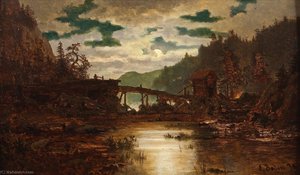
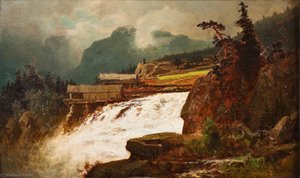
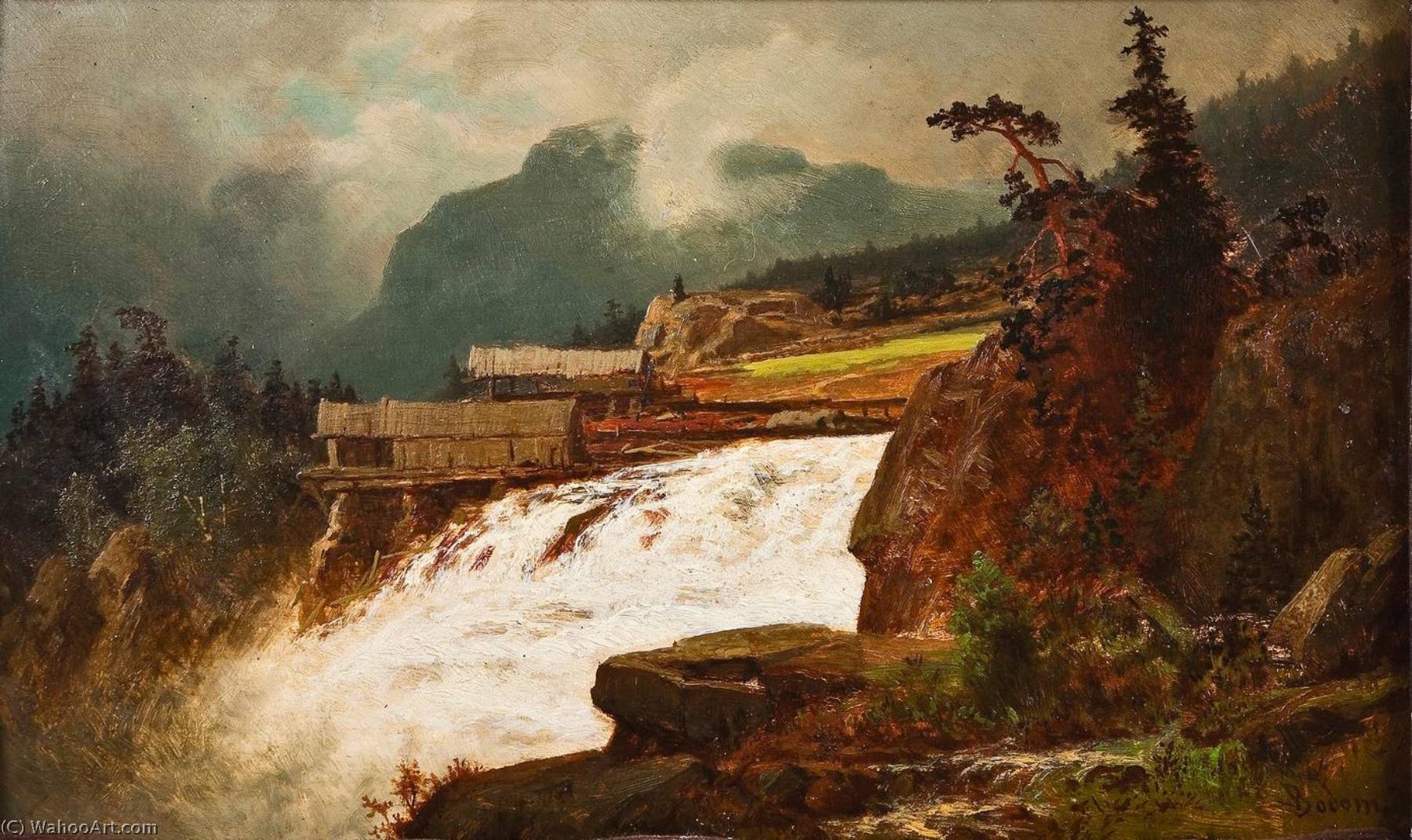
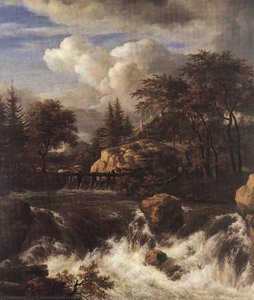
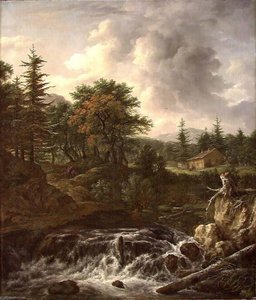
Norwegian Foss med sagbruk Waterfall with sawmill

 Read More
Giclée / Art Print
Museum-quality giclée or canvas print with fast production and flexible finish options. ( Buy Hand Made Painting Buy Image)




































Pick from our preset sizes that match the artwork's original proportions.

You may enter your own dimensions to fit a specific frame or space. If your selected size does not match the original image's proportions, we will either crop the artwork or extend the image with a mirrored or solid-fill edge. A digital mockup will be sent for your approval before production begins.
Please note that the on-screen preview does not reflect the actual cropping or extension. Only the mockup will accurately show the final composition.
While custom sizes are available, we recommend selecting a dimension from the predefined list to preserve the original proportions.
Worldwide Delivery () in 2 weeks instead of standard 4/5 weeks. (27 August)

Free Worldwide Express Shipping

High-Quality Linen Canvas

Full Shipping Insurance

Customs Tax Refund Guarantee

True Color Matching Guarantee

60-Day Return Policy (Defects Only)

100% Money-Back Guarantee

Bulk Discount Offer
 Glass option is only available in size under 110 CM

Norwegian Foss med sagbruk Waterfall with sawmill
Giclée / Art Print
Reproduction Size
-


Total Price
$ 63
Related Artworks
Artist Biography
The Soul of the Norwegian Wild: The Life and Art of Erik Bodom
In the annals of Scandinavian art, few names evoke the haunting beauty of the northern wilderness as poignantly as Erik Bodom. Born on September 28, 1829, in the quiet village of Vestby, Akershus, Bodom was a painter who did not merely observe nature but sought to translate its very heartbeat onto canvas. His journey was one of profound self-dedication; though he attended the Oslo Cathedral School, he famously chose to leave formal education behind to pursue the rigorous, solitary path of a self-taught master. This early commitment to his craft allowed him to develop a vision that was uniquely his own, unburdened by rigid academic dogma yet deeply rooted in the technical excellence of the great traditions.
Bodom’s artistic identity was forged through a series of pivotal encounters with the masters of his era. His formative years were shaped by the meticulous realism of Johannes Flintoe and the expressive, color-driven approach of Hans Gude. These influences acted as the dual pillars of his style—one providing the structural precision required to render the rugged Norwegian terrain, and the other offering the emotional vocabulary needed to imbue those landscapes with life. The most transformative chapter of his life began in 1850, when he traveled to Düsseldorf. Immersed in the prestigious Düsseldorf School of Painting, Bodom underwent a rapid metamorphosis, honing his ability to manipulate light and shadow to create scenes that felt less like topographical records and more like psychological landscapes.
A Symphony of Light and Melancholy
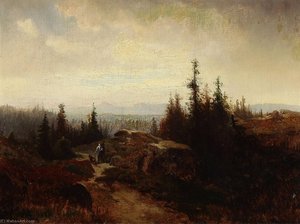
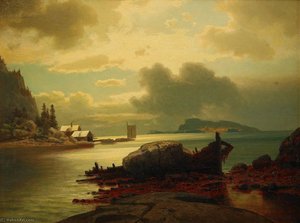
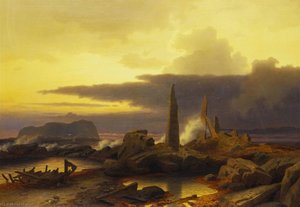
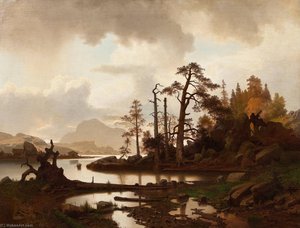
To look upon a Bodom landscape is to enter a world of atmospheric grandeur and quiet contemplation. He was a master of the sublime, specializing in the coniferous forests of Eastern Norway. His compositions often centered on the interplay between the dense, dark silhouettes of ancient pines and the sudden, dramatic intrusion of sunlight piercing through a heavy mist. This technique created a sense of "bewitching atmosphere," where the viewer is caught between the comfort of a serene forest glade and the overwhelming power of the untamed wild. His work frequently mirrored the themes explored by August Cappelen, focusing on solitude, the passage of time, and the profound vulnerability of nature.
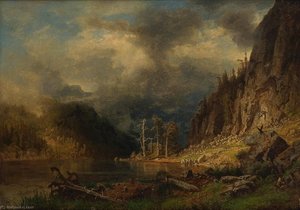
The technical brilliance of his oeuvre lies in his sophisticated use of oil on canvas and panel. Bodom utilized intricate layering and subtle tonal gradations to achieve a remarkable luminosity, making the surfaces of water and the textures of moss appear almost tactile. His palette was often characterized by soft, muted colors that enhanced the melancholic mood prevalent in his most celebrated works. Whether depicting the tranquil flow of a river or the imposing presence of a glacier, his brushstrokes remained delicate yet purposeful, ensuring that every leaf and stone contributed to a larger emotional narrative.
Legacy and Lasting Impressions
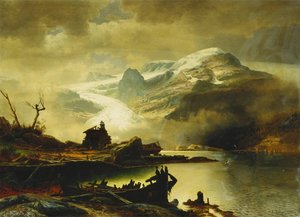
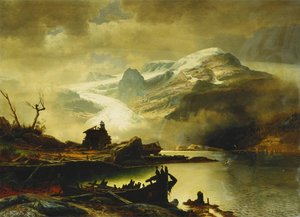
The career of Erik Bodom was marked by significant international recognition, even as he maintained a deep connection to his Norwegian roots. His talent was acknowledged far beyond the borders of Scandinavia; in 1853, he became an honorary member of the Royal Academy in Amsterdam, and his works found homes in prestigious collections such as the Bridgewater Gallery in London. Notable masterpieces like “River with Sawmill” and “The Bondhus Glacier in Sunnhordland” stand as enduring testaments to his ability to capture the fleeting moments of atmospheric change that define the Nordic landscape.
Though his life was tragically short, ending in Düsseldorf in 1879, the impact of his vision remains undiminished. Bodom’s contribution to the Romantic movement in Norway provided a vital bridge between classical realism and a more modern, emotive interpretation of the natural world. His ability to find the spiritual within the physical—to see the divine in a sun-drenched forest or the eternal in a mountain peak—ensures that his art continues to resonate with anyone who has ever felt the profound, quiet pull of the wilderness.
erik bodom
1829 - 1879
Quick Facts
- Artistic Movement Or Style: Romanticism
- Artists Or Movements Influenced By This Artist:
- Romanticism art
- Düsseldorf school
- Artists Who Influenced This Artist:
- August Cappelen
- Hans Gude
- Date Of Birth: 1829
- Date Of Death: 1879
- Full Name: Erik Bodom
- Nationality: Norwegian
- Notable Artworks:
- River with sawmill
- Memorial Stones
- The Bondhus Glacier in Sunnhordland
- Norska kustlandskap 2nd
- foss med sagbruk
- minnesteiner
- Place Of Birth: Vestby, Norway