 Preview
 Send
Send Share
Share
 Details

 Download
 Similars
 X-Ray
X-Ray Diaporama
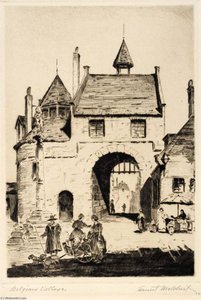
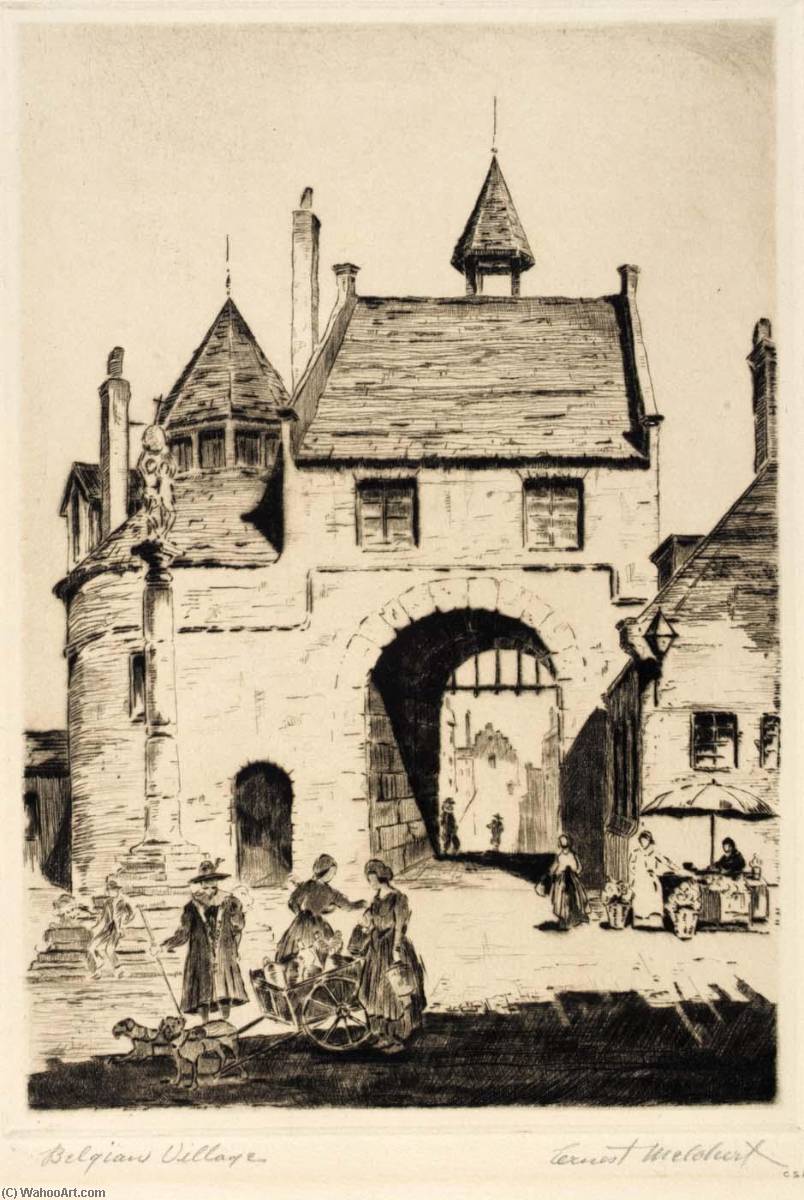
Belgian Village (Chicago Fair, 1933)
 1933
1933 22.0 x 16.0 cm
 Read More
Hand Made Oil Reproduction
Hand-painted oil on canvas in your size and frame, made to order by our artists. ( Buy Print Buy Image)




































Pick from our preset sizes that match the artwork's original proportions.

You may enter your own dimensions to fit a specific frame or space. If your selected size does not match the original image's proportions, we will either crop the artwork or extend the painting with additional hand-painted elements. A digital mockup will be sent for your approval before production begins.
Please note that the on-screen preview does not reflect the actual cropping or extension. Only the mockup will accurately show the final composition.
While custom sizes are available, we recommend selecting a dimension from the predefined list to preserve the original proportions.
After order, ArtsDot.com team will email client for instructions and provide a mockup preview
Worldwide Delivery () in 3/4 weeks instead of standard 5 weeks. (28 August). No compromise on quality.

Free Worldwide Express Shipping

High-Quality Linen Canvas

Full Shipping Insurance

Customs Tax Refund Guarantee

True Color Matching Guarantee

60-Day Return Policy (Defects Only)

100% Money-Back Guarantee

Bulk Discount Offer
 Glass option is only available in size under 110 CM

Belgian Village (Chicago Fair, 1933)
Reproduction Medium
Reproduction Size
-


Total Price
$ 263
Related Artworks









Artist Biography
The Soul of the American Midwest: The Life and Art of Ernest A. Melchert
In the tapestry of American art history, few threads weave together the precision of academic tradition and the ethereal light of Impressionism as gracefully as Ernest A. Melchert. Born in Milwaukee, Wisconsin, in 1868, Melchert emerged from an era defined by rapid industrialization, yet his artistic spirit remained anchored in the quiet, enduring beauty of the natural world. His journey was one of profound transformation, moving from the structured discipline of Midwestern realism toward a more fluid, atmospheric exploration of light and shadow that would eventually define him as a pioneer of Midwestern Impressionism.
Melchert’s early artistic foundation was laid under the watchful eye of George Washington Stetthelm, a prominent figure in the Milwaukee art scene who instilled in him the rigorous principles of academic realism. This training provided Melchert with an unparalleled command over form, texture, and geological accuracy. However, the true metamorphosis of his style occurred in 1893, when he traveled to Paris. Immersed in the vibrant, revolutionary atmosphere of the French capital, Melchert encountered the works of masters like Claude Monet and Pierre-Auguste Renoir. This exposure acted as a catalyst, encouraging him to move beyond mere documentation toward capturing the fleeting, sensory essence of a moment—the way sunlight dances upon a lake or how mist clings to a morning meadow.
A Vision of Light and Landscape
Upon his return to Wisconsin, Melchert did not merely return to his roots; he reimagined them. As an instructor at the Layton Art Institute, he became a vital conduit for European modernism within the American heartland. His canvases began to breathe with a new vitality, characterized by looser brushstrokes and a sophisticated use of dappled light. He possessed a unique ability to balance the meticulous detail required by his academic training with the emotive, atmospheric qualities of Impressionism. His landscapes are not merely depictions of terrain; they are poetic meditations on the serenity of rural life.
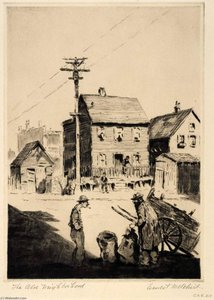
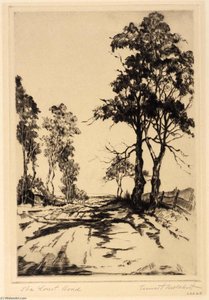
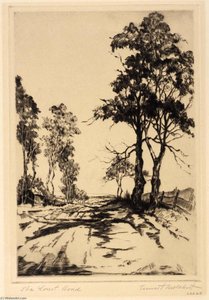
Melchert’s mastery extended beyond oil painting into the delicate realm of printmaking. Through the technique of drypoint, he was able to achieve an extraordinary level of intimacy and texture. In works such as The Covert Road (1934), one can observe his ability to use fine, scratched lines to create a sense of depth and tranquility, guiding the viewer's eye through a receding perspective of trees and roadside charm. Similarly, in The Old Neighborhood, he captured the rhythmic pulse of small-town life, rendering houses and figures with a delicate touch that evokes a profound sense of nostalgia and human connection.
Legacy and Artistic Significance
The historical significance of Ernest A. Melchert lies in his role as a bridge between two worlds. He successfully translated the sophisticated aesthetic language of Europe into a uniquely American vernacular, celebrating the landscapes of the Midwest with a reverence that felt both modern and timeless. His work serves as a vital record of a vanishing era, capturing the quiet dignity of farms, rolling hills, and small towns before the full weight of the 20th century altered the American landscape forever.
Today, Melchert’s contributions are preserved in prestigious institutions such as the Smithsonian American Art Museum, ensuring that his vision of a tranquil, luminous America continues to inspire. His legacy remains a testament to the power of artistic evolution—a journey from the structured observation of reality to the soulful interpretation of light.
Quick Facts
- Artistic Movement Or Style: Academic Realism
- Artists Or Movements Influenced By This Artist: ['French Academic Painting']
- Artists Who Influenced This Artist:
- Jean-Auguste Dominique Ingres
- Gustave Courbet
- Full Name: Ernest A Melchert
- Nationality: American
- Notable Artworks:
- The Covert Road
- The Old Neighborhood
- Place Of Birth: Cincinnati, Ohio