 Preview
 Send
Send Share
Share
 Details

 Download
 Similars
 X-Ray
X-Ray Diaporama
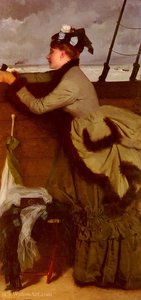
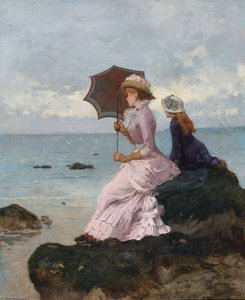
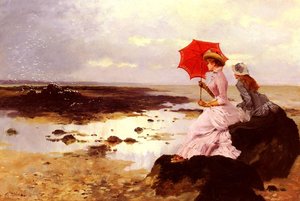
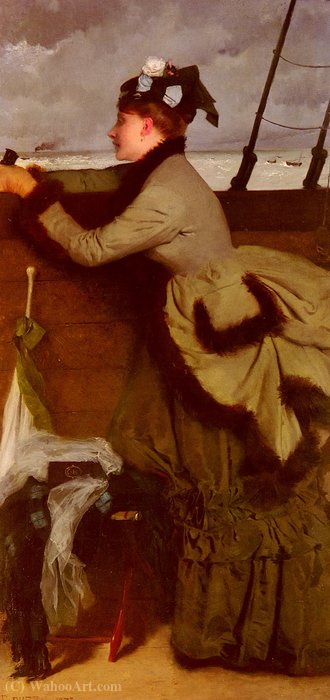
Looking out to sea
 Read More
Hand Made Oil Reproduction
Hand-painted oil on canvas in your size and frame, made to order by our artists. ( Buy Print Buy Image)




































Pick from our preset sizes that match the artwork's original proportions.

You may enter your own dimensions to fit a specific frame or space. If your selected size does not match the original image's proportions, we will either crop the artwork or extend the painting with additional hand-painted elements. A digital mockup will be sent for your approval before production begins.
Please note that the on-screen preview does not reflect the actual cropping or extension. Only the mockup will accurately show the final composition.
While custom sizes are available, we recommend selecting a dimension from the predefined list to preserve the original proportions.
After order, ArtsDot.com team will email client for instructions and provide a mockup preview
Worldwide Delivery () in 3/4 weeks instead of standard 5 weeks. (25 August). No compromise on quality.

Free Worldwide Express Shipping

High-Quality Linen Canvas

Full Shipping Insurance

Customs Tax Refund Guarantee

True Color Matching Guarantee

60-Day Return Policy (Defects Only)

100% Money-Back Guarantee

Bulk Discount Offer
 Glass option is only available in size under 110 CM

Looking out to sea
Reproduction Medium
Reproduction Size
-


Total Price
$ 263
Related Artworks
Artist Biography
The Quiet Mediator of Impressionism
In the vibrant, often turbulent landscape of late 19th-century French art, where the rigid traditions of the Academy clashed violently with the radical light of the Impressionists, there existed a space of profound, quiet harmony. This was the domain of Ernest Ange Duez, an artist who refused to choose between the old world and the new. Born in Paris in 1843, Duez navigated the era not as a revolutionary seeking to dismantle the past, but as a juste milieu—a middle ground painter who synthesized the meticulous discipline of classical training with the atmospheric sensitivity of his contemporaries.
His artistic journey began under the watchful eyes of masters such as Isidore Pils and Carolus Duran. From Pils, he inherited a rigorous devotion to anatomical precision and tonal gradation; from Duran, he learned the delicate art of portraiture and the nuances of studio practice. This foundational training allowed him to approach his subjects with a level of technical control that commanded respect within the prestigious Paris Salon. While he possessed a deep admiration for the avant-garde—owning works by Claude Monet, Edgar Degas, and Berthe Morisot—his own brushwork remained more restrained and his palette more subdued than the flickering, broken strokes of the Impressionist masters.
A Mastery of Genre and Light
The brilliance of Duez lies in his ability to elevate everyday moments into scenes of timeless elegance. His oeuvre is a tapestry of diverse genres, ranging from intimate portraits to sweeping landscapes and evocative religious subjects. In his genre paintings, such as Au restaurant Le Doyen or Café sur la Terrasse, he captured the pulse of modern Parisian life with a sense of dignity and quiet observation. He did not seek to shock the viewer with raw realism; instead, he invited them into a world of refined atmosphere, where light plays softly across fabrics and faces.
His landscapes often drew inspiration from the serene beauty of the Normandy countryside, particularly around Villerville and Le Havre. In these works, one can sense the influence of the Impressionist fascination with light, yet Duez maintains a structural integrity that anchors his scenes in a palpable reality. His ability to render the textures of nature—the soft bloom of flowers in his still lifes or the misty seaside air—demonstrates a painterly sensitivity that bridges the gap between academic realism and modern impressionistic feeling.
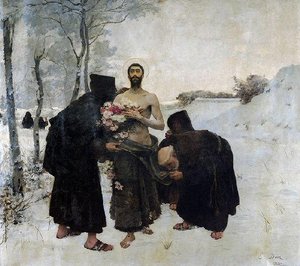
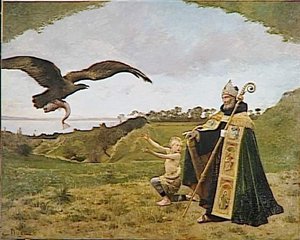
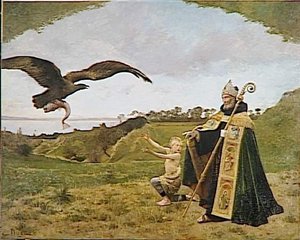
Among his most significant achievements was the large-scale triptych Saint Cuthbert, exhibited at the Salon in 1879. This monumental work, which depicts the stages of the saint's life set against landscapes inspired by Normandy, is widely considered his masterpiece and is now preserved in the Musée d’Orsay. It stands as a testament to his ability to marry grand, historical narrative with a deeply personal, atmospheric execution.
Legacy and Artistic Significance
The life of Ernest Ange Duez was one of interconnected brilliance. His social and professional circles were populated by the very architects of modern art; he lived near John Singer Sargent on boulevard Berthier and shared connections with painters like Paul-Albert Besnard. Even his personal life reflected the cultural richness of the era, as his wife, Amélie Lebatard, was a celebrated singer who performed the works of Gabriel Fauré.
Though history often focuses on the extremes of the art world—the staunch conservatives or the radical rebels—Duez’s significance lies in his role as a bridge. He provided a sense of continuity during a period of unprecedented change. By maintaining a controlled technique and a sophisticated, muted palette, he offered an alternative to the perceived chaos of Impressionism, proving that the modern spirit could be captured with grace, stability, and profound emotional depth. Today, his work remains a vital window into the nuanced elegance of 19th-century France.
ernest ange duez
1843 - 1896
Quick Facts
- Artistic Movement Or Style: Juste milieu; Impressionist Style
- Artists Or Movements Influenced By This Artist:
- Alfred Stevens
- Giuseppe De Nittis
- James Tissot
- Artists Who Influenced This Artist:
- Édouard Manet
- Claude Monet
- Edgar Degas
- Date Of Birth: March 8, 1843
- Date Of Death: April 5, 1896
- Full Name: Ernest Ange Duez
- Nationality: French
- Notable Artworks:
- Saint Cuthbert Triptych
- Splendeur et Misère
- Place Of Birth: Paris, France