 Preview
 Send
Send Share
Share
 Details

 Download
 Similars
 X-Ray
X-Ray Diaporama
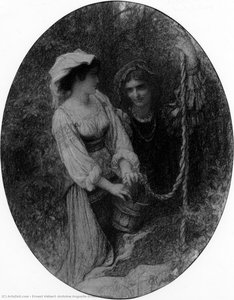
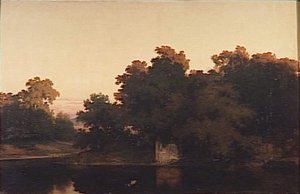
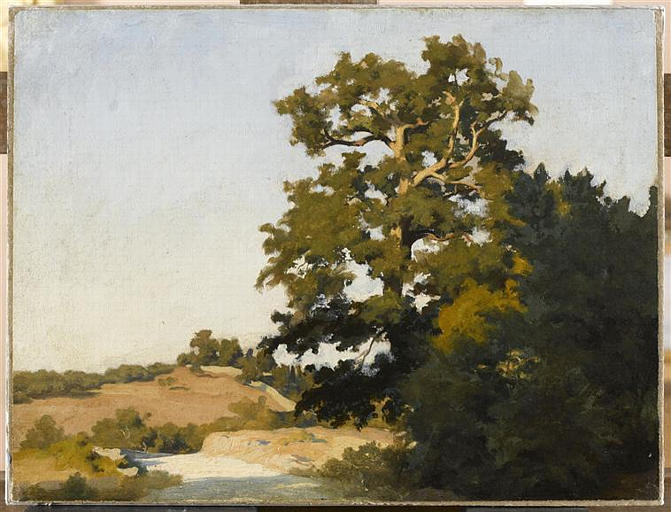
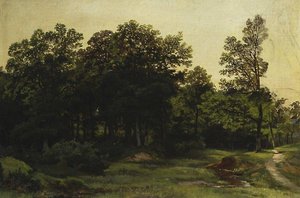
SENTIER VERS MARINO


 Read More
Giclée / Art Print
Museum-quality giclée or canvas print with fast production and flexible finish options. ( Buy Hand Made Painting Buy Image)




































Pick from our preset sizes that match the artwork's original proportions.

You may enter your own dimensions to fit a specific frame or space. If your selected size does not match the original image's proportions, we will either crop the artwork or extend the image with a mirrored or solid-fill edge. A digital mockup will be sent for your approval before production begins.
Please note that the on-screen preview does not reflect the actual cropping or extension. Only the mockup will accurately show the final composition.
While custom sizes are available, we recommend selecting a dimension from the predefined list to preserve the original proportions.
Worldwide Delivery () in 2 weeks instead of standard 4/5 weeks. (17 August)

Free Worldwide Express Shipping

High-Quality Linen Canvas

Full Shipping Insurance

Customs Tax Refund Guarantee

True Color Matching Guarantee

60-Day Return Policy (Defects Only)

100% Money-Back Guarantee

Bulk Discount Offer
 Glass option is only available in size under 110 CM

SENTIER VERS MARINO
Giclée / Art Print
Reproduction Size
-


Total Price
$ 63
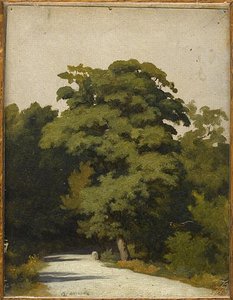
Related Artworks
Artist Biography
Ernest Hébert: A Parisian Romantic Capturing the Essence of Italy
Antoine Auguste Ernest Hébert (1817-1908), a name perhaps less familiar than many of his 19th-century contemporaries, nevertheless represents a significant figure in French academic painting. Born in Grenoble and nurtured by a family steeped in legal tradition, Hébert’s artistic journey began not through formal training alone, but with a self-directed passion ignited by the tutelage of sculptors and history painters. This unconventional start shaped his distinctive style – one characterized by meticulous detail, a profound understanding of light and shadow, and an undeniable romantic sensibility.
Hébert’s early life in Grenoble instilled a deep appreciation for the natural world, a theme that would become central to his artistic output. Moving to Paris at the age of eighteen, he immersed himself in the vibrant art scene, studying under both David d'Angers and Paul Delaroche – masters who exposed him to classical techniques and historical narrative. However, it was his time in Rome, awarded through the prestigious Prix de Rome in 1839, that truly crystallized his artistic vision. The scholarship afforded him a lengthy period of study at the Villa Medici, allowing him to absorb the grandeur of Italian landscapes and culture, experiences which would profoundly influence his later works.
The Influence of Italy and Academic Tradition
Hébert’s most celebrated work, “La Mal'aria” (1848-49), now housed in the Musée d’Orsay, exemplifies this Italian influence. The painting depicts a poignant scene of a peasant family fleeing an outbreak of malaria along the canals of Venice – a subject that resonated deeply with the Romantic movement’s fascination with suffering and the sublime. Yet, Hébert doesn't simply portray a dramatic event; he meticulously renders every detail—the worn clothing, the weathered faces, the shimmering water—with astonishing realism. This commitment to academic precision, honed during his Roman studies, is evident throughout his oeuvre.
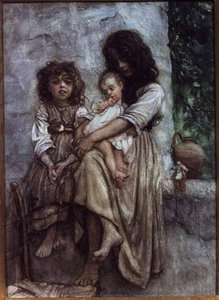
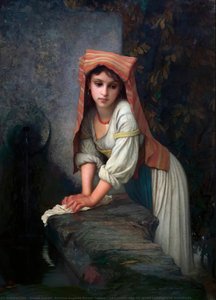
His Italian series, however, extended beyond mere picturesque landscapes. Hébert sought to capture the essence of Italian life – its people, its customs, and its atmosphere. He painted scenes of shepherds tending their flocks, fishermen casting their nets, and families gathering in sun-drenched piazzas. These works are not merely depictions of scenery; they’re imbued with a sense of melancholy and nostalgia, reflecting Hébert's own observations of the fading traditions of rural Italy.
A Parisian Salon Star
Despite his time abroad, Hébert remained firmly rooted in Paris, becoming a prominent figure at the prestigious Salon exhibitions. His paintings consistently garnered critical acclaim, securing him numerous commissions and establishing him as one of the leading academic painters of his era. He was even appointed director of the French Academy in Rome twice, a testament to his standing within the artistic community.
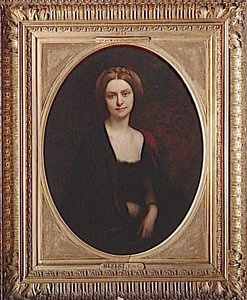
Beyond landscapes, Hébert excelled at portraiture, capturing the likenesses of prominent figures from Parisian society. His portraits are notable for their elegance and psychological depth, revealing not only the outward appearance but also the inner character of his subjects. These works demonstrate a remarkable ability to convey personality through subtle gestures and expressions.
Legacy and Musée Hébert
Ernest Hébert’s legacy extends beyond his individual paintings. He established the Musée Hébert in Paris, now known as the National Ernest Hébert Museum, which houses an extensive collection of his works alongside a remarkable ensemble of historic rooms that offer a glimpse into 19th-century Parisian life. The museum serves as a vital resource for scholars and art enthusiasts alike, ensuring that Hébert’s artistic contributions are preserved and celebrated.
His work continues to be studied and appreciated for its technical mastery, its evocative imagery, and its poignant portrayal of the human condition. Ernest Hébert remains a compelling example of an artist who successfully blended academic rigor with Romantic sensibility, leaving behind a rich and enduring body of art that reflects both the beauty and the melancholy of 19th-century France.
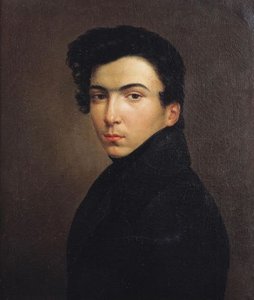
ernest hébert (antoine auguste ernest hebert)
1817 - 1908 , France
Quick Facts
- Artistic Movement Or Style: Academic Realism, Romantic
- Artists Or Movements Influenced By This Artist: ['Paul Trouillebert']
- Artists Who Influenced This Artist:
- David d’Angers
- Paul Delaroche
- Date Of Birth: November 3, 1817
- Date Of Death: December 5, 1908
- Full Name: Antoine Auguste Ernest Hébert
- Nationality: French
- Notable Artworks:
- Portrait de Madame Janvier d'Attainville
- Young girls of Ischia
- Study for Les Filles d'Alvito
- La Païva
- Place Of Birth: Grenoble, France
Related Articles

Romantic Landscapes: 10 Masterpieces for Your Home | ArtsDot
Journey through 10 Romantic landscape masterpieces by Friedrich, Turner & Cole. Explore emotional art, sublime nature scenes & iconic 19th-century paintings. Find museum-quality reproductions for your home at ArtsDot.com – discover the full collection online!

Evoking Nature's Sublime: A Comprehensive Exploration of 19th-Century Landscape Painting
Explore the captivating world of 19th-century landscape painting! Discover renowned artists like Friedrich & Monet, key movements, and find the perfect artwork to bring nature's serenity into your home. Expert insights at ArtsDot.
Ernest Hébert: A Master of Academic Realism & Parisian Salon Success
Explore the captivating world of Ernest Hébert, a master of 19th-century academic realism. Discover his Salon successes, stunning portraits & Italian landscapes. Learn about his legacy and find high-quality reproductions at ArtsDot.

Beyond the Horizon: 10 Landscape Masterpieces for Your Home Decor
Journey through 10 breathtaking landscape paintings by Monet, Van Gogh & more! Explore iconic artworks, artistic techniques & find inspiration for your home decor. Museum-quality reproductions at ArtsDot.com. Discover all masterpieces on ArtsDot.com

Evoking Emotion & Transcendence: Romantic Landscape Painting (18th-19th Century)
Explore the emotional depth of Romantic landscape painting (18th-19th century). Discover key artists like Friedrich & Cole, and the concepts of the sublime. Expert insights for art lovers & collectors.