 Preview
 Send
Send Share
Share
 Details

 Download
 Similars
 X-Ray
X-Ray Diaporama
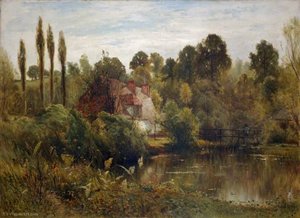
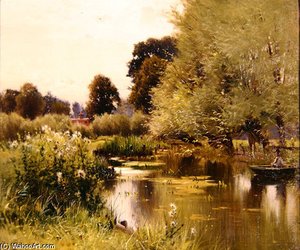
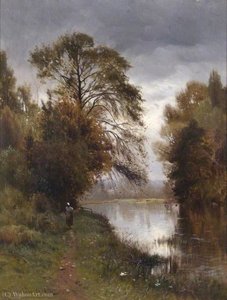
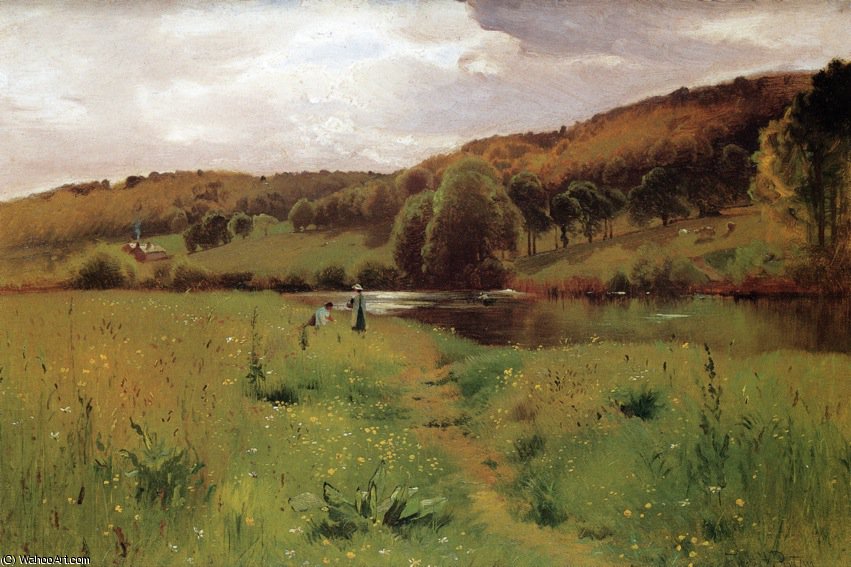
Springtime on the Thames - England
 Read More
Hand Made Oil Reproduction
Hand-painted oil on canvas in your size and frame, made to order by our artists. ( Buy Print Buy Image)




































Pick from our preset sizes that match the artwork's original proportions.

You may enter your own dimensions to fit a specific frame or space. If your selected size does not match the original image's proportions, we will either crop the artwork or extend the painting with additional hand-painted elements. A digital mockup will be sent for your approval before production begins.
Please note that the on-screen preview does not reflect the actual cropping or extension. Only the mockup will accurately show the final composition.
While custom sizes are available, we recommend selecting a dimension from the predefined list to preserve the original proportions.
After order, ArtsDot.com team will email client for instructions and provide a mockup preview
Worldwide Delivery () in 3/4 weeks instead of standard 5 weeks. (17 August). No compromise on quality.

Free Worldwide Express Shipping

High-Quality Linen Canvas

Full Shipping Insurance

Customs Tax Refund Guarantee

True Color Matching Guarantee

60-Day Return Policy (Defects Only)

100% Money-Back Guarantee

Bulk Discount Offer
 Glass option is only available in size under 110 CM

Springtime on the Thames - England
Reproduction Medium
Reproduction Size
-


Total Price
$ 263
Related Artworks
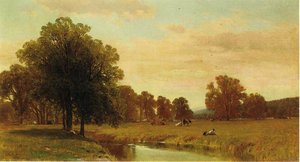
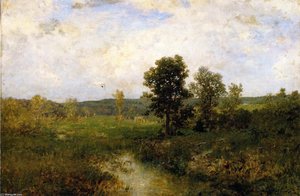
Artist Biography
The Ethereal Landscapes of Ernest Parton
Born in the scenic Hudson Valley in 1845, Ernest Parton emerged as a painter capable of capturing the very soul of the American wilderness. His life and work serve as a bridge between the grand, sweeping narratives of the Hudson River School and the more intimate, light-drenched sensibilities of Impressionism. Growing up in Hudson, New York, Parton was immersed in an environment where the landscape was not merely a backdrop but a profound subject of spiritual and aesthetic inquiry. His early years were shaped by the atmospheric majesty of the region, a setting that would later manifest in his canvases as tranquil, almost otherworldly vistas that seem to exist in a state of perpetual twilight or morning mist.
The development of Parton’s technique was a sophisticated evolution from academic rigor to expressive freedom. His formal training at the Yale University School of Fine Arts provided him with a foundation in meticulous detail and structural precision. This academic discipline allowed him to master the complexities of light, shadow, and texture, ensuring that even his most dreamlike compositions possessed a grounding sense of realism. However, as the art world shifted toward the fleeting impressions of the late 19th century, so too did Parton’s brushwork. He began to move away from the rigid, highly finished surfaces of his predecessors, embracing a more fluid approach where broken color and loose strokes could evoke the shimmering quality of air and water.
Influences and Artistic Vision
Parton’s oeuvre is deeply indebted to the luminaries of American landscape painting. The influence of Frederic Church and Asher B. Durand is unmistakable in his ability to utilize atmospheric perspective to create immense depth. From these masters, he learned how to use tonal harmonies to convey a sense of the sublime, making the viewer feel the vastness and the quiet power of nature. Yet, Parton possessed a unique sensitivity that distinguished him from the purely monumental style of the Hudson River School. He often turned his gaze toward more intimate subjects—a secluded pond, a shaded woodland, or a gentle hillside—imbued with an ethereal, almost fairy-tale quality.
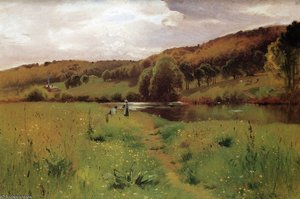
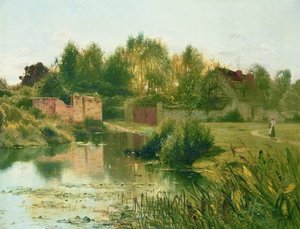
This stylistic duality is perhaps best exemplified in works such as “The Village Pond,” where the artist demonstrates a masterful command of Impressionistic light. In such paintings, the meticulous attention to botanical detail remains, but it is softened by a palette that dances with light and shadow, creating a sense of movement and atmosphere. His work often feels less like a documented record of a place and more like a memory or a dream, capturing those ephemeral moments when the sun breaks through a canopy of leaves or when mist clings to the surface of a still lake.
Legacy and Recognition
Throughout his career, Parton sought recognition within the most prestigious artistic circles of his era. His paintings were featured in significant exhibitions, including the Pennsylvania Academy of Fine Arts and the Société Nationale des Beaux-Arts in Paris. These appearances placed him in conversation with the leading international movements of his time, allowing his American landscapes to be viewed through a global lens of artistic excellence. While he may have remained somewhat underappreciated by the mainstream critics during his lifetime, his contribution to the American landscape tradition is undeniable.
Today, the significance of Ernest Parton lies in his ability to harmonize two seemingly opposing worlds: the structured realism of the academic tradition and the emotive, light-focused spirit of Impressionism. His legacy is found in the quiet reverence he commands for the natural world, inviting modern viewers to rediscover the enchantment of the American landscape through a lens of profound tranquility and enduring beauty.
ernest parton
1845 - 1938 , United States of America
Quick Facts
- Artistic Movement Or Style: Academic Painting
- Date Of Birth: 1845
- Full Name: Ernest Parton
- Nationality: American
- Notable Artworks:
- Landscape in Derbyshire
- The Village Pond
- Place Of Birth: Hudson, United States of America