 Preview
 Send
Send Share
Share
 Details

 Download
 Similars
 X-Ray
X-Ray Diaporama
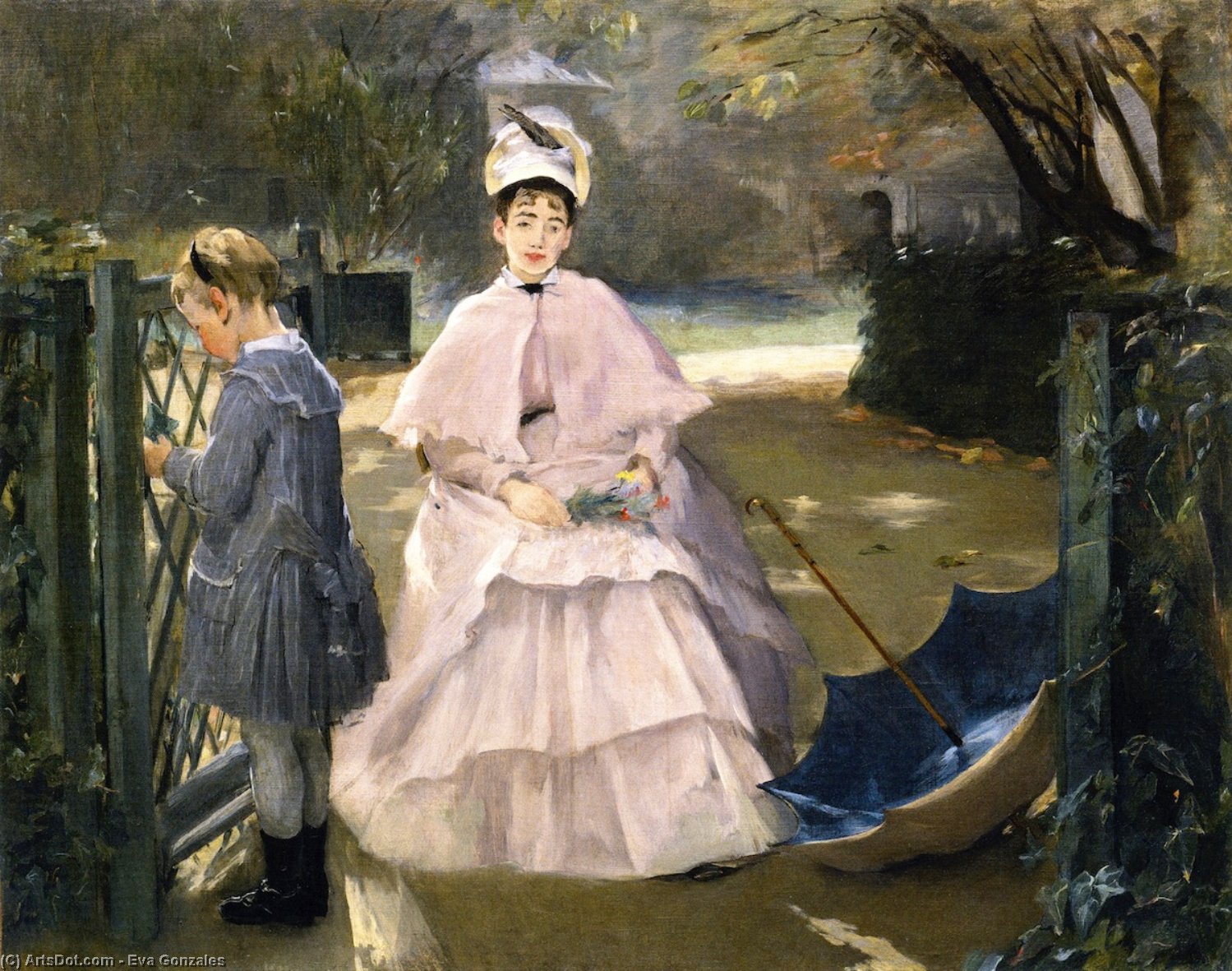
Nanny and Baby
 Acrylic On Canvas
- WallArt
- Impressionism
 1877
1877 65.0 x 82.0 cm
 National Gallery of Art
 Read More
Hand Made Oil Reproduction
Hand-painted oil on canvas in your size and frame, made to order by our artists. ( Buy Print Buy Image)




P118B $10

P118H $10

P118W $10

P438Z $10

P508JH $12

P508YH $12

P805H $10

P805Z $10

P919BZ $10

P919G $10

P919XJ $10

P959ZH $10

P968JZ $12

W106C $8

W218G $10

W218JH $8

W218Y $10

W307PJ $10

W316G $10

W316PJ $8

W316Y $10

W398PJ $8

W4111J $10

W500HY $15

W500JH $15

W692G $12

W849H $8

W940BG $15

W953PJ $8




Pick from our preset sizes that match the artwork's original proportions.

You may enter your own dimensions to fit a specific frame or space. If your selected size does not match the original image's proportions, we will either crop the artwork or extend the painting with additional hand-painted elements. A digital mockup will be sent for your approval before production begins.
Please note that the on-screen preview does not reflect the actual cropping or extension. Only the mockup will accurately show the final composition.
While custom sizes are available, we recommend selecting a dimension from the predefined list to preserve the original proportions.
After order, ArtsDot.com team will email client for instructions and provide a mockup preview
Worldwide Delivery () in 3/4 weeks instead of standard 5 weeks. (16 August). No compromise on quality.

Free Worldwide Express Shipping

High-Quality Linen Canvas

Full Shipping Insurance

Customs Tax Refund Guarantee

True Color Matching Guarantee

60-Day Return Policy (Defects Only)

100% Money-Back Guarantee

Bulk Discount Offer
 Glass option is only available in size under 110 CM

Nanny and Baby
Reproduction Medium
Reproduction Size
-


Total Price
$ 288
Artwork Description
Nanny and Baby: An Impressionist Portrait of Domestic Tranquility
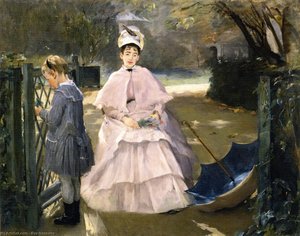
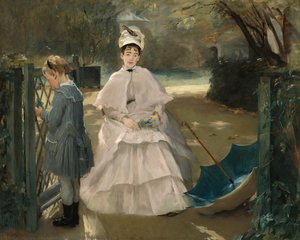
Eva Gonzalès’ “Nanny and Baby,” painted in 1877, stands as a quintessential example of Impressionism—a movement that sought to capture fleeting moments of everyday life with remarkable sensitivity to light and color. Currently residing at the National Gallery of Art in Washington D.C., this oil on canvas piece transcends mere depiction; it embodies an atmosphere of quiet contemplation and subtle melancholy, reflecting the artistic spirit of its time.- Style & Composition: The painting’s harmonious balance centers around a seated nanny—dressed in opulent attire—and her infant charge positioned near a wrought iron gate overlooking a verdant park landscape. Gonzalès skillfully employs loose brushstrokes and layering techniques characteristic of Impressionism, prioritizing tonal relationships over precise detail to convey the essence of the scene. Lines define forms with graceful curves, mirroring the organic shapes of trees and foliage, creating depth and enhancing the overall visual experience.
- Technique & Materials: Gonzalès’ masterful use of oil paints allows for a rich palette—dominated by muted greens, browns, and pale pinks—that captures the diffused light filtering through the trees. Bold brushstrokes contribute to an energetic feel, while subtle blending creates soft textures that evoke a sense of warmth and tranquility. The artist's signature adorns the gate door near the lower left corner, underscoring her dedication to capturing authentic emotion.
- Historical Context: Created during the Belle Époque—a period marked by optimism and artistic experimentation— “Nanny and Baby” aligns with the broader Impressionist preoccupation with portraying domestic life as experienced by women. It echoes the stylistic innovations pioneered by artists like Edgar Degas and Pierre-Auguste Renoir, who similarly explored themes of femininity and observation within urban environments.
- Symbolism & Emotional Impact: Beyond its aesthetic beauty, “Nanny and Baby” speaks to deeper considerations about motherhood, family life, and the passage of time. The nanny’s gaze—directed outwards—suggests a moment of reflection amidst the bustle of daily routines, inviting viewers to contemplate the significance of simple gestures and connections.
- Connections & Similar Artists: Consider comparing Gonzalès' work with Degas’ “Portrait of Mademoiselle Malo” (available on ArtsDot.com) – both pieces demonstrate a similar commitment to capturing psychological nuance alongside visual realism. Furthermore, explore the impressive Impressionist collection housed at the Rhode Island School of Design Museum of Art—a testament to the enduring legacy of artists like Gonzalès and Renoir.
Related Artworks
Artist Biography
A Parisian Life in Paint: The World of Eva Gonzalès
Eva Gonzalès, born into the vibrant cultural landscape of 1849 Paris, occupies a fascinating yet often understated position within the history of Impressionism. While frequently mentioned alongside luminaries like Monet, Renoir, and Degas, her story is one of navigating societal expectations and forging an artistic identity in a world that wasn’t always ready to acknowledge female talent. Daughter to writer Emmanuel Gonzalès and a mother skilled in music, she was immersed from childhood in the intellectual and artistic circles of Parisian society. This privileged upbringing provided access – through her father's connections within the Société des gens de lettres – to a network of influential figures who shaped the burgeoning art scene. It wasn’t merely exposure; it was an invitation into a world brimming with new ideas about representation, light, and the very purpose of art itself. Her formal artistic training began at sixteen under Charles Chaplin, a respected portraitist, but her trajectory truly shifted in 1869 when she became the only formal student of Édouard Manet.Under Manet’s Wing: Formation and Early Works
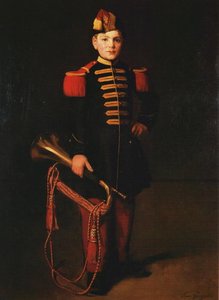
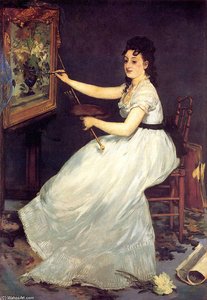
The relationship between Gonzalès and Manet was pivotal. He painted her portrait in 1870, a work titled *Mlle E.G.* that, while celebrated for its depiction of a modern woman artist, inadvertently highlighted the challenges she faced. The painting presents Gonzalès at an easel, yet critics often remarked on the incongruity between her elegant attire and the perceived practicality of artistic labor. This sparked commentary suggesting she was more model than creator, a beautiful adornment to Manet’s world rather than an independent force. Despite this initial reception, Manet's influence on Gonzalès was profound. She absorbed his techniques – the loose brushwork, the emphasis on tonal values, and the focus on contemporary life – but she wasn’t simply a mimic. Even in her early works, like *Enfant de troupe* (1870), a clear nod to Manet's *Le Fifre*, Gonzalès began to infuse her paintings with a delicate sensibility and an attention to detail that would become hallmarks of her style. She skillfully balanced the lessons learned from Manet with her own emerging artistic voice, exploring themes of domesticity, portraiture, and the everyday lives of women.A Unique Impressionist Voice: Style and Subject Matter
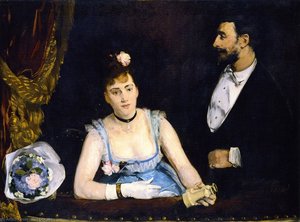
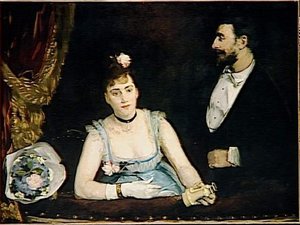
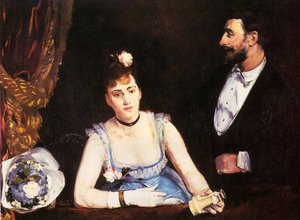
Gonzalès’s work distinguishes itself within the broader Impressionist movement through its intimate scale and focus on interior scenes. While many of her contemporaries sought to capture fleeting moments outdoors, she often turned inward, depicting women in private settings – reading, sewing, or simply lost in thought. Her paintings are characterized by a refined palette, subtle harmonies, and a remarkable sensitivity to light and texture. Critics frequently noted a “feminine technique” in her work, sometimes as praise, other times as a dismissive categorization. However, this perceived delicacy shouldn’t be mistaken for weakness. Her painting *Une loge aux théâtre italiens* (1874), rejected by the Salon jury for its "masculine vigor" – ironically questioning its authenticity as a woman's work – demonstrates a boldness and compositional strength that defied expectations. She consistently received positive reviews, with critics like Louis Leroy and Émile Zola praising her intuitive approach to art and technical skill. Maria Deraismes championed Gonzalès for challenging conventional views of female painters, recognizing her contribution to the evolving Parisian art scene.Legacy and Historical Significance
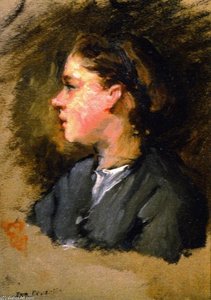
Though she never exhibited with the Impressionists themselves – preferring the more traditional venue of the Salon – Eva Gonzalès is rightfully considered a part of their circle. Her untimely death in 1883, just five days after Manet’s passing, at the age of thirty-four cut short a promising career. A retrospective exhibition held in 1885 showcased eighty-eight of her works, but it was often overshadowed by discussions of her association with Manet. For decades, Gonzalès remained somewhat obscured by the more prominent figures of Impressionism. However, recent scholarship has begun to reassess her contributions, recognizing her as a significant artist in her own right. Her paintings offer a unique perspective on 19th-century Parisian life, filtered through the lens of a woman navigating both artistic ambition and societal constraints. Her legacy lies not only in the beauty and sensitivity of her work but also in her quiet defiance of expectations, paving the way for future generations of female artists to claim their place within the art historical canon. Her paintings, such as *Nanny and Baby* and *Portrait of Jeanne Gonzalès in Profile*, continue to captivate viewers with their intimate charm and subtle power, reminding us that the story of Impressionism is richer and more complex than often portrayed.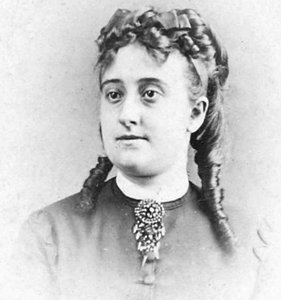
Eva Gonzalès
1849 - 1883 , France
Quick Facts
- Artistic Movement Or Style: Impressionism
- Artists Who Influenced This Artist:
- Édouard Manet
- Charles Chaplin
- Date Of Birth: 1849
- Date Of Death: 1883
- Full Name: Eva Gonzalès
- Nationality: French
- Notable Artworks:
- Mlle E.G.
- Enfant de troupe
- Box at the théâtre des italiens
- Nanny and Baby
- Jeanne Gonzales in Profile
- Place Of Birth: Paris, France
Related Articles

Impressionist Landscapes: 10 Masterpieces for Your Home | ArtsDot
Journey through 10 iconic Impressionist landscapes by Monet, Renoir & Degas. Explore the history, techniques & emotions behind these masterpieces. Find museum-quality reproductions for your home at ArtsDot.com – where art comes to life! Discover all masterpieces on ArtsDot.com
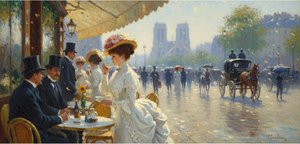
Impressionistic Realism's Finest: 10 Masterpieces for Your Home | ArtsDot
Journey through Impressionistic Realism with 10 iconic masterpieces by Monet, Renoir & Van Gogh. Explore art history, techniques & find museum-quality reproductions for your home at ArtsDot.com. Discover all masterpieces online!

Renoir's Masterpieces: Explore 25 Iconic Paintings & Bring Art Home | ArtsDot
Explore 25 iconic Pierre-Auguste Renoir paintings! Discover the stories behind Impressionist masterpieces like 'Dance at Le Moulin de la Galette' & 'Luncheon of the Boating Party'. Find museum-quality art reproductions and elevate your home decor with ArtsDot.com.
Impressionistic Landscapes: 10 Masterpieces That Changed Art & Decor
Journey into the heart of Impressionism! Explore 10 masterpieces by Monet, Renoir & Degas that revolutionized landscape art. Discover their stories, techniques & find museum-quality reproductions to elevate your home decor on ArtsDot.com.

Capturing Light & Emotion: A Beginner's Guide to the Impressionist Aesthetic
Discover the beauty of Impressionism. Learn how masters like Monet and Renoir use light and color to evoke emotion, and explore how to bring this luminous aesthetic into your home with museum-quality, hand-painted reproductions.