

 Preview
 Send
Send Share
Share
 Details

 Download
 Similars
 X-Ray
X-Ray Diaporama
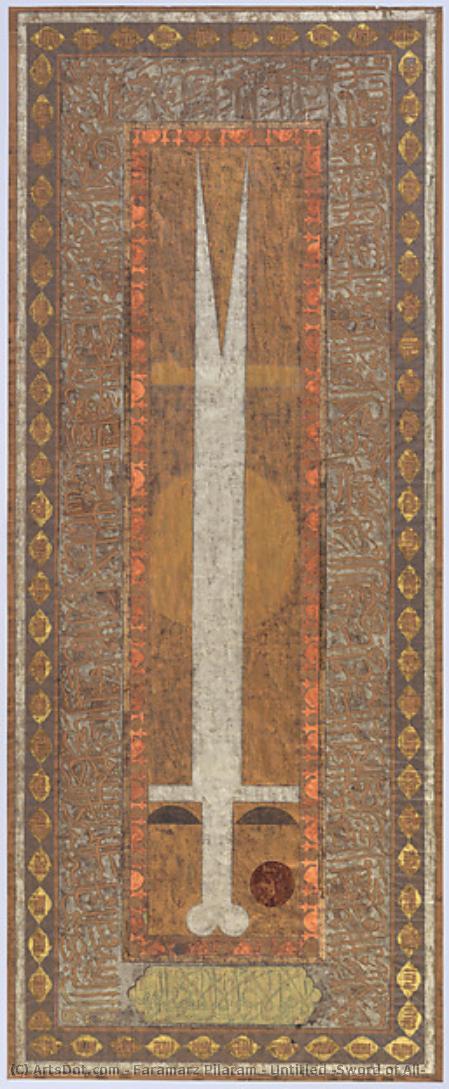
Untitled (Sword of Ali)
 1960
1960 148.0 x 61.0 cm
 Read More
Purchase a high-resolution, enhanced digital image, far superior to the online preview.
Each file is meticulously prepared by our in-house specialists using advanced tools and expert manual retouching. We ensure every image has exceptional clarity, precise color accuracy, and fine detail.
The final file is delivered via email within 72 hours, optimized for immediate use in professional, editorial, and print environments. This is the same quality trusted by top-tier design studios, publishers, and galleries.
Digital Image
Download a high-resolution file for personal display, printing, and creative projects. ( Buy Print Buy Hand Made Painting)
Included in Every Digital Image Order
Expert Digital Delivery, Guaranteed
When you choose ArtsDot.com, you're not just getting an image - you're receiving a professionally enhanced digital artwork, crafted with precision and backed by a satisfaction guarantee. Here's everything that comes with your order, automatically:

Fast Email Delivery
Your high-resolution digital image file will be emailed to you within 72 hours of ordering - ready for immediate use.

AI-Enhanced Digital File
Your artwork is professionally optimized using advanced AI tools and manual editing, ensuring maximum detail, clarity, and color accuracy.

Free Lifetime Re-Delivery
Accidentally deleted or lost your file? No worries - we'll resend it to you anytime, free of charge.

No Import Fees - Ever
Enjoy your artwork instantly with zero customs, duties, or delivery fees - digital downloads are always tax-free.

Color Accuracy Guarantee
We ensure your digital image reflects the original colors as closely as possible using professional tools and color management.

60-Day Satisfaction Guarantee
If you're not satisfied with your digital image, we'll revise it or refund 100% within 60 days - no questions asked.

100% Money-Back Guarantee
Not satisfied? Get a full refund within 60 days of receiving your digital file - no questions asked.

Bulk Order Discounts
Buy 3 images, save 10% - Buy 5, save 15% - Buy 10+, save 20%. Great for creative projects, galleries, and agencies.
Collectible Description
Related Artworks







Artist Biography
The Visionary of Saqqakhaneh: The Life and Legacy of Faramarz Pilaram
In the vibrant tapestry of twentieth-century Iranian art, few names resonate with as much transformative power as Faramarz Pilaram. A true pioneer of Iranian Modernism, Pilaram did not merely paint; he sought to bridge the ancient soul of Persia with the radical pulse of contemporary abstraction. Born in Tehran on April 10, 1937, his journey was one of profound synthesis, where the delicate traditions of Persian miniature painting met the bold, experimental spirit of the Saqqakhaneh school. His life’s work stands as a testament to the idea that heritage is not a static relic of the past, but a living, breathing language capable of infinite reinvention.
Pilaram’s artistic foundation was laid within the prestigious halls of Jalil Ziapour's School of Decorative Arts for Boys. It was here, amidst the rigorous study of classical aesthetics, that he encountered masters such as Mahmoud Farshchian and Shookoh Riazi. This early immersion in traditional Persian conventions provided him with a deep reservoir of cultural symbols—motifs of mythology, calligraphy, and geometric intricacy—that would later serve as the raw materials for his modernist explorations. After graduating from Tehran University’s Faculty of Decorative Arts in 1965 and earning a master's degree in painting and interior design in 1968, Pilaram emerged not just as a skilled technician, but as an intellectual force capable of reshaping the visual identity of a nation.
A Trilogy of Evolution: From Figure to Calligraphy
The brilliance of Pilaram’s oeuvre lies in its remarkable evolutionary arc, which can be viewed through three distinct yet interconnected stylistic periods. His early career was marked by figurative representation, where he explored the human form and narrative storytelling. As his vision matured, he transitioned into a decorative phase, characterized by complex compositions infused with geometric patterns and rhythmic ornamentation. This period saw him experimenting with the structural beauty of Persian design, creating works that felt both ancient and avant-garde.
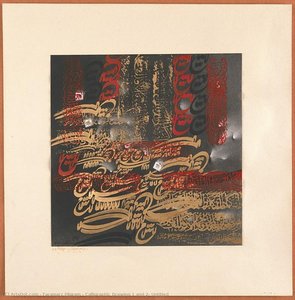
However, it was in his final, most expressive stage that Pilaram truly found his definitive voice: calligraphic abstraction. In this era, the written word was liberated from its literal meaning, transformed into a purely visual element of motion and energy. By utilizing scripts such as shikasta and naskhi, he turned letters into sweeping gestures of gold and red, where the overlap and rotation of characters created a sense of spiritual depth. In these works, the boundary between reading and seeing dissolved, allowing the viewer to experience the rhythm of the script as a visceral, emotional landscape.
The Saqqakhaneh Movement and Historical Significance
Pilaram was far more than a solitary creator; he was a central architect of a collective revolution. In 1964, he played a pivotal role in establishing the Iran Gallery (Tālār-e Iran), a collaborative venture that brought together a cohort of visionary artists including Mansoor Ghandriz and Massoud Arabshahi. This group became the heartbeat of the Saqqakhaneh school, a neo-traditionalist movement that sought to revitalize Iranian identity by reclaiming sacred and folk motifs—such as the swords of legendary heroes or the symbolic use of metallic orbs—and recontextualizing them within the framework of global modernism.
His contributions extended deeply into the academic and social fabric of Iran. As a professor at the Iran University of Science and Technology from 1972 to 1980, he nurtured the next generation of artists, ensuring that his philosophy of cultural synthesis would endure. Though his life was tragically short, ending in 1983, the impact of Faramarz Pilaram remains indelible. He successfully navigated the tension between the local and the universal, proving that an artist could be deeply rooted in their specific heritage while simultaneously speaking a language understood by the entire world.
Faramarz Pilaram
1937 - 1983 , Iran
Quick Facts
- Artistic Movement Or Style: Saqqakhaneh School
- Artists Or Movements Influenced By This Artist: ['Iranian Modern Art']
- Artists Who Influenced This Artist:
- Mahmoud Farshchian
- Shokouh Riazi
- Date Of Birth: April 10, 1937 Tehran, Iran
- Date Of Death: September 1983
- Full Name: Faramarz Pilaram
- Nationality: Iranian
- Notable Artworks:
- Untitled (Sword of Ali)
- Calligraphic Drawing 1 and 2, Untitled
- Place Of Birth: Tehran, Iran

