Preview
 Send
Send Share
Share
 Details

 Download
 Similars
 X-Ray
X-Ray Diaporama
 Stats
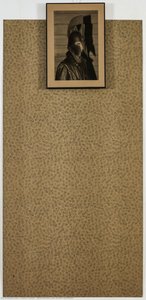
StatsAutoritratto con occhio luminoso
 100.0 x 210.0 cm
 Ministero degli Affari Esteri e della Cooperazione Internazionale. Collezione Farnesina
 Read More
Giclée / Art Print
Museum-quality giclée or canvas print with fast production and flexible finish options. ( Buy Hand Made Painting Switch to Digital Image)




































Pick from our preset sizes that match the artwork's original proportions.

You may enter your own dimensions to fit a specific frame or space. If your selected size does not match the original image's proportions, we will either crop the artwork or extend the image with a mirrored or solid-fill edge. A digital mockup will be sent for your approval before production begins.
Please note that the on-screen preview does not reflect the actual cropping or extension. Only the mockup will accurately show the final composition.
While custom sizes are available, we recommend selecting a dimension from the predefined list to preserve the original proportions.
Worldwide Delivery () in 2 weeks instead of standard 4/5 weeks. (17 September)

Free Worldwide Express Shipping

High-Quality Linen Canvas

Full Shipping Insurance

Customs Tax Refund Guarantee

True Color Matching Guarantee

100-Day Return Policy (Defects Only)

100% Money-Back Guarantee

Bulk Discount Offer
 Glass option is only available in size under 110 CM

Autoritratto con occhio luminoso
Giclée / Art Print
Reproduction Size
-


Total Price
$ 63
Related Artworks










Artist Biography
A Life Submerged in Myth: The Art of Felice Levini
Felice Levini, born in Rome in 1956, is an artist whose work feels intrinsically linked to the ancient heart of his city—a place where layers of history are not merely visible but palpable. His artistic journey began with formal training at the Academy of Fine Arts, yet quickly diverged into a more experimental path. In 1978, alongside fellow artists Giuseppe Salvatori and Claudio Damiani, Levini co-founded an exhibition space on Via S. Agata dei Goti, fostering a vibrant community centered around both visual art and poetry. This early initiative wasn’t simply about showcasing work; it was about creating dialogue, establishing a network of creative exchange that would prove formative for the burgeoning Roman art scene. His debut in “Artericerca ’78” at the Palazzo delle Esposizioni marked an initial foray into public recognition, but it was his involvement with the “Nuovi-Nuovi” group in 1980—curated by the influential Renato Barilli—that truly positioned him within a broader artistic discourse.Decomposition and Decorative Symbolism
Levini’s art is characterized by a fascinating process of decomposition, a deliberate dismantling of form that isn't destructive but rather transformative. Beginning in 1982, he began to explore techniques reminiscent of Seurat’s pointillist divisionism, creating images built from countless tiny elements. However, Levini’s intent wasn’t purely optical; these speckled surfaces weren’t about capturing light so much as evoking a sense of fragmentation and the passage of time. This led to highly decorative two-dimensional works that felt like glimpses into ancient mosaics or faded frescoes—a deliberate aesthetic choice that underscored his fascination with mythology and symbolism. As the 1980s progressed, his work evolved towards more three-dimensional forms, solid geometric structures that hinted at architectural spaces, yet remained imbued with a sense of ethereal lightness. Recurring motifs – self-portraits, animals, arabesques – began to populate these works, acting as visual anchors within the increasingly complex compositions.Mythology, Metaphysics and the Past
The core of Levini’s artistic vision lies in his engagement with the collective unconscious—the shared symbols, proverbs, and myths that shape cultural identity. He doesn't simply *represent* these icons; he interrogates them, stripping away their conventional meanings to reveal their underlying structures and operative power. His work isn’t nostalgic for a lost Edenic past but rather recognizes these images as fundamental building blocks of artistic expression, a “material and organizational structure” that informs poetics and formal values. This approach is evident in pieces featuring classical masks, funerary urns, or even the iconic “Mouth of Truth,” recontextualized within contemporary settings. He often employs repetition—a multitude of tiny skulls covering surfaces, for example—to abstract the image while simultaneously emphasizing its cultural weight. The resulting works are thought-provoking meditations on memory, tragedy, spectacle, and the enduring power of archetypes.Exhibitions and Recognition
Throughout his career, Levini’s work has been widely exhibited in prestigious institutions across Italy. His participation in the XXXIV Festival dei Due Mondi in Spoleto in 1991 brought his art to a wider audience, followed by inclusion in the XLV Venice Biennale in 1993 and the XII Quadrennial of Rome in 1996. A significant exhibition at the GNAM National Gallery of Modern Art in 2013 further solidified his position as a leading figure in contemporary Italian art. More recently, exhibitions like those at Galleria Niccoli have highlighted the ongoing relevance of his work, demonstrating its ability to resonate with new generations of viewers. His pieces are regularly featured in auction houses and analyzed by art critics, confirming his lasting impact on the artistic landscape.A Legacy of Symbolic Resonance
Felice Levini’s contribution to contemporary art lies not simply in his distinctive aesthetic—though that is undeniably compelling—but in his ability to create works that operate on multiple levels. He blends mythology and metaphysics with a deft hand, inviting viewers to contemplate the past, present, and the enduring power of symbols. His process of decomposition isn't about destruction but about revealing hidden layers of meaning, prompting us to question our own cultural assumptions and the ways in which we interpret images. His art is a testament to the idea that true creativity lies not in inventing new forms but in re-imagining existing ones, breathing new life into ancient icons and forging connections between seemingly disparate worlds. Levini’s work continues to evolve, yet remains steadfastly rooted in his exploration of the human condition and the enduring mysteries of existence.
felice levini
1956 - , Italy
Quick Facts
- Artistic Movement Or Style: Surrealism, Metaphysical Art
- Date Of Birth: 1956
- Full Name: Felice Levini
- Nationality: Italian
- Notable Artworks: ['Autoritratto con occhio luminoso']
- Place Of Birth: Rome, Italy