 Preview
 Send
Send Share
Share
 Details

 Download
 Similars
 X-Ray
X-Ray Diaporama
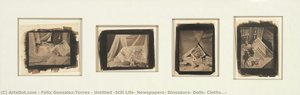
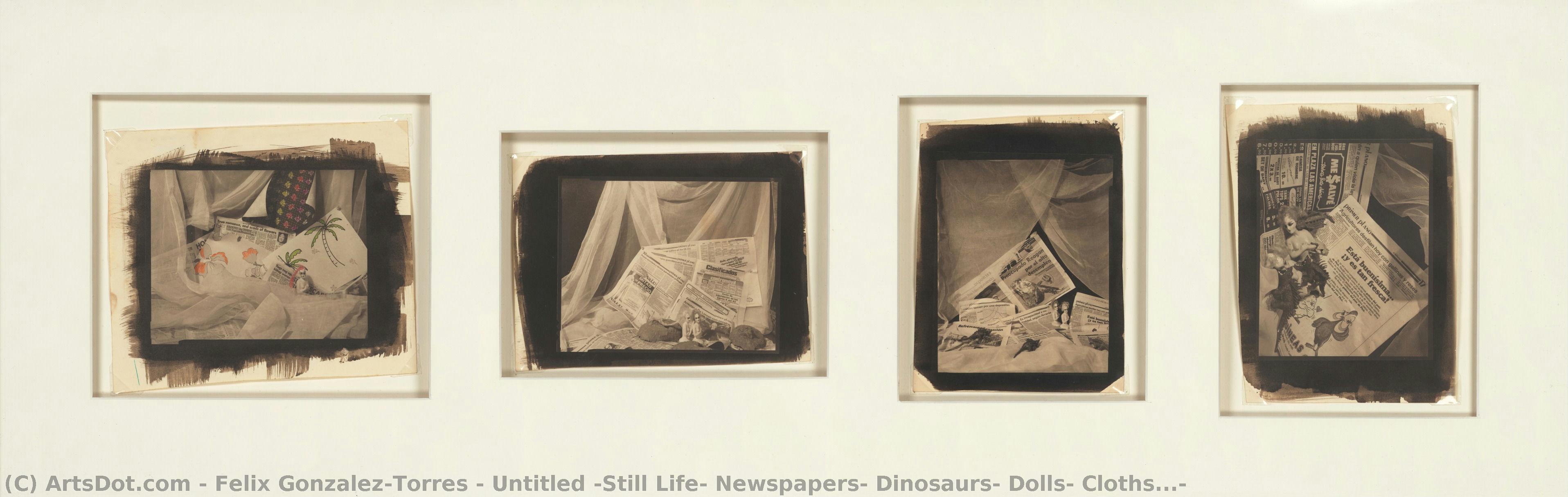
Untitled (Still Life: Newspapers, Dinosaurs, Dolls, Cloths...)


 Read More
Hand Made Oil Reproduction
Hand-painted oil on canvas in your size and frame, made to order by our artists. ( Buy Print Buy Image)




































Pick from our preset sizes that match the artwork's original proportions.

You may enter your own dimensions to fit a specific frame or space. If your selected size does not match the original image's proportions, we will either crop the artwork or extend the painting with additional hand-painted elements. A digital mockup will be sent for your approval before production begins.
Please note that the on-screen preview does not reflect the actual cropping or extension. Only the mockup will accurately show the final composition.
While custom sizes are available, we recommend selecting a dimension from the predefined list to preserve the original proportions.
After order, ArtsDot.com team will email client for instructions and provide a mockup preview
Worldwide Delivery () in 3/4 weeks instead of standard 5 weeks. (22 August). No compromise on quality.

Free Worldwide Express Shipping

High-Quality Linen Canvas

Full Shipping Insurance

Customs Tax Refund Guarantee

True Color Matching Guarantee

60-Day Return Policy (Defects Only)

100% Money-Back Guarantee

Bulk Discount Offer
 Glass option is only available in size under 110 CM

Untitled (Still Life: Newspapers, Dinosaurs, Dolls, Cloths...)
Reproduction Medium
Reproduction Size
-


Total Price
$ 263
Related Artworks









Artist Biography
A Life Shaped by Displacement and Loss
Félix González-Torres, born in Guáimaro, Cuba, in 1957, lived a life profoundly marked by displacement and loss—experiences that would become central themes in his deeply moving artistic practice. His early years were disrupted when he and his sister Gloria were sent to Madrid, Spain, as unaccompanied minors, navigating an orphanage before eventually finding refuge with relatives in Puerto Rico. This initial separation from homeland and family instilled a sense of longing and impermanence that resonated throughout his work. He pursued education at Colegio San Jorge, graduating in 1976, then immersed himself in the vibrant art scene at the University of Puerto Rico. However, it was his move to New York City in 1979, fueled by a study fellowship, that proved pivotal. The city became both his adopted home and the crucible for his artistic evolution. His formal training continued with a BFA in photography from the Pratt Institute of Art (1983) and an MFA from the International Center of Photography and New York University (1987), but it was his participation in the Whitney Independent Study Program, in both 1981 and 1983, that truly shaped his intellectual framework. Exposure to critical theory during this period provided a lens through which he would examine issues of identity, memory, and the social structures surrounding love and loss.Minimalism as a Vehicle for Profound Emotion
González-Torres is celebrated for his minimalist installations—works that often employ everyday materials like strings of lightbulbs, stacks of paper, clocks, and perhaps most famously, piles of wrapped candies. These seemingly simple arrangements are imbued with layers of meaning, functioning as poignant metaphors for absence, desire, and the ephemeral nature of life. His approach is fundamentally conceptual; he prioritized ideas and experiences over traditional artistic representation. The deliberate titling of his works—almost exclusively “Untitled” followed by a parenthetical description or date—further underscores this emphasis on open-endedness, rejecting fixed interpretations and inviting viewers to engage with the work on their own terms. A crucial element of many installations is audience participation. Viewers are often encouraged – even expected – to take candies from stacks, sheets of paper from piles, or interact with other elements, blurring the boundaries between artwork and life, and enacting a symbolic act of consumption and loss. This interactive quality isn’t merely playful; it directly addresses themes of absence and the ways in which we attempt to fill voids left by those we have lost.Love, Loss, and the Shadow of AIDS
Recurring motifs within González-Torres's oeuvre reveal a deeply personal narrative interwoven with broader social concerns. Love, particularly romantic love, is a central theme, often explored in relation to loss—a consequence tragically amplified by the AIDS crisis that ravaged the art community during his lifetime. “Untitled” (Portrait of Marcel Brient) (1992), which achieved a record-breaking $4.6 million at auction, exemplifies this approach; the seemingly endless stack of candies represents the weight of love and loss, diminishing as pieces are taken by viewers, mirroring the physical decline experienced by those afflicted with AIDS. “Untitled” (Perfect Lovers) (1991), featuring two clocks set to different times, speaks to the complexities of relationships and the inexorable passage of time. Perhaps most heartbreaking is "Untitled" (Placebo) (1991), a work that literally disappeared over time as pills were removed from a pile, directly reflecting his partner Ross Laycock’s illness and the slow erosion of life. Beyond personal experience, González-Torres also explored themes of identity—particularly LGBTQ+ identity—memory, public versus private spaces, and consumerism through his evocative installations and “Dateline” series, which presented lists of dates and events on paper, prompting reflection on history and social issues. His lightbulb installations, delicate strands that gradually burn out, serve as powerful symbols of fragility and the transient nature of existence.Influences and a Lasting Legacy
González-Torres’s artistic vision was shaped by several key influences. The aesthetic principles of Minimalism—its emphasis on simplicity, reduction, and geometric forms—are readily apparent in his work. He also drew heavily from Conceptual art's focus on ideas and processes over traditional artistic skills. Furthermore, the theories of Bertolt Brecht’s Epic Theater resonated with him; like Brecht, González-Torres aimed to engage viewers actively and critically, prompting them to question their own perceptions and assumptions. His involvement with Group Material, a collaborative artist collective focused on social activism, further solidified his commitment to art as a vehicle for political commentary. Tragically, Félix González-Torres succumbed to AIDS-related complications in Miami in 1996 at the young age of 39. However, his artistic legacy has only grown stronger in the years since his death. Numerous retrospective exhibitions have been organized, solidifying his place as a major figure in contemporary art, and a comprehensive catalogue raisonné was published in 1997 documenting his output. His work continues to be exhibited and studied worldwide, inspiring new generations of artists and scholars who grapple with themes of loss, memory, identity, and the power of art to connect us to one another. He remains a vital voice in contemporary discourse, reminding us of the enduring importance of empathy, remembrance, and social justice.
Felix Gonzalez-Torres
1957 - 1996 , Cuba
Quick Facts
- Artistic Movement Or Style: Minimalism, Conceptual Art
- Artists Or Movements Influenced By This Artist:
- Contemporary installation art
- Socially engaged art
- Artists Who Influenced This Artist:
- Bertolt Brecht
- Minimalist artists
- Date Of Birth: 1957
- Date Of Death: 1996
- Full Name: Félix González-Torres
- Nationality: American
- Notable Artworks:
- Untitled (Portrait of Marcel Brient)
- Untitled (Perfect Lovers)
- Untitled (Placebo)
- Place Of Birth: Guáimaro, Cuba