Preview
 Send
Send Share
Share
 Details

 Download
 Similars
 X-Ray
X-Ray Diaporama
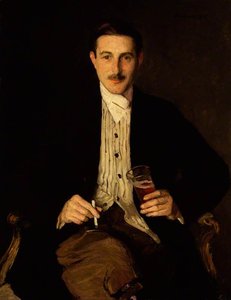
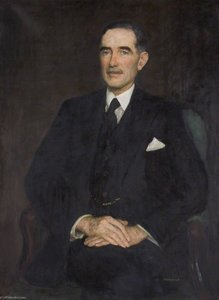
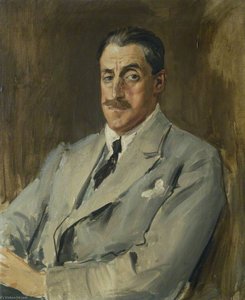
Clarence Napier Bruce (1885–1957), 3rd Lord Aberdare
 1947
1947 102.0 x 77.0 cm
 Read More
Giclée / Art Print
Museum-quality giclée or canvas print with fast production and flexible finish options. ( Buy Hand Made Painting Buy Image)




































Pick from our preset sizes that match the artwork's original proportions.

You may enter your own dimensions to fit a specific frame or space. If your selected size does not match the original image's proportions, we will either crop the artwork or extend the image with a mirrored or solid-fill edge. A digital mockup will be sent for your approval before production begins.
Please note that the on-screen preview does not reflect the actual cropping or extension. Only the mockup will accurately show the final composition.
While custom sizes are available, we recommend selecting a dimension from the predefined list to preserve the original proportions.
Worldwide Delivery () in 2 weeks instead of standard 4/5 weeks. (26 August)

Free Worldwide Express Shipping

High-Quality Linen Canvas

Full Shipping Insurance

Customs Tax Refund Guarantee

True Color Matching Guarantee

60-Day Return Policy (Defects Only)

100% Money-Back Guarantee

Bulk Discount Offer
 Glass option is only available in size under 110 CM

Clarence Napier Bruce (1885–1957), 3rd Lord Aberdare
Giclée / Art Print
Reproduction Size
-


Total Price
$ 63
Related Artworks








Artist Biography
A Legacy of Light and Line: The Life of Flora Lion
In the grand tapestry of early twentieth-century British art, few threads are as delicately woven yet structurally resilient as those left by Flora Marguerite Lion. Born in London in 1878 to a heritage that bridged the English and French worlds, Lion possessed an artistic sensibility shaped by the cosmopolitan elegance of her Anglo-Franco Jewish roots. Her lineage connected her to a profound cultural tradition, being related to the esteemed Solomon family, a dynasty of celebrated artists. This early immersion in a world where creativity was a primary language provided the foundation for a career that would eventually command respect at the highest levels of the Royal Academy and beyond.
Lion’s journey through the corridors of artistic excellence began with rigorous discipline. Her training was a masterclass in the classical traditions of her era, moving from the St. John’s Wood Art School in 1894 to the prestigious Royal Academy Schools between 1895 and 1899. It was during these formative years that she studied under the legendary John Singer Sargent, an influence that undoubtedly contributed to her ability to capture the ephemeral qualities of light and the dignified essence of her subjects. Seeking to expand her horizons beyond the British Isles, she traveled to Paris to attend the Académie Julian at the turn of the century, immersing herself in the vibrant, experimental atmosphere of the Belle Époque. This duality of training—the structured realism of London and the atmospheric impressionism of Paris—became the hallmark of her mature style.
The Art of the Human Spirit
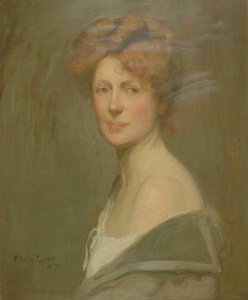
As her career flourished after 1900, Lion became a sought-after portraitist, known for her ability to render society figures with both meticulous accuracy and a profound psychological depth. Her canvases were never merely records of appearance; they were studies in character. Whether depicting the quiet elegance of a socialite or the weary strength of a laborer, her brushwork possessed a unique texture that balanced realism with an impressionistic softness. This versatility allowed her to move seamlessly between the intimate scale of private commissions and the grander narratives of public history.
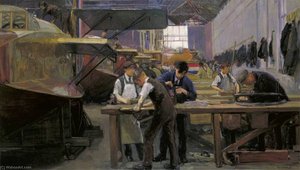
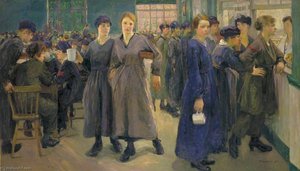
Perhaps her most historically significant contribution arose from the crucible of the First World War. Tasked by the Ministry of Information to document the British home front, Lion stepped into spaces rarely visited by female artists of her standing. She ventured into the industrial heartlands of Leeds and Bradford, capturing the grit and determination of the wartime era. Her depictions of factory workers—specifically her poignant scenes of women in munitions canteens—offered a rare, dignified glimpse into the changing social fabric of Britain. In these works, she moved beyond the traditional boundaries of portraiture to become a chronicler of national resilience, portraying the confidence of female workers with a sensitivity that contrasted beautifully with the more somber depictions of their male counterparts.
An Enduring Impression
The life of Flora Lion was one of remarkable professional autonomy. In an era when many women artists were overshadowed by their spouses, Lion maintained a distinct and successful identity. Even after her marriage to the journalist and artist Ralph Amato in 1915, she remained the preeminent creative force in their partnership, with Amato often serving as her dedicated secretary and press officer. This rare level of professional agency allowed her to navigate the complexities of the art world with a singular vision.
By the time of her passing in London in 1958, Lion had left behind an oeuvre that spanned landscapes, murals, and portraits, each piece serving as a window into the shifting aesthetics of the Victorian and Edwardian eras. Her work remains a vital touchstone for those studying the evolution of British portraiture, reminding us of a period when art was used not only to celebrate individual beauty but to document the very pulse of a nation in transition. Through her mastery of light and her empathetic eye, Flora Lion ensured that the faces and stories of her time would never fade into obscurity.
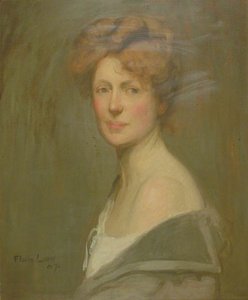
flora lion
1878 - 1958
Quick Facts
- Artistic Movement Or Style: Realist-Impressionism
- Artists Or Movements Influenced By This Artist: ['']
- Artists Who Influenced This Artist: ['']
- Date Of Birth: December 3, 1878
- Date Of Death: May 15, 1958
- Full Name: Flora Marguerite Lion
- Nationality: English
- Notable Artworks:
- Mrs Sylvia Gascoigne
- Flora Drummond
- Place Of Birth: London, England