

 Preview
 Send
Send Share
Share
 Details

 Download
 Similars
 X-Ray
X-Ray Diaporama
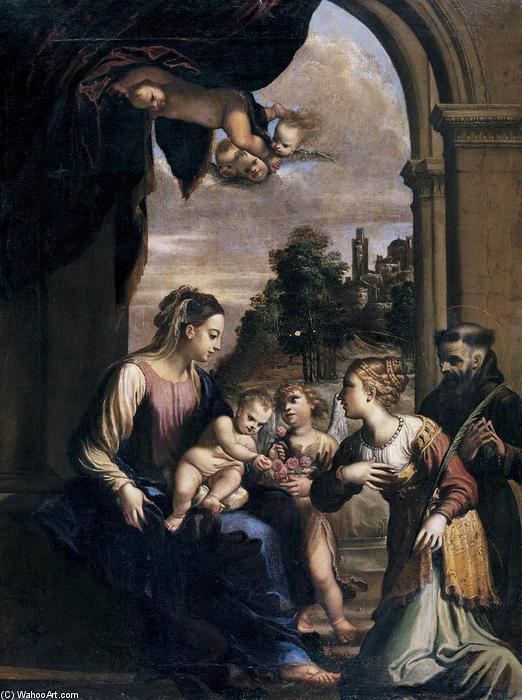
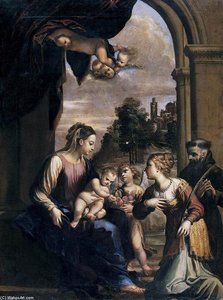
Madonna and Child with Sts Catherine and Francis
 1610
1610 101.0 x 76.0 cm
 Read More
Hand Made Oil Reproduction
Hand-painted oil on canvas in your size and frame, made to order by our artists. ( Buy Print Buy Image)




































Pick from our preset sizes that match the artwork's original proportions.

You may enter your own dimensions to fit a specific frame or space. If your selected size does not match the original image's proportions, we will either crop the artwork or extend the painting with additional hand-painted elements. A digital mockup will be sent for your approval before production begins.
Please note that the on-screen preview does not reflect the actual cropping or extension. Only the mockup will accurately show the final composition.
While custom sizes are available, we recommend selecting a dimension from the predefined list to preserve the original proportions.
After order, ArtsDot.com team will email client for instructions and provide a mockup preview
Worldwide Delivery () in 3/4 weeks instead of standard 5 weeks. (25 August). No compromise on quality.

Free Worldwide Express Shipping

High-Quality Linen Canvas

Full Shipping Insurance

Customs Tax Refund Guarantee

True Color Matching Guarantee

60-Day Return Policy (Defects Only)

100% Money-Back Guarantee

Bulk Discount Offer
 Glass option is only available in size under 110 CM

Madonna and Child with Sts Catherine and Francis
Reproduction Medium
Reproduction Size
-


Total Price
$ 263
Related Artworks
Artist Biography
The Shadow and Light of the Bolognese Baroque
Francesco Brizio stands as a compelling figure within the vibrant tapestry of Bolognese Baroque art, an artist whose oeuvre is characterized by a distinctive blend of realism and psychological depth—a stylistic hallmark that distinguishes him from many of his contemporaries. Born in Bologna around 1574, Brizio emerged during a transformative era when the rigid structures of the Renaissance were beginning to dissolve into the dramatic, emotive language of the early Baroque. His life and work reflect the shifting tides of Italian art, moving away from mere imitation toward a profound exploration of human emotion and divine grandeur.
The trajectory of Brizio’s artistic development was shaped by the masters of his age. He began his journey under the tutelage of Bartolommeo Passarotti, absorbing the humanist ideals that remained deeply rooted in the Bolognese tradition. However, it was his subsequent association with the revolutionary Carracci family—specifically Agostino and Ludovico Carracci—that truly ignited his creative spirit. Through this lineage, Brizio embraced a new way of seeing: one defined by meticulous anatomical accuracy, the masterful use of chiaroscuro, and a renewed commitment to naturalism. This training allowed him to bridge the gap between the classical elegance of the past and the burgeoning drama of the Baroque period.
A Master of Fresco and Narrative Grandeur
Brizio’s reputation was cemented not merely through individual canvases, but through his monumental contributions to the architectural landscapes of Italy. He possessed a rare technical prowess, particularly in the demanding medium of fresco, which allowed him to transform ceilings and cloisters into windows onto the divine. His collaborative spirit was perhaps most evident in the loggias of the Palazzo Bentivoglio, where, alongside luminaries such as Lucio Massari and Leoniente Spada, he breathed life into the epic narratives of Torquato Tasso’s Gerusalemme Liberata. In these works, Brizio demonstrated an extraordinary ability to weave complex, poetic themes into a cohesive visual language that captivated both the eye and the soul.
His reach extended beyond Bologna, as he undertook ambitious decorative projects in Modena and Pieve di Cento. Whether decorating the ceiling of the Oratorio della SS Trinità or frescoing the serene cloisters of San Michele in Bosco, Brizio’s hand was marked by a sense of movement and atmospheric depth. His religious commissions, such as the Coronation of the Madonna del Borgo for the Church of San Petronio, serve as enduring testaments to his ability to render sacred mysteries with a palpable, earthly presence. In these compositions, the divine is not distant; it is felt through the weight of fabric, the warmth of skin, and the dramatic interplay of light and shadow.
Legacy and Artistic Contribution
Beyond his large-scale frescoes, Brizio was also a skilled engraver, a facet of his talent that allowed him to disseminate the stylistic innovations of the Bolognese School more widely. His engravings, often inspired by or modeled after the works of the Carracci and Correggio, showcase a refined sense of line and composition. While historical records occasionally faced confusion—with some early biographers like Cesare Malvasia mistakenly conflating him with other artists—the true essence of Brizio’s contribution lies in his role as a vital link in the evolution of the Baroque.
The significance of Francesco Brizio extends to the generations that followed. His influence can be seen in the way he prepared the ground for a more emotive, naturalistic approach to religious storytelling. Even his personal legacy continued through his family; his son, Filippo, would go on to study under the great Guido Reni, carrying forward the torch of Bolognese excellence. Today, Brizio is remembered as an artist who could capture the "dark vision" of the Baroque—a painter capable of finding profound beauty within the shadows and elevating the human experience to the level of the eternal.
Francesco Brizio
1574 - 1623 , Italy
Quick Facts
- Artistic Movement Or Style: Baroque
- Artists Or Movements Influenced By This Artist: ['Ludovico Carracci']
- Artists Who Influenced This Artist:
- Bartolommeo Passarotti
- Agostino Carracci
- Date Of Birth: Bologna, Italy (1574)
- Date Of Death: 1623
- Full Name: Francesco Brizio
- Nationality: Italian
- Notable Artworks:
- Madonna and Child with Sts Catherine and Francis
- San Francesco
- Place Of Birth: Bologna

