 Preview
 Send
Send Share
Share
 Details

 Download
 Similars
 X-Ray
X-Ray Diaporama
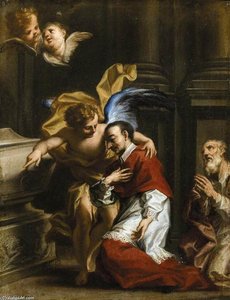
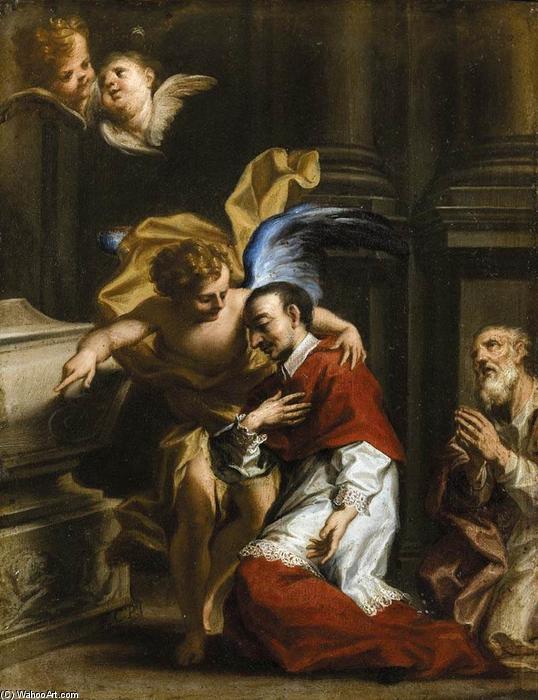
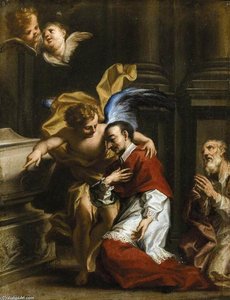
St Carlo Borromeo Tended by an Angel
 27.0 x 21.0 cm
 Read More
Hand Made Oil Reproduction
Hand-painted oil on canvas in your size and frame, made to order by our artists. ( Buy Print Buy Image)




































Pick from our preset sizes that match the artwork's original proportions.

You may enter your own dimensions to fit a specific frame or space. If your selected size does not match the original image's proportions, we will either crop the artwork or extend the painting with additional hand-painted elements. A digital mockup will be sent for your approval before production begins.
Please note that the on-screen preview does not reflect the actual cropping or extension. Only the mockup will accurately show the final composition.
While custom sizes are available, we recommend selecting a dimension from the predefined list to preserve the original proportions.
After order, ArtsDot.com team will email client for instructions and provide a mockup preview
Worldwide Delivery () in 3/4 weeks instead of standard 5 weeks. (26 August). No compromise on quality.

Free Worldwide Express Shipping

High-Quality Linen Canvas

Full Shipping Insurance

Customs Tax Refund Guarantee

True Color Matching Guarantee

60-Day Return Policy (Defects Only)

100% Money-Back Guarantee

Bulk Discount Offer
 Glass option is only available in size under 110 CM

St Carlo Borromeo Tended by an Angel
Reproduction Medium
Reproduction Size
-


Total Price
$ 263
Related Artworks
Artist Biography
Early Life and Training in the Bolognese Tradition
Francesco Caccianiga, born in Milan in 1700, embarked on an artistic journey that would see him navigate the vibrant centers of Italian painting during the Baroque era and beyond. His initial training took place within the established traditions of Bologna, a city renowned for its prestigious academies and masterful painters. He became a pupil of Marcantonio Franceschini, a prominent figure whose work embodied the grandeur and theatricality characteristic of late Baroque art. This foundational education instilled in Caccianiga a deep appreciation for classical composition, meticulous draftsmanship, and a rich palette—skills that would define his early style.
Roman Patronage and Artistic Development
Driven by ambition and a desire to expand his horizons, Caccianiga relocated to Rome. It was here, under the generous patronage of Marcantonio Borghese, 5th Prince of Sulmona, that he truly began to establish himself as an independent artist. The Palazzo and Villa Borghese became significant venues for his work, providing him with opportunities to execute substantial commissions and refine his artistic voice. The influence of Roman Baroque masters is palpable in these early Roman works; however, Caccianiga’s style was not merely imitative. He demonstrated a growing ability to blend the dramatic intensity of the Baroque with a more refined sensibility, hinting at the stylistic shifts that would characterize the later 18th century.
Ancona and Religious Masterpieces
While Rome provided crucial early support, Caccianiga’s artistic maturity blossomed during his time in Ancona. This Adriatic port city became a focal point for his career, where he undertook numerous commissions for altar-pieces that showcased his burgeoning talent. Among his most celebrated works from this period are the Marriage of the Virgin and The Last Supper. These paintings reveal Caccianiga’s mastery of narrative composition, his ability to convey emotional depth through expressive figures, and a sophisticated use of light and shadow. His religious scenes were not simply depictions of biblical events; they were imbued with a sense of spiritual reverence and human drama.
Engravings and the Pursuit of Diverse Media
Caccianiga’s artistic pursuits extended beyond painting to encompass engraving, though this aspect of his oeuvre remains relatively less known. His engravings, such as The Death of Lucretia, demonstrate a keen attention to detail and a skillful command of line and texture. This foray into printmaking suggests a desire to disseminate his imagery more widely and engage with a broader audience. It also highlights his versatility as an artist—a willingness to explore different media and techniques in pursuit of artistic expression.
Legacy and Historical Significance
Francesco Caccianiga’s career spanned a period of significant transition in Italian art, bridging the gap between the Baroque and Neoclassical styles. While often described as a “diligent craftsman of little originality,” this assessment overlooks his subtle yet important contributions to the artistic landscape of his time. He successfully synthesized the traditions of classical Bologna with the dramatic flair of Roman Baroque painting, creating works that were both technically accomplished and emotionally resonant. His paintings for the Borghese family, along with his altar-pieces in Ancona, stand as testaments to his skill and dedication. Though he may not be a household name like some of his contemporaries, Caccianiga’s work offers valuable insights into the artistic currents of 18th-century Italy and deserves continued scholarly attention.
francesco caccianiga
1700 - 1781 , Italy
Quick Facts
- Artistic Movement Or Style: Baroque
- Artists Who Influenced This Artist: ['Marcantonio Franceschini']
- Date Of Birth: 1700
- Date Of Death: 1781
- Full Name: Francesco Caccianiga
- Nationality: Italian
- Notable Artworks:
- Marriage of the Virgin
- Last Supper
- Death of Lucretia
- Place Of Birth: Milan, Italy