 Preview
 Send
Send Share
Share
 Details

 Download
 Similars
 X-Ray
X-Ray Diaporama
The Annunciation


 Read More
Hand Made Oil Reproduction
Hand-painted oil on canvas in your size and frame, made to order by our artists. ( Buy Print Buy Image)




P118B $10

P118H $10

P118W $10

P438Z $10

P508JH $12

P508YH $12

P805H $10

P805Z $10

P919BZ $10

P919G $10

P919XJ $10

P959ZH $10

P968JZ $12

W106C $8

W218G $10

W218JH $8

W218Y $10

W307PJ $10

W316G $10

W316PJ $8

W316Y $10

W398PJ $8

W4111J $10

W500HY $15

W500JH $15

W692G $12

W849H $8

W940BG $15

W953PJ $8




Pick from our preset sizes that match the artwork's original proportions.

You may enter your own dimensions to fit a specific frame or space. If your selected size does not match the original image's proportions, we will either crop the artwork or extend the painting with additional hand-painted elements. A digital mockup will be sent for your approval before production begins.
Please note that the on-screen preview does not reflect the actual cropping or extension. Only the mockup will accurately show the final composition.
While custom sizes are available, we recommend selecting a dimension from the predefined list to preserve the original proportions.
After order, ArtsDot.com team will email client for instructions and provide a mockup preview
Worldwide Delivery () in 3/4 weeks instead of standard 5 weeks. (16 August). No compromise on quality.

Free Worldwide Express Shipping

High-Quality Linen Canvas

Full Shipping Insurance

Customs Tax Refund Guarantee

True Color Matching Guarantee

60-Day Return Policy (Defects Only)

100% Money-Back Guarantee

Bulk Discount Offer
 Glass option is only available in size under 110 CM

The Annunciation
Reproduction Medium
Reproduction Size
-


Total Price
$ 263
Artwork Description
A Moment Suspended in Sacred Light
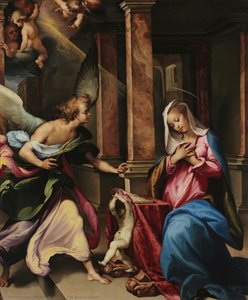
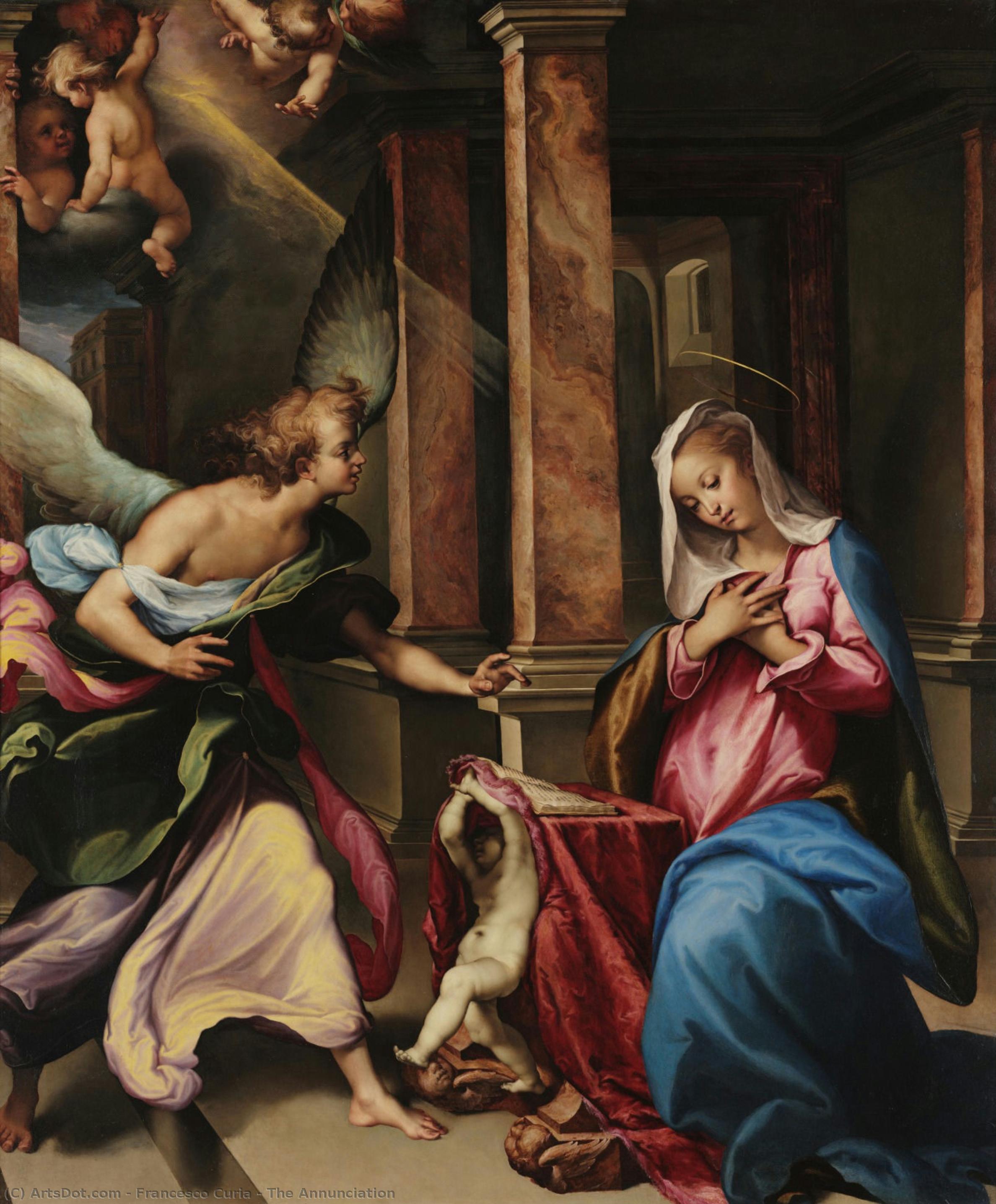
To gaze upon this depiction of The Annunciation is to step across the threshold into a moment of profound, hushed revelation. It captures not merely an event from Christian scripture, but the very breath held between divine will and human acceptance. Here, the Virgin Mary cradles the infant Jesus, their bond radiating a palpable warmth that anchors the entire composition. Flanking this central, tender tableau are two angels, figures caught in attitudes of reverence, guiding the viewer's eye toward the sacred mystery unfolding before us. The inclusion of symbolic elements—the open book near Mary and the watchful dog at the base—adds layers of narrative depth, inviting contemplation on themes of knowledge, fidelity, and divine promise.
The Hand of a Neapolitan Master
This exquisite work is attributed to Francesco Curia, a painter whose mastery was deeply rooted in the vibrant artistic currents of late sixteenth-century Naples. Trained initially under the rigorous hand of Giovanni Filippo Criscuolo, Curia absorbed the Florentine emphasis on anatomical precision while infusing his own style with a luminous color palette characteristic of the Italian Renaissance masters. His commitment to naturalistic observation is evident; even the gentle repose of the sleeping child and the attentive posture of the figures speak to an artist who observed the world around him with meticulous care. The date, circa 1596, places this piece within a period where religious art continued to thrive as both devotion and high culture.
Symbolism Woven into Serenity
The symbolism at play here is rich and deeply resonant. The Annunciation itself represents the Incarnation—the moment the divine enters the human realm. Mary’s gentle bearing contrasts beautifully with the ethereal presence of the angels, suggesting a harmonious meeting point between heaven and earth. Consider the book: it often symbolizes scripture or divine wisdom, hinting at the profound truths contained within this sacred narrative. Furthermore, the dog, a traditional motif in art, frequently serves as a symbol of loyalty and fidelity, grounding the spiritual drama with an element of earthly devotion. These carefully placed details transform the painting from a mere portrait into a complex meditation on faith.
Craftsmanship for the Modern Sanctuary
For those seeking to bring the quiet grandeur of Renaissance piety into a contemporary space—be it a drawing-room, study, or chapel—this reproduction offers an unparalleled connection to history. The technique employed by Curia, with its luminous quality and detailed rendering, suggests a mastery that transcends time. Owning a piece inspired by this work is not simply acquiring art; it is curating an atmosphere of peace. It invites the viewer to slow down, to breathe in the serene atmosphere, and to feel the weight of centuries of artistic devotion surrounding them.
Related Artworks
Artist Biography
The Neapolitan Renaissance: The Life and Legacy of Francesco Curia
In the vibrant, sun-drenched streets of sixteenth-century Naples, a period of profound artistic transformation was unfolding, and at the heart of this creative renaissance stood Francesco Curia. Born around 1538 into a lineage of artistic devotion, Curia was the son of the painter Michele Curia, a heritage that likely provided him with an early, intimate connection to the alchemy of pigments and the discipline of the brush. His journey as an artist was not merely one of inherited skill but of rigorous intellectual and technical evolution. Under the guidance of the esteemed Giovanni Filippo Criscuolo, Curia absorbed the foundational principles of anatomical precision and expressive realism that would define his later masterpieces. This formative period in Naples, a city teeming with humanist ideals and religious fervor, instilled in him a profound respect for the sanctity of the subject matter, particularly within the realm of sacred iconography.
As his talent matured, Curia’s artistic vision expanded beyond the borders of his hometown. His travels to Rome allowed him to stand in the presence of greatness, where he studied the divine compositions of Raphael, an encounter that undoubtedly refined his sense of harmony and classical grace. This exposure to the Roman school, combined with the stylistic influence of Giorgio Vasari, helped shape a unique aesthetic that balanced the meticulous observation of nature with the idealized beauty of the High Renaissance. His work became a bridge between the structured elegance of the Florentine tradition and the burgeoning naturalism that would soon characterize Southern Italian art. Curia’s ability to infuse religious narratives with emotional intensity made him one of the most significant figures in Naples before the seismic arrival of Caravaggio.
Mastery of Form and the Language of Devotion
The oeuvre of Francesco Curia is a testament to his ability to translate complex theological concepts into palpable, visual experiences. His paintings and drawings often serve as windows into the spiritual psyche of the late Renaissance, utilizing a luminous color palette and a meticulous attention to detail to evoke awe in the viewer. Whether through the delicate pen strokes of his sketches or the grand scale of his altarpiements, Curia possessed a rare gift for capturing the human condition within a divine context. His mastery is particularly evident in works such as The Annunciation, where the interplay of light and shadow creates a sense of profound stillness and miraculous presence.
Beyond his finished paintings, Curia’s skill as a draughtsman offers an intimate glimpse into his creative process. His surviving sketches, some of which were once part of prestigious collections like that of the Swedish collector Carl Gustav Tessin, reveal a strong awareness of Emilian Mannerism and a sophisticated command of line. In these works, one can observe:
- Theological Symbolism: The use of iconography, such as the dog representing fidelity or the chalice signifying the Eucharist, to deepen the narrative layers of his compositions.
- Anatomical Precision: A commitment to the realistic depiction of the human form, a trait inherited from his training under Criscuolo.
- Emotional Resonance: The capacity to convey deep piety, sorrow, or joy through subtle facial expressions and gestural language.
A Lasting Impression on Neapolitan Art
The historical significance of Francesco Curia extends far beyond his individual accomplishments; he was a cornerstone of the Neapolitan school, fostering a generation of artists who would carry his torch into the next century. As a mentor to notable figures such as Fabrizio Santafede and Ippolito Borghese, Curia ensured that his stylistic principles—clarity of form, naturalistic observation, and emotional depth—remained embedded in the artistic fabric of Naples. His influence acted as a vital link in the continuity of Italian art, providing a stable foundation of Renaissance ideals upon which the more dramatic, chiaroscuro-heavy styles of the Baroque could later be built.
Though he may have been overshadowed for centuries by the monumental fame of later masters, the modern reconstruction of his painted works has restored Curia to his rightful place in the canon of Italian art. He remains a pivotal figure whose work captures the transition from the structured grace of the sixteenth century to the visceral energy of the seventeenth. Through his dedication to the sacred and his mastery of the medium, Francesco Curia left behind an indelible legacy that continues to resonate with anyone seeking to understand the soul of the Neapolitan Renaissance.
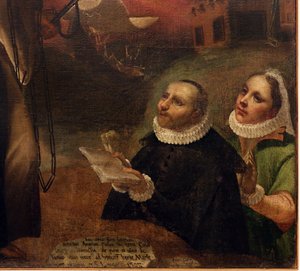
Francesco Curia
1538 - 1610 , Italy
Quick Facts
- Artistic Movement Or Style: Renaissance Painting
- Artists Or Movements Influenced By This Artist:
- Fabrizio Santafede
- Ippolito Borghese
- Artists Who Influenced This Artist:
- Giovanni Filippo Criscuolo
- Giorgio Vasari
- Date Of Birth: c. 1538
- Date Of Death: 1610
- Full Name: Francesco Curia
- Nationality: Italian
- Notable Artworks:
- The Annunciation
- The Coronation of the Virgin
- Place Of Birth: Naples, Italy
Related Articles

Fra Angelico's Masterpieces: 25 Renaissance Paintings for Your Home | ArtsDot
Explore 25 breathtaking masterpieces by Fra Angelico, a Renaissance master. Discover the stories behind his iconic frescoes, Annunciations & religious art. Find museum-quality reproductions and elevate your home decor with ArtsDot.com.

Uffizi's 25 Masterpieces: Renaissance Art & Timeless Decor Inspiration
Journey through the Uffizi Gallery's 25 most iconic Renaissance artworks! Explore Botticelli, Leonardo da Vinci & Michelangelo’s masterpieces. Find museum-quality art reproductions and curated decor ideas to bring timeless Italian beauty into your home. Discover all masterpieces on ArtsDot.com
Marianne North's Masterpieces: 25 Botanical Paintings That Bloom With Adventure | ArtsDot
Journey through the vibrant world of Marianne North’s botanical paintings! Explore 25 iconic artworks from this Victorian artist, celebrating exotic flora & travel. Find museum-quality reproductions and curated decor ideas at ArtsDot.com.
Giotto's Masterpieces: 25 Renaissance Artworks for Your Home | ArtsDot
Explore 25 breathtaking artworks by Giotto di Bondone, a Renaissance master. Discover the stories behind iconic frescoes & paintings like the Scrovegni Chapel cycle. Find museum-quality Giotto reproductions and elevate your home decor with ArtsDot.com.
Hermitage Masterpieces: 25 Art Treasures to Inspire Your Home Decor
Journey through the Hermitage Museum's 25 greatest artworks! Explore masterpieces by Rembrandt, Leonardo da Vinci & Vermeer. Find museum-quality art reproductions and curated decor ideas to bring timeless beauty home. Discover all masterpieces on ArtsDot.com.