 Preview
 Send
Send Share
Share
 Details

 Download
 Similars
 X-Ray
X-Ray Diaporama
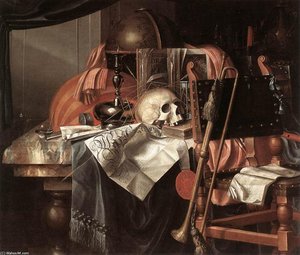
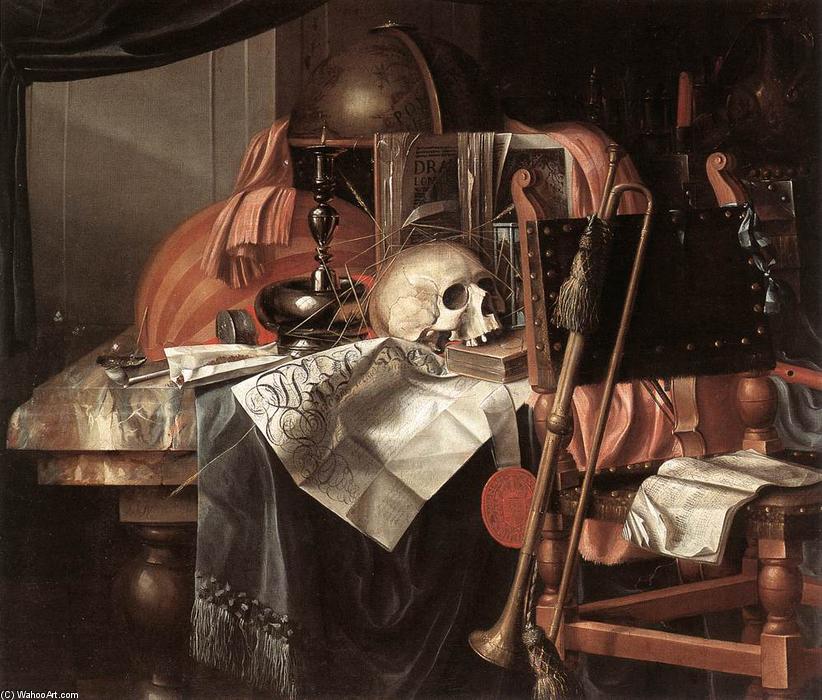
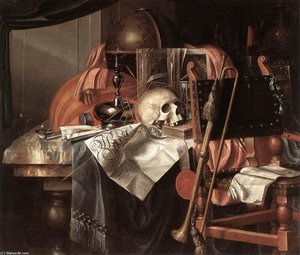
Vanitas
 115.0 x 134.0 cm
 Koninklijk Museum voor Schone Kunsten
 Read More
Giclée / Art Print
Museum-quality giclée or canvas print with fast production and flexible finish options. ( Buy Hand Made Painting Buy Image)




































Pick from our preset sizes that match the artwork's original proportions.

You may enter your own dimensions to fit a specific frame or space. If your selected size does not match the original image's proportions, we will either crop the artwork or extend the image with a mirrored or solid-fill edge. A digital mockup will be sent for your approval before production begins.
Please note that the on-screen preview does not reflect the actual cropping or extension. Only the mockup will accurately show the final composition.
While custom sizes are available, we recommend selecting a dimension from the predefined list to preserve the original proportions.
Worldwide Delivery () in 2 weeks instead of standard 4/5 weeks. (29 August)

Free Worldwide Express Shipping

High-Quality Linen Canvas

Full Shipping Insurance

Customs Tax Refund Guarantee

True Color Matching Guarantee

60-Day Return Policy (Defects Only)

100% Money-Back Guarantee

Bulk Discount Offer
 Glass option is only available in size under 110 CM

Vanitas
Giclée / Art Print
Reproduction Size
-


Total Price
$ 63
Related Artworks








Artist Biography
Franciscus Gijsbrechts: Weaver of Shadows and Echoes of Mortality
The world of 17th-century Dutch art is a tapestry woven with light, color, and an almost unsettling preoccupation with mortality. Within this rich landscape emerges Franciscus Gijsbrechts (c. 1649 – after 1677), a painter whose name, often overshadowed by his more celebrated father, Cornelis Norbertus Gijsbrechts, nonetheless holds a unique and haunting significance. Gijsbrechts wasn’t merely an artist; he was a meticulous architect of illusion, a master of the trompe-l'œil, and a profound interpreter of the vanitas – the contemplation of life’s fleeting nature. His paintings aren’t simply still lifes; they are carefully constructed dialogues with death, rendered in exquisitely detailed shadows and subtly suggestive symbolism.
Born into an artistic lineage steeped in the tradition of Dutch still-life painting, Franciscus Gijsbrechts inherited a legacy that demanded both technical skill and a keen eye for detail. His father, Cornelis Norbertus Gijsbrechts, was already establishing himself as a leading figure in the genre, renowned for his groundbreaking trompe-l'œil paintings – illusions so convincing they seemed to spill out of the canvas and into the viewer’s space. Franciscus’s early life likely involved apprenticeship under his father, absorbing not just the technical aspects of painting but also the philosophical underpinning of their work: a recognition that beauty and material possessions were ultimately transient, destined for decay and oblivion.
The Language of Illusion: Trompe-l'œil and Vanitas
Gijsbrechts’s artistic identity is inextricably linked to two distinct yet intertwined techniques. First and foremost, he was a master of the trompe-l'œil – a technique that sought to deceive the eye into believing it was looking at a three-dimensional reality when, in fact, it was observing a meticulously crafted illusion on a flat surface. His compositions often featured seemingly overflowing cabinets filled with objects – writing implements, silverware, musical instruments, and exotic shells – arranged as if they were genuinely present within the room. The precision of his rendering, the subtle variations in light and shadow, and the careful manipulation of perspective created an astonishing sense of depth and volume. It’s a testament to his skill that viewers often find themselves instinctively reaching out to touch the objects depicted.
However, Gijsbrechts didn't simply replicate reality; he imbued his trompe-l'œil paintings with a deeper meaning through the incorporation of vanitas symbols. These emblems – a skull, an hourglass, a wilting flower, a candle flame, or a broken timepiece – served as potent reminders of mortality and the futility of earthly pursuits. Unlike some of his contemporaries who employed vanitas solely to preach religious morality, Gijsbrechts’s depictions often felt more subtly melancholic, reflecting on the ephemeral nature of beauty, wealth, and achievement. He wasn't offering a didactic sermon; he was inviting contemplation.
A Delicate Balance: Style and Influence
While undeniably influenced by his father’s established style – particularly in the meticulous rendering of objects and the use of chiaroscuro (the dramatic contrast between light and dark) – Gijsbrechts developed a distinct artistic voice. His paintings possess a certain somberness, a quiet intensity that sets them apart from the more overtly celebratory works of other Dutch still-life painters. There’s a deliberate restraint in his palette, favoring muted browns, grays, and blacks, which contribute to the overall atmosphere of melancholy and introspection.
It's important to note that distinguishing between Gijsbrechts’s work and that of his father can be challenging. Both artists shared a similar technical approach and favored comparable subjects. However, subtle differences in brushwork, composition, and the specific arrangement of vanitas symbols suggest that Franciscus developed his own unique style – one characterized by a heightened sense of realism and an almost unnerving attention to detail. Recent scholarship suggests he may have been active as an assistant to his father in Copenhagen in 1672, further blurring the lines between their artistic output.
Legacy and Historical Significance
Despite often being relegated to a secondary role within the broader narrative of Dutch still-life painting, Franciscus Gijsbrechts’s work holds considerable historical significance. He represents a crucial link in the evolution of the trompe-l'œil technique and the vanitas genre, demonstrating a remarkable ability to combine technical virtuosity with profound philosophical reflection. His paintings offer a poignant glimpse into the mindset of 17th-century Europe – a society grappling with questions of mortality, faith, and the meaning of life in an age of unprecedented prosperity and artistic innovation.
Today, Gijsbrechts’s works are treasured for their exquisite detail, haunting atmosphere, and subtle yet powerful symbolism. They serve as enduring reminders of the transience of beauty and the inevitability of death – a timeless meditation on the human condition rendered with remarkable skill and sensitivity.
franciscus gysbrechts
1630 - 1680
Quick Facts
- Artistic Movement Or Style: Baroque, Trompe-l'oeil
- Artists Who Influenced This Artist: ['Cornelis Norbertus Gijsbrechts']
- Date Of Birth: 1649
- Full Name: Franciscus Gijsbrechts
- Nationality: Flemish
- Notable Artworks:
- Vanitas paintings
- Trompe-l'œil still lifes
- Place Of Birth: Antwerp, Belgium