 Preview
 Send
Send Share
Share
 Details

 Download
 Similars
 X-Ray
X-Ray Diaporama
Money, ''Me importa un bledo...'', L'Assiette au beurre


 Read More
Giclée / Art Print
Museum-quality giclée or canvas print with fast production and flexible finish options. ( Buy Hand Made Painting Buy Image)




P118B $10

P118H $10

P118W $10

P438Z $10

P508JH $12

P508YH $12

P805H $10

P805Z $10

P919BZ $10

P919G $10

P919XJ $10

P959ZH $10

P968JZ $12

W106C $8

W218G $10

W218JH $8

W218Y $10

W307PJ $10

W316G $10

W316PJ $8

W316Y $10

W398PJ $8

W4111J $10

W500HY $15

W500JH $15

W692G $12

W849H $8

W940BG $15

W953PJ $8




Pick from our preset sizes that match the artwork's original proportions.

You may enter your own dimensions to fit a specific frame or space. If your selected size does not match the original image's proportions, we will either crop the artwork or extend the image with a mirrored or solid-fill edge. A digital mockup will be sent for your approval before production begins.
Please note that the on-screen preview does not reflect the actual cropping or extension. Only the mockup will accurately show the final composition.
While custom sizes are available, we recommend selecting a dimension from the predefined list to preserve the original proportions.
Worldwide Delivery () in 2 weeks instead of standard 4/5 weeks. (16 August)

Free Worldwide Express Shipping

High-Quality Linen Canvas

Full Shipping Insurance

Customs Tax Refund Guarantee

True Color Matching Guarantee

60-Day Return Policy (Defects Only)

100% Money-Back Guarantee

Bulk Discount Offer
 Glass option is only available in size under 110 CM

Money, ''Me importa un bledo...'', L'Assiette au beurre
Giclée / Art Print
Reproduction Size
-


Total Price
$ 63
Collectible Description
A Satirical Vision of Avarice
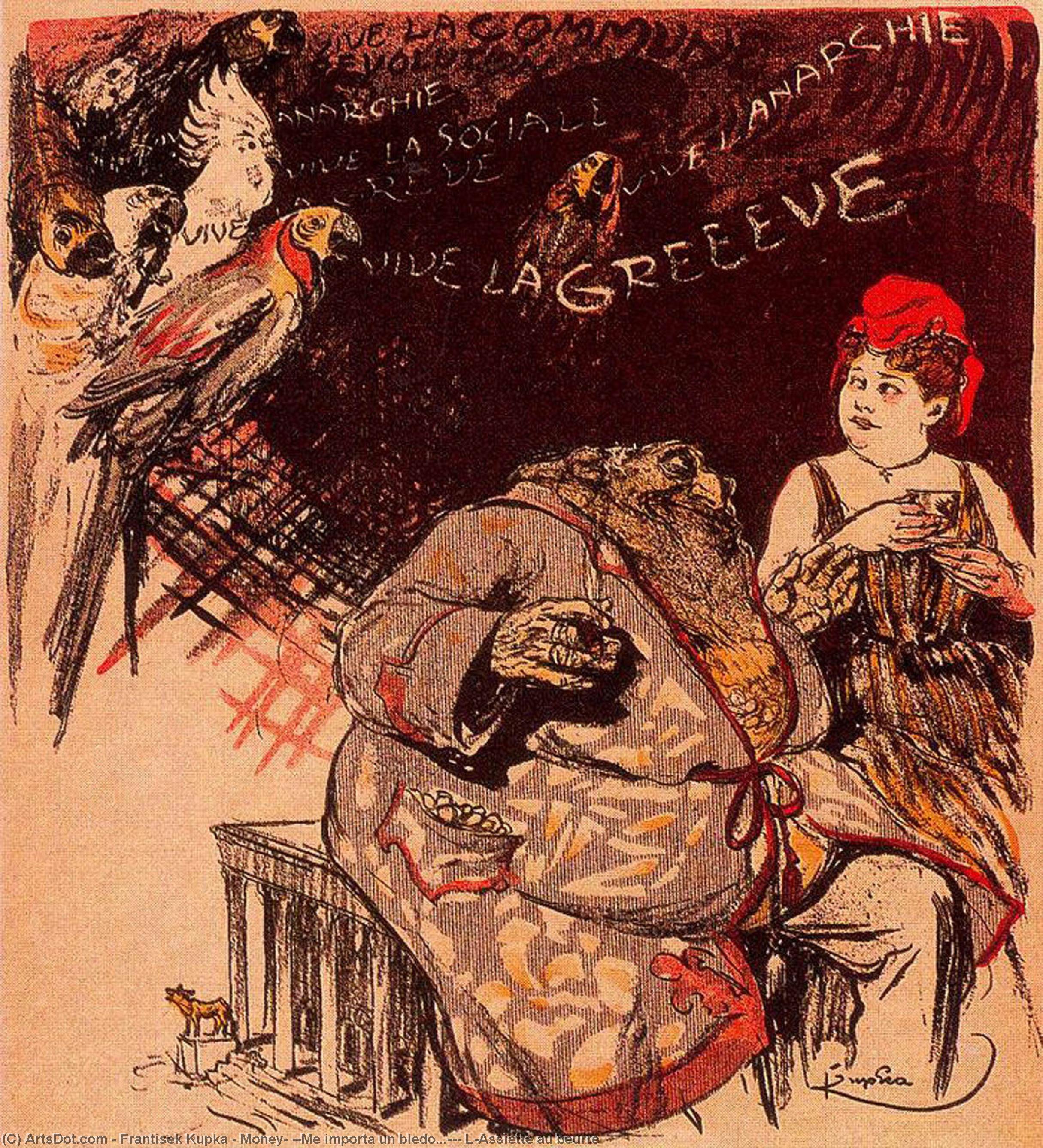
In the captivating lithograph titled Money, ''Me importa un bledo...'', we are transported into a whimsical yet biting world of social commentary. Created during a period of profound transition in European graphic arts, this piece serves as a striking example of how art can wield satire to critique the very foundations of human greed. The composition is anchored by a monumental, anthropomorphic figure that embodies the heavy, suffocating presence of wealth. This central character, rendered with an almost cartoonish gravity, dominates the visual field, creating an immediate sense of awe and uneversity. Beside this titan of avarice sits a young girl, her presence offering a poignant contrast of innocence against the backdrop of material excess. Above them all, a solitary bird perches, acting as a silent observer to this theatrical display of social hierarchy and desire.
The stylistic execution of the work draws heavily from the expressive power of Art Nouveau, utilizing flowing, organic lines that dance across the page, yet it is tempered by the sharp, graphic edge characteristic of early 20th-century political caricature. The artist employs a masterful use of bold, expressive linework to define shapes and imbue the figures with a sense of tactile reality. Through the delicate application of hatching and cross-hatching, depth and texture are subtly introduced into an otherwise flattened, two-dimensional space. This technique allows for a rich interplay of light and shadow that, while diffused, lends a certain weight to the central figure's robes and the delicate features of the surrounding elements. The color palette is intentionally restrained, leaning into warm, earthy tones of deep reds, burnt oranges, and rich browns, which evokes a sense of antiquity and historical gravity.
Symbolism and the Spirit of the Era
Beyond its visual charm, the artwork functions as a complex tapestry of symbols designed to provoke thought. The text banners that drift across the upper portion of the composition act as linguistic layers, adding a dimension of political or social commentary that invites the viewer to decode the artist's true intent. Every element—from the rounded, amorphous shape of the personified money to the stylized wings of the bird—is a deliberate choice meant to evoke an emotional response. The piece captures a tension between the pursuit of material gain and the preservation of human spirit, making it a deeply resonant work for those who appreciate art that speaks to the universal struggles of the human condition.
For the discerning collector or interior designer, this reproduction offers more than just a decorative element; it provides a conversation piece steeped in historical significance. The artwork's ability to blend the aesthetic elegance of fine printmaking with the raw energy of social critique makes it a versatile addition to any curated space. Whether placed in a modern gallery setting or a classic study, the piece commands attention through its unique ability to balance whimsical charm with profound, unsettling truth. It is an invitation to reflect on the enduring nature of greed and the timeless beauty of artistic rebellion.
Related Artworks
Artist Biography
A Pioneer of Abstraction: The Life and Art of František Kupka
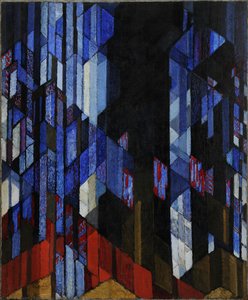
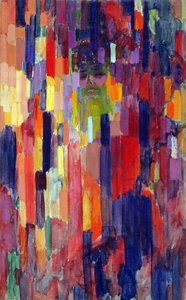
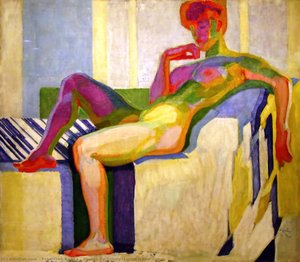
František Kupka, a name resonating with the dawn of abstract art, was born in 1871 in Opočno, Bohemia—a landscape that would subtly inform his later explorations of form and color. His journey from academic training to radical abstraction wasn’t a swift leap but rather a gradual unfolding, deeply influenced by spiritual currents and a relentless pursuit of visual truth. Initially steeped in historical and patriotic themes during his studies at the Academy of Fine Arts in Prague and then Vienna, Kupka's early work demonstrated technical skill yet lacked the distinctive voice that would soon define him. It was his move to Paris in 1894 that proved pivotal, immersing him in a vibrant artistic milieu where he briefly attended the Académie Julian and later studied with Jean-Pierre Laurens at the École des Beaux-Arts. However, it wasn’t merely formal training but the intellectual ferment of fin-de-siècle Paris—the burgeoning interest in symbolism, Neo-Impressionism, and Fauvism—that truly ignited his artistic evolution.The Path to Pure Abstraction: Influences and Innovations
Kupka’s artistic trajectory wasn't solely driven by aesthetic considerations; it was profoundly shaped by philosophical and spiritual inquiries. His engagement with Theosophy, a mystical system blending Eastern religions and Western esotericism, proved particularly influential. This belief system posited an underlying unity to all things and sought to reveal hidden realities beyond the visible world—a concept that resonated deeply with Kupka’s artistic aspirations. He began to believe that art could transcend mere representation and access these deeper truths through the manipulation of color, form, and line. This conviction led him away from depicting recognizable objects and towards a more subjective, internal exploration of visual experience. His early experiments involved blurring the boundaries between figuration and abstraction, as seen in works like *The Beginning of Life*, where symbolic imagery intertwined with emerging abstract elements. He wasn’t alone in this quest; Kupka engaged with contemporary scientific theories regarding color and light, seeking to understand their psychological effects on the viewer. This fusion of spiritual inquiry and scientific observation became a hallmark of his approach. He began to see color not as a descriptive element but as an independent force capable of evoking emotion and conveying meaning directly.Orphic Cubism and Beyond: A Unique Visual Language
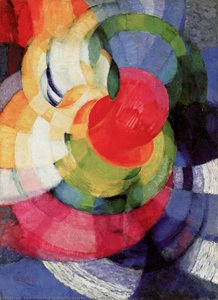
By the early 1910s, Kupka had embarked on a path that would lead him to become one of the pioneers of abstract art. His paintings from this period, such as *Amorpha: Fugue in Two Colors* (1912), were among the first truly non-representational works exhibited publicly, challenging conventional notions of artistic representation. He wasn’t interested in simply dismantling form—as some Cubists were doing—but rather in creating a new visual language based on pure abstraction. This led to his association with Orphic Cubism (also known as Orphism), a movement spearheaded by Robert Delaunay that emphasized the dynamic interplay of color and light. However, Kupka’s approach differed from Delaunay's; while both explored abstract forms, Kupka often retained a sense of underlying structure and rhythm, evoking musical compositions in his paintings—hence the frequent use of terms like “fugue” and “disks.” His *Disks of Newton* series exemplifies this exploration, depicting circular forms that seem to vibrate with energy and suggest the forces governing the universe. He wasn’t merely creating aesthetically pleasing arrangements; he was attempting to visualize underlying cosmic principles.Legacy and Lasting Influence
František Kupka's contributions extended beyond his individual paintings. As a founding member of Abstraction-Création in 1931, an international group dedicated to promoting abstract art, he played a vital role in shaping the course of modernism. His work was recognized internationally, featured in landmark exhibitions like “Cubism and Abstract Art” at the Museum of Modern Art in New York in 1936. Though often overshadowed by more prominent figures like Kandinsky or Mondrian, Kupka’s pioneering spirit and unique visual language have secured his place as a crucial figure in the history of abstract art. His legacy continues to inspire artists today, reminding us that abstraction isn't merely about eliminating representation but about unlocking new possibilities for expression and revealing hidden dimensions of reality. He sought not to depict what he saw, but what he felt—and in doing so, he opened up a universe of visual experience. His dedication to exploring the fundamental elements of art – color, form, line – remains profoundly relevant, demonstrating that true innovation lies in questioning established norms and embracing the power of pure abstraction.Museums Featuring Kupka’s Work
- Solomon R. Guggenheim Museum (New York, United States)
- The Paris Museum of Modern Art (Paris, France)
- Galerie Manés (Prague, Czech Republic)
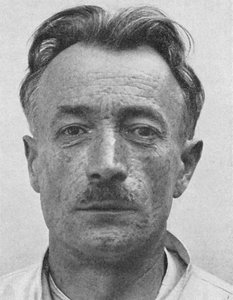
František Kupka
1871 - 1957 , Czech Republic
Quick Facts
- Artistic Movement Or Style: Abstract art, Orphic Cubism
- Artists Or Movements Influenced By This Artist: ['Orphism']
- Date Of Birth: September 23, 1871
- Date Of Death: 1957
- Full Name: František Kupka
- Nationality: Czech
- Notable Artworks:
- The Colored One
- Around a Point
- Place Of Birth: Opava, Czech Republic
Related Articles
Sandstone & Sunlight: 10 Masterpieces of Earth-Toned Art |
Journey through 10 iconic paintings bathed in 'sand' tones – from Van Gogh to Monet. Explore the stories, techniques & warm palettes of these timeless masterpieces. Find museum-quality art reproductions at and bring classic beauty home.
Earthy Hues & Masterpieces: Top 10 Paintings with 'Mushroom' Tones |
Explore 10 iconic paintings with captivating 'mushroom' tones! Discover Van Gogh, Monet & Rembrandt’s masterpieces—earthy palettes, rich history & artistic techniques. Find museum-quality art reproductions and curated decor ideas at

Crimson Threads of Narrative: Exploring Symbolism & Representation in Artworks Featuring the Red Dress
Explore the rich symbolism of the red dress in art history! From ancient power displays to iconic portraits like Cézanne’s 'Madame Cezanne', discover the cultural and artistic significance behind this captivating color. Expert analysis & insights.
Earthy Hues & Masterpieces: Top 10 Paintings Dominated by Clay Tones |
Explore 10 iconic paintings dominated by rich clay tones – from Rembrandt's warmth to Van Gogh’s earthy landscapes. Discover art history, techniques & find museum-quality reproductions at . Explore the full collection online!

Titan Buff Tones: 10 Masterpieces for a Warm & Sophisticated Home |
Explore 10 iconic paintings bathed in 'Titan Buff' – from Rembrandt to Rubens. Discover the stories, techniques & warm tones that define these masterpieces. Find museum-quality art reproductions for your home at .