

 Preview
 Send
Send Share
Share
 Details

 Download
 Similars
 X-Ray
X-Ray Diaporama
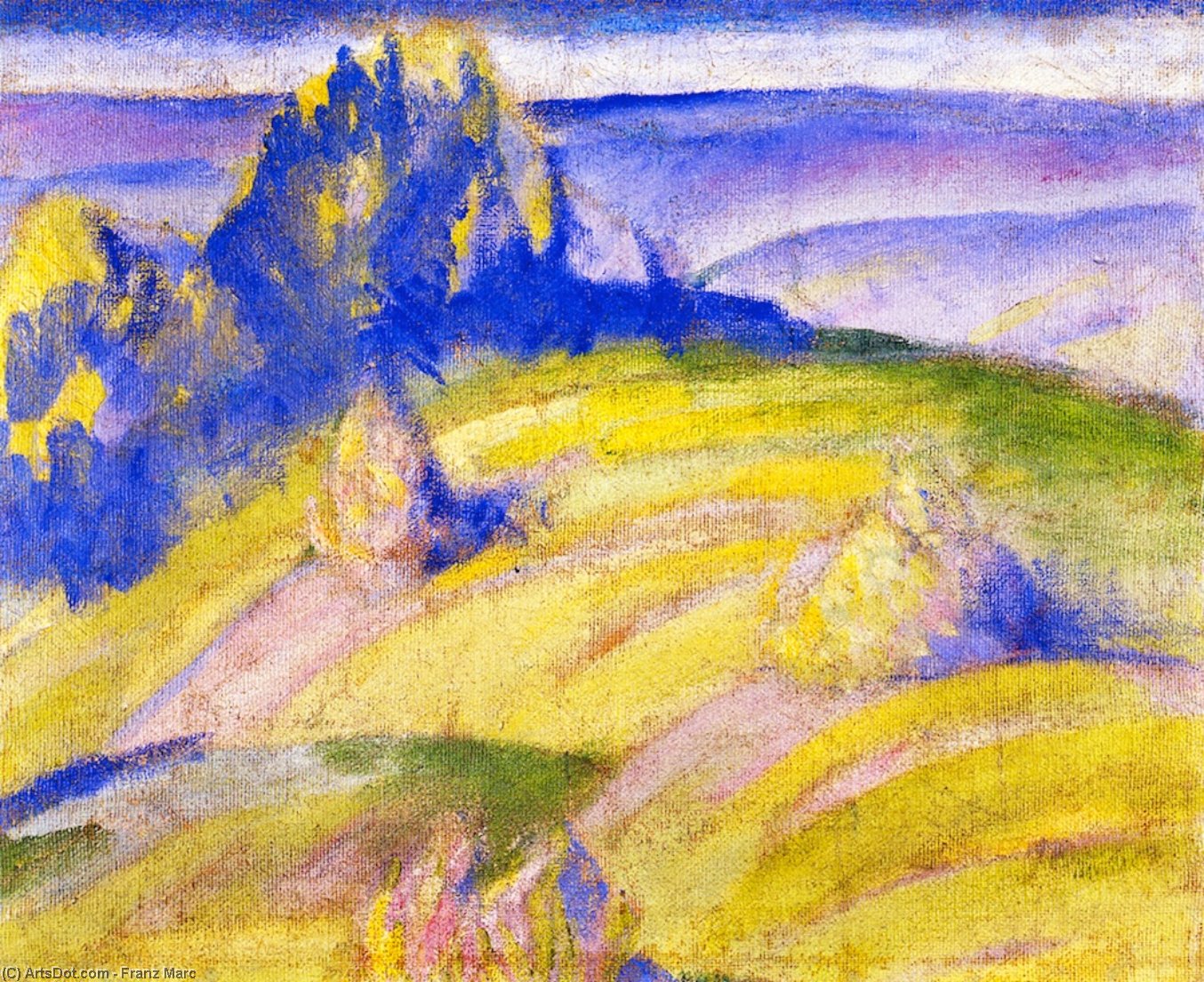
Landscape: Foothills of the Alps
 Acrylic On Canvas
- WallArt
- Post-Impressionism
 1909
1909 62.0 x 75.0 cm
 Read More
Purchase a high-resolution, enhanced digital image, far superior to the online preview.
Each file is meticulously prepared by our in-house specialists using advanced tools and expert manual retouching. We ensure every image has exceptional clarity, precise color accuracy, and fine detail.
The final file is delivered via email within 72 hours, optimized for immediate use in professional, editorial, and print environments. This is the same quality trusted by top-tier design studios, publishers, and galleries.
Digital Image
Download a high-resolution file for personal display, printing, and creative projects. ( Buy Print Buy Hand Made Painting)
Included in Every Digital Image Order
Expert Digital Delivery, Guaranteed
When you choose ArtsDot.com, you're not just getting an image - you're receiving a professionally enhanced digital artwork, crafted with precision and backed by a satisfaction guarantee. Here's everything that comes with your order, automatically:

Fast Email Delivery
Your high-resolution digital image file will be emailed to you within 72 hours of ordering - ready for immediate use.

AI-Enhanced Digital File
Your artwork is professionally optimized using advanced AI tools and manual editing, ensuring maximum detail, clarity, and color accuracy.

Free Lifetime Re-Delivery
Accidentally deleted or lost your file? No worries - we'll resend it to you anytime, free of charge.

No Import Fees - Ever
Enjoy your artwork instantly with zero customs, duties, or delivery fees - digital downloads are always tax-free.

Color Accuracy Guarantee
We ensure your digital image reflects the original colors as closely as possible using professional tools and color management.

60-Day Satisfaction Guarantee
If you're not satisfied with your digital image, we'll revise it or refund 100% within 60 days - no questions asked.

100% Money-Back Guarantee
Not satisfied? Get a full refund within 60 days of receiving your digital file - no questions asked.

Bulk Order Discounts
Buy 3 images, save 10% - Buy 5, save 15% - Buy 10+, save 20%. Great for creative projects, galleries, and agencies.
Collectible Description
Landscape: Foothills of the Alps – A Vision of Tranquility
Franz Marc’s “Landscape: Foothills of the Alps” (1909) stands as a cornerstone of German Expressionism, embodying the movement's core belief in conveying emotion and spiritual insight through artistic representation. Painted during a pivotal moment in art history—a reaction against academic realism and fueled by philosophical explorations into the subconscious—this oil on canvas offers more than just a picturesque depiction of alpine scenery; it’s an invitation to contemplate the profound beauty inherent in nature and its connection to the human spirit.Composition and Technique: Impressionistic Depth
The artwork's visual language is rooted in Impressionism, albeit imbued with Post-Impressionist sensibilities. Marc employs a technique known as wet-on-wet—a layering process where paint remains pliable on the canvas for extended periods—allowing for subtle blending and creating an atmospheric haze that softens contours and enhances depth. Horizontal bands dominate the composition, delineating distinct planes of the landscape: the foreground hillsides, punctuated by patches of vegetation; the midground expanse of rolling slopes; and finally, the distant peaks bathed in diffused sunlight. Broken lines weave throughout the painting, mimicking the movement of air and conveying a sense of dynamism despite the overall stillness. The artist’s brushstrokes are loose and expressive, prioritizing feeling over precise detail—a deliberate choice that prioritizes capturing the essence of the scene rather than its literal form.Symbolism Within Nature: Hints of Isolation and Resilience
Beyond its masterful execution, “Landscape: Foothills of the Alps” resonates with symbolic significance. Marc’s fascination with animal imagery – particularly horses – reflects his conviction that animals possessed a purity and instinct untouched by human intellect, representing a connection to primal forces and spiritual truth. The prominent blue trees—a striking departure from traditional depictions—are interpreted as emblems of solitude and resilience. Against the vastness of the mountains, they symbolize perseverance and an unwavering gaze toward the horizon, mirroring Marc’s own philosophical quest for meaning amidst turbulent times.Historical Context: Expressionism's Response to Modernity
The painting emerged during a period of intense intellectual ferment in Germany—the early years of the 20th century—marked by anxieties surrounding industrialization and societal change. Expressionist artists sought to express inner emotions and psychological states, rejecting objective representation in favor of subjective experience. Marc’s work aligns perfectly with this ethos, capturing not merely what he saw but how he *felt* upon encountering the majesty of the Alps. It stands as a testament to the transformative power of art—its ability to transcend mere visual perception and communicate profound spiritual ideas.Emotional Impact: Serene Contemplation
Ultimately, “Landscape: Foothills of the Alps” succeeds in evoking a powerful emotional response. Its muted color palette—dominated by blues, greens, and browns—creates an atmosphere of tranquility and melancholy, inviting viewers to pause and contemplate the beauty of the natural world. The painting’s dreamlike quality stems from Marc's deliberate blurring of boundaries between reality and imagination, prompting introspection and fostering a sense of connection with something larger than oneself. It remains a timeless masterpiece, demonstrating that art can illuminate not only what is seen but also what is felt—a legacy firmly established in the annals of Expressionist history.Related Artworks
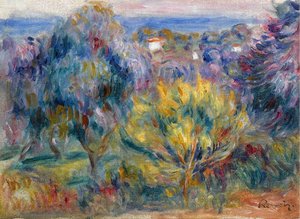
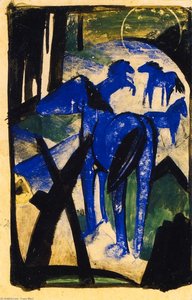
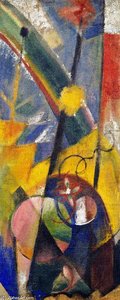
Artist Biography
A Life Immersed in Color and Spirit
Franz Moritz Wilhelm Marc, born in Munich in 1880, was a painter whose brief but intensely focused career irrevocably altered the course of German Expressionism. His story is one of profound spiritual seeking translated into a vibrant visual language, a quest to understand the essence of life through the purity he found in the natural world—particularly within the animal kingdom. Initially influenced by his father, Wilhelm Marc, a landscape painter, young Franz’s artistic path wasn't immediately certain. He briefly considered theology, grappling with questions of faith and existence before ultimately dedicating himself to art at the Academy of Fine Arts in Munich. These early explorations into religious thought would remain deeply embedded within his work, shaping his belief that art could be a conduit for spiritual experience. His academic training provided him with technical foundations, but it was encounters with the works of Vincent van Gogh during visits to Paris that truly ignited his artistic vision. Van Gogh’s emotive use of color and raw expression resonated profoundly with Marc, liberating him from conventional techniques and setting him on a path toward a more subjective and emotionally charged style.The Blue Rider and a New Artistic Vision
Marc's artistic development wasn’t solitary; it flourished within the dynamic context of early 20th-century Munich. He experimented with various artist groups, including the Neue Künstlervereinigung München, before co-founding *Der Blaue Reiter* (The Blue Rider) in 1911 alongside Wassily Kandinsky. This wasn’t merely a group or an exhibition series; it was a philosophical and artistic revolution. *Der Blaue Reiter* sought to move beyond mere representation, aiming instead to express inner spiritual truths through abstraction and symbolic color. The journal of the same name became a platform for disseminating these ideas, showcasing not only their own work but also that of other forward-thinking artists and exploring diverse cultural influences from folk art to primitive sculpture. Marc’s contributions during this period were pivotal. He moved away from depicting landscapes as static scenes, instead focusing on animals—horses, deer, foxes—as vessels of spiritual energy. These weren't simply animal portraits; they were symbolic representations of innocence, harmony, and a connection to the natural world that he believed humanity had lost. The influence of Robert Delaunay’s exploration of abstract forms and vibrant colors further propelled Marc toward simplification and heightened emotional expression in his work. Paintings like *The Tiger* (1912) and *Red Deer* (1912) exemplify this shift, showcasing bold color choices and a growing focus on the inherent qualities of his subjects rather than realistic depiction.Symbolism, Color, and the Essence of Being
Marc’s artistic style is immediately recognizable for its distinctive use of color and form. He didn't employ color descriptively; instead, he imbued it with symbolic meaning. Blue represented spirituality and masculinity, yellow signified joy and femininity, and red embodied violence and materiality. These weren’t arbitrary choices but a carefully constructed system designed to convey specific emotional and philosophical ideas. His animals aren’t merely subjects; they are embodiments of these concepts. The simplification of forms—reducing figures to their essential shapes—further emphasized the underlying spiritual essence he sought to capture. *The Tower of Blue Horses* (1913), sadly lost during World War II, is perhaps the most iconic example of this approach, a powerful and evocative composition that encapsulates his artistic vision. He believed animals possessed an inherent purity and connection to nature that humans had forfeited through societal constraints and intellectualization. By portraying them with such reverence and symbolic weight, Marc sought to remind viewers of this lost harmony and inspire a deeper appreciation for the natural world. His work wasn’t about depicting *what* he saw but rather *how* he felt—a deeply personal and spiritual response to his surroundings.A Tragic End and Lasting Legacy
The outbreak of World War I in 1914 dramatically altered Marc's life and artistic trajectory. Despite seeking exemption due to his status as an artist, he was drafted into the German army, serving as a cavalryman. The horrors of war deeply affected him, yet even amidst the chaos, he continued to paint, finding solace and meaning in his art. Tragically, Franz Marc died on March 4, 1916, at the Battle of Verdun, a devastating loss for the art world. His untimely death cut short a career brimming with potential, but it also cemented his place as a pivotal figure in modern art history. His work continues to resonate today, influencing generations of artists and captivating audiences with its emotional depth and spiritual resonance. Marc’s paintings are exhibited in major museums worldwide, including the Lenbachhaus in Munich, which holds an extensive collection of his work. He is remembered not only as a pioneer of German Expressionism but also as a visionary artist who dared to explore the profound connection between art, spirituality, and the natural world—a legacy that continues to inspire awe and contemplation. His artistic vision remains a testament to the power of art to transcend the material realm and touch upon something deeper within the human spirit.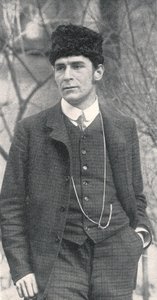
Franz Marc
1880 - 1916 , Germany
Quick Facts
- Artistic Movement Or Style: German Expressionism
- Artists Or Movements Influenced By This Artist:
- Abstract art
- Der Blaue Reiter
- Artists Who Influenced This Artist:
- Van Gogh
- Delaunay
- Date Of Birth: February 8, 1880
- Date Of Death: March 4, 1916
- Full Name: Franz Moritz Wilhelm Marc
- Nationality: German
- Notable Artworks:
- The Tiger
- Red Deer
- Tower of Blue Horses
- Place Of Birth: Munich, Germany

