
- Home

- Oil Painting Reproduction
- friedrich adler, metallwarenfabrik für kleinkunst walter scherf & co, nürnberg
 Preview
 Send
Send Share
Share
 Details

 Download
 Similars
 X-Ray
X-Ray Diaporama
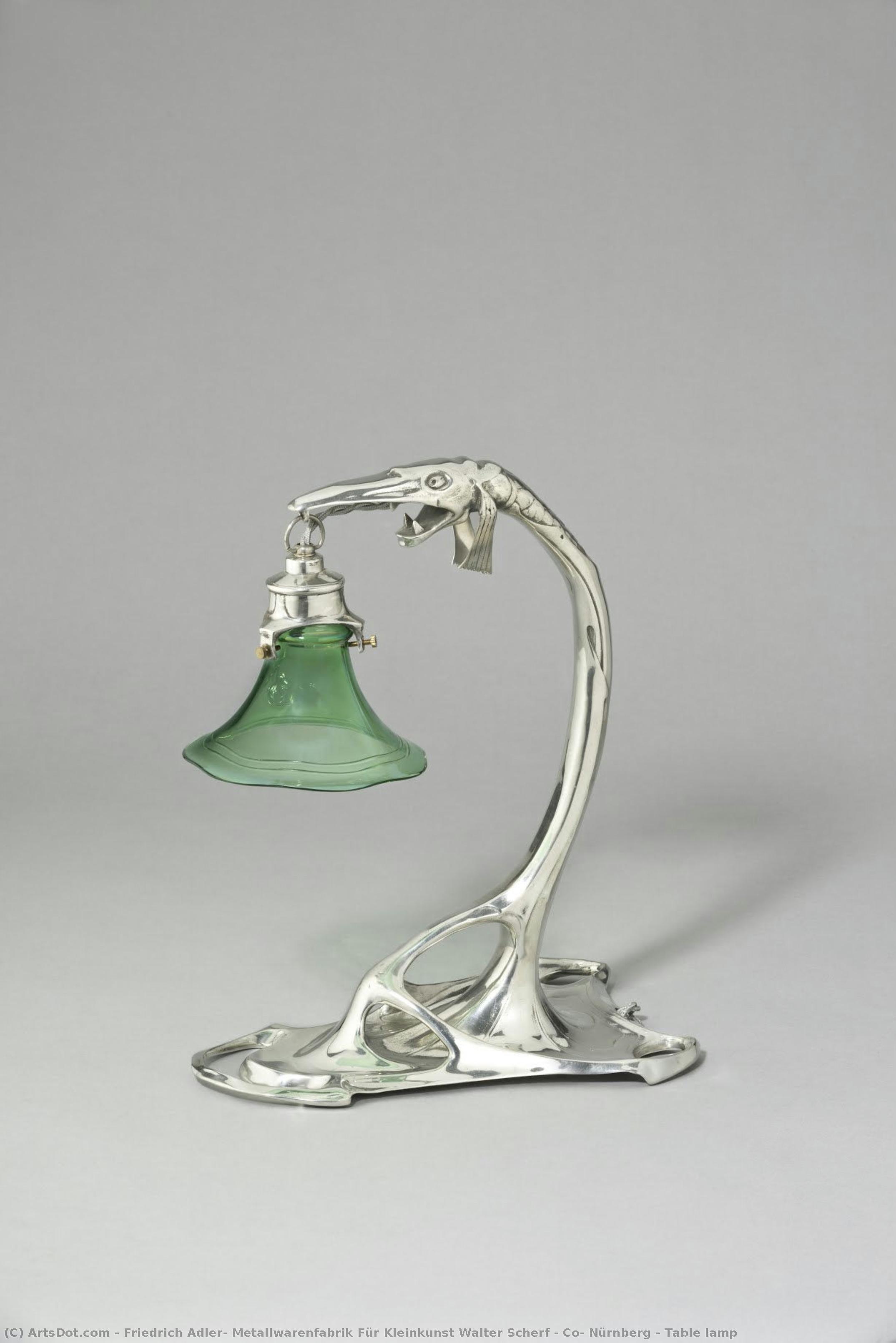
Table lamp

 Read More
Hand Made Oil Reproduction
Hand-painted oil on canvas in your size and frame, made to order by our artists. ( Buy Print Buy Image)




































Pick from our preset sizes that match the artwork's original proportions.

You may enter your own dimensions to fit a specific frame or space. If your selected size does not match the original image's proportions, we will either crop the artwork or extend the painting with additional hand-painted elements. A digital mockup will be sent for your approval before production begins.
Please note that the on-screen preview does not reflect the actual cropping or extension. Only the mockup will accurately show the final composition.
While custom sizes are available, we recommend selecting a dimension from the predefined list to preserve the original proportions.
After order, ArtsDot.com team will email client for instructions and provide a mockup preview
Worldwide Delivery () in 3/4 weeks instead of standard 5 weeks. (17 August). No compromise on quality.

Free Worldwide Express Shipping

High-Quality Linen Canvas

Full Shipping Insurance

Customs Tax Refund Guarantee

True Color Matching Guarantee

60-Day Return Policy (Defects Only)

100% Money-Back Guarantee

Bulk Discount Offer
 Glass option is only available in size under 110 CM

Table lamp
Reproduction Medium
Reproduction Size
-


Total Price
$ 263
Related Artworks


Artist Biography
A Life Interrupted: The Art and Tragic Fate of Friedrich Adler
Friedrich Adler, born in Laupheim, Germany, in 1878, was a multifaceted artist whose career blossomed during the vibrant years of Jugendstil and Art Deco. He embodied the spirit of his time—a fervent belief in the unity of art and life, and a dedication to craftsmanship that sought to elevate everyday objects into works of beauty. Adler wasn’t confined to a single medium; he excelled as an architect, furniture designer, ceramicist, and textile artist, but it was perhaps his metalwork designs, created for the Metallwarenfabrik für Kleinkunst Walter Scherf & Co. in Nürnberg, that cemented his reputation. His story is one of artistic innovation tragically cut short by the horrors of the Holocaust. Adler came from a family steeped in artisanal tradition; his father, Isidor Adler, was an affluent confectioner with a keen eye for aesthetics, commissioning an Italian Renaissance-style building to house his shop and family residence—a testament to the importance placed on visual culture within the family circle. This early exposure undoubtedly fostered Friedrich’s sensitivity to form and design.From Jugendstil Flourishes to Art Deco Geometry
Adler's artistic journey began with a formal education, initially at the local Jewish community school before progressing to the Laupheim Latin School and an international school in Mittenberg am Main. He then enrolled at the School of Applied Arts in Munich from 1894 to 1898, where he honed his skills under Hermann Obrist and Wilhelm Debschitz. His early work was deeply influenced by the flowing organic lines and natural motifs characteristic of Munich Jugendstil—a German variant of Art Nouveau. However, Adler wasn’t content with mere imitation. After a period of independent work, a move to Hamburg in 1907 marked a turning point. There, he absorbed the stricter linearity and geometric precision of Viennese Jugendstil, likely through his colleague Carl Otto Czeschka. This shift signaled a broader evolution in his style, foreshadowing the streamlined aesthetics of Art Deco. He became highly regarded as both an artist and teacher, eventually being nominated for a leading position at the Bavarian Applied Arts Museum in Nuremberg—a clear indication of his growing prominence within the artistic community.A Synthesis of Disciplines: Adler’s Artistic Output
Adler's genius lay in his ability to seamlessly integrate diverse artistic disciplines. His designs weren’t isolated creations but rather components of a holistic aesthetic vision. He produced textiles, ivory carvings, and leather goods, often publishing them in prominent art journals like *Kunst und Handwerk* and *Deutsche Kunst und Dekoration*. However, it was his collaboration with Walter Scherf & Co. that yielded some of his most recognizable works. The company, known for producing high-quality pewter objects under the trademarks Isis and Osiris, provided Adler with a platform to realize his designs on a larger scale. These metalwork pieces—table lamps, candlesticks, bowls, and other decorative items—are characterized by their elegant forms, intricate detailing, and masterful craftsmanship. Beyond metalwork, Adler also designed furniture that reflected his commitment to functional beauty, and he even ventured into ceramics, creating pieces that showcased his sensitivity to texture and color. His commission to design the entrance hall of the Württemburg display for the 1902 international exposition in Turin stands as a testament to his versatility and artistic authority.Pioneering Modern Judaica
Perhaps one of the most significant, yet often overlooked, aspects of Adler’s legacy is his pioneering work in modernizing Judaica—ritual objects used in Jewish religious practice. In 1908, he designed a silver spice container with clean lines and a perforated cover that rose to form a handle, representing a departure from traditional ornamentation. Three years later, he created a bulbous Torah crown for the Hamburg Temple, blending nineteenth-century shapes with the principles of Jugendstil aesthetics. These designs weren’t merely stylistic exercises; they represented a conscious effort to reconcile Jewish tradition with contemporary artistic sensibilities—a bold move that challenged conventional norms and paved the way for future generations of artists working within the Jewish community.A Life Silenced: Legacy and Remembrance
Tragically, Adler’s promising career was brutally interrupted by the rise of Nazism. As a Jew, he became increasingly vulnerable in Germany during the 1930s. He was ultimately deported to the Auschwitz-Birkenau concentration camp in 1942, where he perished. His story serves as a poignant reminder of the devastating impact of intolerance and persecution on artistic expression. Despite his untimely death, Adler’s work continues to resonate today. His designs—particularly those produced with Walter Scherf & Co.—are highly sought after by collectors and museums alike. He is remembered not only for his exceptional talent but also for his courage in challenging conventions and his commitment to creating beauty in a world increasingly consumed by darkness. Friedrich Adler’s legacy endures as a testament to the power of art, even in the face of unimaginable adversity—a poignant symbol of creativity lost, yet never forgotten. His work stands as a powerful reminder of the importance of preserving cultural heritage and honoring the artists whose voices were silenced by hatred.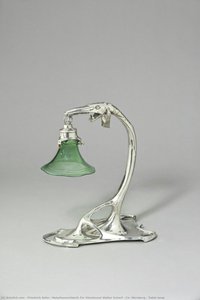
friedrich adler, metallwarenfabrik für kleinkunst walter scherf & co, nürnberg
1878 - 1942 , Germany
Quick Facts
- Artistic Movement Or Style: Jugendstil, Art Deco
- Date Of Birth: 1878
- Date Of Death: 1942
- Full Name: Friedrich Adler
- Nationality: German
- Notable Artworks: ['Table lamp']
- Place Of Birth: Laupheim, Germany

