Preview
 Send
Send Share
Share
 Details

 Download
 Similars
 X-Ray
X-Ray Diaporama
Allegory of Wealth
 Oil
Oil- WallArt
- Baroque
 1779
1779- Early Modern
 94.0 x 76.0 cm
 Kunsthalle Bremen
 Read More
Hand Made Oil Reproduction
Hand-painted oil on canvas in your size and frame, made to order by our artists. ( Buy Print Buy Image)




P118B $10

P118H $10

P118W $10

P438Z $10

P508JH $12

P508YH $12

P805H $10

P805Z $10

P919BZ $10

P919G $10

P919XJ $10

P959ZH $10

P968JZ $12

W106C $8

W218G $10

W218JH $8

W218Y $10

W307PJ $10

W316G $10

W316PJ $8

W316Y $10

W398PJ $8

W4111J $10

W500HY $15

W500JH $15

W692G $12

W849H $8

W940BG $15

W953PJ $8




Pick from our preset sizes that match the artwork's original proportions.

You may enter your own dimensions to fit a specific frame or space. If your selected size does not match the original image's proportions, we will either crop the artwork or extend the painting with additional hand-painted elements. A digital mockup will be sent for your approval before production begins.
Please note that the on-screen preview does not reflect the actual cropping or extension. Only the mockup will accurately show the final composition.
While custom sizes are available, we recommend selecting a dimension from the predefined list to preserve the original proportions.
After order, ArtsDot.com team will email client for instructions and provide a mockup preview
Worldwide Delivery () in 3/4 weeks instead of standard 5 weeks. (17 August). No compromise on quality.

Free Worldwide Express Shipping

High-Quality Linen Canvas

Full Shipping Insurance

Customs Tax Refund Guarantee

True Color Matching Guarantee

60-Day Return Policy (Defects Only)

100% Money-Back Guarantee

Bulk Discount Offer
 Glass option is only available in size under 110 CM

Allegory of Wealth
Reproduction Medium
Reproduction Size
-


Total Price
$ 263
Artwork Description
A Vision of Opulence and its Fragility
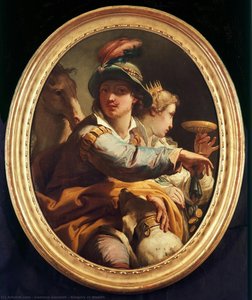
In the grand tradition of the Bolognese Baroque, Gaetano Gandolfi’s Allegory of Wealth serves as a profound meditation on the nature of earthly abundance. Created in 1779, this exquisite oval composition transcends mere portraiture to offer a complex narrative on status and the fleeting essence of material gain. The painting captures a middle-aged couple, draped in magnificent attire that speaks of high social standing, yet there is a palpable tension beneath the surface of their splendor. While one might expect a celebration of prosperity, Gandolfi weaves a subtle warning into the very fabric of the scene, inviting the viewer to look beyond the shimmering silks and golden vessels to find a deeper, more philosophical truth.
The composition is masterfully balanced, utilizing a dynamic arrangement of figures and animals to guide the eye through a landscape of luxury. At the heart of the work, the man and woman are positioned with a striking sense of detachment; unlike the idealized, romanticized couples found in pastoral idylls, these figures turn away from one another, suggesting that wealth can often act as a barrier to human connection. Surrounding them, the presence of powerful horses and a vigilant hunting hound reinforces their aristocratic identity, yet these elements also ground the allegory in a sense of earthly, physical reality. The interplay of light and shadow—a hallmark of Gandolf and his late Baroque training—adds a dramatic depth that makes the scene feel both intimate and monumental.
Symbolism and the Transient Nature of Gold
Every element within this masterpiece is imbued with symbolic weight, designed to provoke thought in the discerning observer. The man’s action of emptying a purse of coins, allowing the wealth to literally flow through his fingers, serves as a poignant memento mori—a reminder of the transience of all worldly possessions. This movement of gold acts as a visual metaphor for the inevitable loss of what we hold most dear. Complementing this is the woman’s golden drinking bowl, an object of beauty that nonetheless underscores the ephemeral nature of pleasure and consumption.
The painting also functions within a larger historical context, likely originally part of a series depicting the seasons of human life. If we view this work as representing the autumn of life, the themes of accumulation and eventual loss become even more resonant. For collectors and interior designers, this piece offers more than just aesthetic beauty; it provides a conversational centerpiece that explores the duality of human existence—the tension between the desire for permanence through wealth and the reality of our fleeting time on earth. A high-quality reproduction of this work brings not only the sophisticated elegance of 18th-century Italy into a space but also an enduring intellectual depth that continues to captivate the modern soul.
Related Artworks
Artist Biography
The Visionary of Bologna: The Life and Legacy of Gaetano Gandolfi
In the vibrant heart of the Italian late Baroque, a period defined by theatrical grandeur and emotional depth, the name Gaetano Gandolfi resonates as a symbol of artistic transition and mastery. Born in 1734 in San Mateo della Decima, near the illustrious city of Bologna, Gandolfi was destined for a life steeped in the aesthetics of his era. His very lineage was woven into the fabric of Italian art; with a brother, Ubaldo, and a son, Mauro, also pursuing the brush, the creative impulse was a familial inheritance. This early immersion provided him with a profound understanding of the discipline required to navigate the complex demands of painting, sculpture, and draughtsmanship.
Gandolfi’s formal journey began within the hallowed halls of the Accademia Clementina in Bologna. It was here that his raw talent was refined through rigorous classical training under the guidance of masters such as Felice Torelli and Ercole Lelli. This academic foundation did more than teach him technique; it instilled in him a reverence for the human form and the structural integrity of composition. His early prowess was quickly recognized by the academy, where he earned prestigious accolades for his skill in figure drawing and sculpture, signaling the arrival of a formidable talent capable of bridging the gap between the exuberant Baroque and the emerging clarity of Neoclassicism.
A Journey Through Light and Grandeur
The evolution of Gandolfi’s style was profoundly shaped by his travels and his encounters with the monumental. One of the most transformative moments in his career occurred during his journey to England, where he was exposed to the breathtaking illusionistic frescoes of Andrea Pozzo in the Sant’Ignazio Basilica. This encounter with quadratura—the art of painting architectural perspectives—deeply moved him, sparking an admiration for the sweeping, theatrical compositions perfected by Tiepolo. As a result, Gandolfi’s work began to exhibit a unique synthesis: the dramatic lighting and opulent ornamentation characteristic of the Baroque, infused with a newfound sense of spatial grandeur and airy elegance.
His repertoire was as diverse as his influences, ranging from the sacred to the profane. He possessed a singular ability to breathe life into biblical narratives and mythological legends, imbuing them with an emotional intensity that captivated both clergy and nobility alike. Whether depicting the divine intervention of a saint or the ethereal beauty of a mythological deity, Gandolfi utilized light not merely as a tool for visibility, but as a narrative force capable of evoking awe and spiritual contemplation.
The Enduring Impression of a Master
Beyond his grand canvases, Gandolfi was a master of the intimate. His portraits serve as windows into the 18th-century soul, capturing the dignity, status, and psychological depth of his subjects with remarkable precision. This versatility—the ability to command a massive frescoed ceiling and a delicate portrait with equal grace—is what secures his place in the pantheon of Italian masters. His work stands as a testament to a period of profound cultural shift, where the heavy shadows of the past were beginning to yield to the luminous clarity of a new age.
The historical significance of Gaetano Gandolfi lies in his role as a bridge between eras. He did not merely replicate the styles of his predecessors; he synthesized them into a cohesive visual language that reflected the intellectual fervor of Bologna. Today, his oeuvre remains a vital study for anyone seeking to understand the transition from the dramatic flourishes of the Baroque to the disciplined grace of Neoclassicism, ensuring that his luminous legacy continues to inspire awe in the hearts of art lovers worldwide.
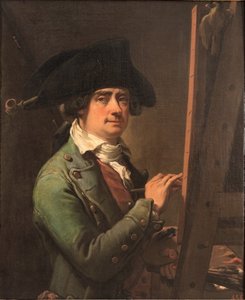
Gaetano Gandolfi
1734 - 1802 , Italy
Quick Facts
- Artistic Movement Or Style: Late Baroque & Neoclassical
- Artists Or Movements Influenced By This Artist: ['Tiepolo']
- Artists Who Influenced This Artist:
- Felice Torelli
- Ercole Graziani
- Date Of Birth: August 31, 1734
- Date Of Death: June 20, 1802
- Full Name: Gaetano Gandolfi
- Nationality: Italian
- Notable Artworks:
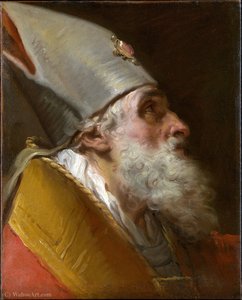
- Head of a Bishop
- Study of a Bearded Man
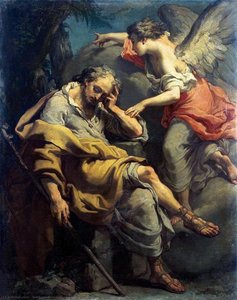
- Joseph's Dream
- Place Of Birth: San Mateo della Decima, Italy
Related Articles
Slate Blue Masterpieces: 10 Iconic Paintings & Timeless Home Decor Ideas
Immerse yourself in the captivating world of slate blue! Explore 10 iconic paintings by Monet, Van Gogh & Renoir. Discover their stories, techniques & find museum-quality art reproductions for your home at .
The Allure of Azure: Exploring the Symbolic & Aesthetic Depths of Blue in Art History
Explore the rich history of blue in art! Discover its symbolism, from ancient pigments to modern masterpieces by Kandinsky & Seurat. Uncover the psychological impact and cultural meanings behind this captivating hue.

Baroque Drama: Bringing Opulence & Emotion into Contemporary Interiors
Explore the opulent world of Baroque interior design! Discover key elements, modern applications & how to bring dramatic elegance into your home with 's authentic reproductions.

The Dramatic Flourish: Exploring the Baroque Movement's Enduring Legacy in Art History
Explore the dramatic world of Baroque art! Discover iconic artists like Caravaggio & Rubens, defining techniques, and its lasting impact on art history. Expert insights for collectors & enthusiasts at ArtsDot.

Baroque Masterpieces: 10 Paintings That Defined an Era |
Journey through the drama & grandeur of Baroque art! Explore 10 masterpieces by Caravaggio, Rembrandt, Rubens & more. Discover stunning oil paintings, rich colors & timeless stories. Find museum-quality reproductions at .