


 Preview
 Send
Send Share
Share
 Details

 Download
 Similars
 X-Ray
X-Ray Diaporama
Young Woman Sewing by the Light of a Lamp
 Acrylic On Canvas
- WallArt
- Biedermeier
 1823
1823- 19th Century
 40.0 x 34.0 cm
 Neue Pinakothek
 Read More
Purchase a high-resolution, enhanced digital image, far superior to the online preview.
Each file is meticulously prepared by our in-house specialists using advanced tools and expert manual retouching. We ensure every image has exceptional clarity, precise color accuracy, and fine detail.
The final file is delivered via email within 72 hours, optimized for immediate use in professional, editorial, and print environments. This is the same quality trusted by top-tier design studios, publishers, and galleries.
Digital Image
Download a high-resolution file for personal display, printing, and creative projects. ( Buy Print Buy Hand Made Painting)
Included in Every Digital Image Order
Expert Digital Delivery, Guaranteed
When you choose ArtsDot.com, you're not just getting an image - you're receiving a professionally enhanced digital artwork, crafted with precision and backed by a satisfaction guarantee. Here's everything that comes with your order, automatically:

Fast Email Delivery
Your high-resolution digital image file will be emailed to you within 72 hours of ordering - ready for immediate use.

AI-Enhanced Digital File
Your artwork is professionally optimized using advanced AI tools and manual editing, ensuring maximum detail, clarity, and color accuracy.

Free Lifetime Re-Delivery
Accidentally deleted or lost your file? No worries - we'll resend it to you anytime, free of charge.

No Import Fees - Ever
Enjoy your artwork instantly with zero customs, duties, or delivery fees - digital downloads are always tax-free.

Color Accuracy Guarantee
We ensure your digital image reflects the original colors as closely as possible using professional tools and color management.

60-Day Satisfaction Guarantee
If you're not satisfied with your digital image, we'll revise it or refund 100% within 60 days - no questions asked.

100% Money-Back Guarantee
Not satisfied? Get a full refund within 60 days of receiving your digital file - no questions asked.

Bulk Order Discounts
Buy 3 images, save 10% - Buy 5, save 15% - Buy 10+, save 20%. Great for creative projects, galleries, and agencies.
A Moment Frozen in Time: The Intimate World of Georg Friedrich Kersting
Georg Friedrich Kersting’s “Young Woman Sewing by the Light of a Lamp” isn't merely a portrait; it’s a carefully constructed tableau, a window into a quiet domesticity that speaks volumes about 19th-century life in Germany. Painted in 1823, this work exemplifies the Biedermeier style – a reaction against the grandiosity of Neoclassicism and Romanticism, favoring instead an emphasis on realism, intimacy, and everyday subjects. Kersting’s skill lies not in dramatic gesture or sweeping landscapes, but in his ability to capture the subtle nuances of human interaction within a confined space. The painting immediately draws us in with its soft light, emanating from both the lamp and the diffused glow filtering through the window – elements that create an atmosphere of warmth and tranquility despite the subject’s focused activity.
- Subject Matter: A young woman diligently sewing at a table, her face illuminated by lamplight. The scene is remarkably simple, yet profoundly engaging.
- Style: Biedermeier – characterized by its realism, focus on domestic life, and avoidance of overt sentimentality.
- Technique: Kersting’s meticulous attention to detail is evident in the rendering of fabrics, textures, and the subtle play of light and shadow. He employs a muted color palette, dominated by browns, creams, and blues, contributing to the painting's overall sense of calm.
The Symbolism of Light and Labor
Beyond its surface simplicity, “Young Woman Sewing” is rich in symbolic meaning. The lamp itself represents not just illumination but also a connection to domesticity and tradition – a beacon guiding the woman through her work. Her sewing, a commonplace activity, becomes imbued with significance within the context of the painting. It’s a quiet act of creation, a testament to female labor and skill, often overlooked in historical narratives. The arrangement of the room—the table, the chair, the window—suggests a space designed for comfort and productivity, reflecting the values of the Biedermeier aesthetic: order, practicality, and a celebration of the familiar.
Note the careful positioning of the woman’s hands – they are not overly dramatic or stylized; instead, they convey a sense of focused concentration and quiet determination. This understated realism is a hallmark of Kersting's style and contributes to the painting’s enduring appeal.A Glimpse into 19th-Century German Life
To understand “Young Woman Sewing,” it’s helpful to consider the historical context in which it was created. Prussia in the early 19th century was a society undergoing significant social and political change, yet also deeply rooted in tradition. The Biedermeier style emerged as a response to these shifting dynamics, offering a refuge from the turmoil of the Napoleonic era and the subsequent rise of Romanticism. Kersting’s painting provides a poignant glimpse into the lives of ordinary people – women particularly – who played a vital role in shaping society. His work reflects a growing interest in documenting everyday life and capturing the essence of German culture.
Replicas and Artistic Legacy
Reproductions of “Young Woman Sewing by the Light of a Lamp” offer an accessible way to experience Kersting’s masterful artistry. The meticulous detail and evocative atmosphere of the original painting are faithfully reproduced in high-quality prints, making it a beautiful addition to any home or office. Kersting's work continues to resonate with viewers today because it speaks to universal themes of domesticity, labor, and the quiet beauty of everyday life. His ability to capture such profound emotion within a seemingly simple scene is a testament to his skill as an artist and a keen observer of human nature.
Related Artworks
Artist Biography
The Quiet Observer: The Life and Legacy of Georg Friedrich Kersting
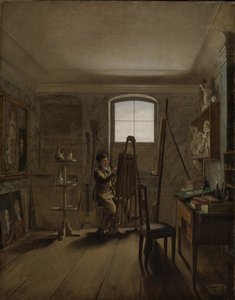
In the grand tapestry of German Romanticism, where dramatic peaks and tempestuous skies often dominate the visual narrative, there exists a more intimate, whispered beauty found in the works of Georg Friedrich Kersting. Born in 1785 in the modest village of Gostendorf to a glazier, Kersting’s journey from humble beginnings to the heights of Prussian artistic prestige is a testament to a life dedicated to the profound observation of the everyday. His early training at the Copenhagen Academy between 1805 and 1808 provided him with a foundation of stylistic clarity and meticulous draughtsmanship, earning him a silver medal and instilling in him a precision that would become his artistic hallmark.
Kersting’s life was not merely one of quiet studio contemplation; it was deeply intertwined with the turbulent political currents of his era. Upon moving to Dresden in 1808, he joined the Lützow Free Corps, a patriotic volunteer unit, embodying the spirit of national reform and service. This period of military involvement likely sharpened his eye for detail and human character, experiences that would later inform the psychological depth found in his paintings. It was during this era that he forged one of the most significant artistic bonds of the nineteenth century through his relationship with Caspar David Friedrich. Walking together through the rugged landscapes of the Riesengebirge, Kersting acted as both a companion and a collaborator, producing preparatory drawings that would serve as vital inspirations for Friedrich’s more monumental, sublime landscapes.
The Art of the Intimate: Style and Technique
While his mentor, Friedrich, sought to capture the infinite and the divine through overwhelming natural phenomena, Kersting found his calling in the Biedermeier tradition—a style characterized by a retreat into the domestic, the cozy, and the tranquil. He mastered the genre of interior scenes, transforming simple rooms into stages for quiet human drama. His technique was a sophisticated blend of Romantic sensitivity and a reverence for the seventeenth-century Dutch masters. By employing subtle nuances of light and color, Kersting could breathe life into a sunlit corner or a shadowed study, imbuing domesticity with a sense of dignity and timelessness.
His work is defined by several key artistic elements:
- Meticulous Realism: A dedication to the precise rendering of textures, from the grain of wooden furniture to the soft folds of fabric.
- Psychological Depth: The ability to capture fleeting moments of contemplation or quiet interaction, suggesting a rich inner life within his subjects.
- Luminous Atmosphere: A masterful use of light to create a sense of warmth and peace, often focusing on the way natural light enters a domestic space.
- The Beauty of the Ordinary: An elevated focus on everyday objects and scenes, finding profound meaning in the mundane aspects of life.
Historical Significance and Artistic Endurance
The historical importance of Georg Friedrich Kersting lies in his ability to bridge the gap between the sweeping emotionalism of Romanticism and the grounded, observational realism of the Biedermeier period. He provided a necessary counterpoint to the era's more grandiose movements, offering a window into the soul of the German middle class and the sanctity of the private sphere. His collaborations and his ability to translate the spirit of his time into intimate visual poetry ensure his place as a vital figure in European art history.
Through his paintings, Kersting invites us to slow our pace and find wonder in the stillness. He reminds us that greatness is not only found in the epic or the extraordinary, but in the quiet, light-filled moments of our shared human experience. His legacy remains a profound celebration of the beauty found within the boundaries of the home and the heart.
Georg Friedrich Kersting
1785 - 1847 , Germany
Quick Facts
- Artistic Movement Or Style: Biedermeier
- Artists Or Movements Influenced By This Artist: Dutch Genre Painting
- Artists Who Influenced This Artist: Caspar David Friedrich
- Date Of Birth: October 31, 1785
- Date Of Death: July 1, 1847
- Full Name: Georg Friedrich Kersting
- Nationality: German
- Notable Artworks:
- The Embroiderer
- Morning in the Riesengebirge
- Place Of Birth: Göstendorf, Germany

