 Preview
 Send
Send Share
Share
 Details

 Download
 Similars
 X-Ray
X-Ray Diaporama
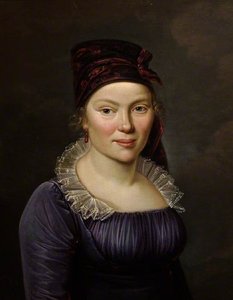
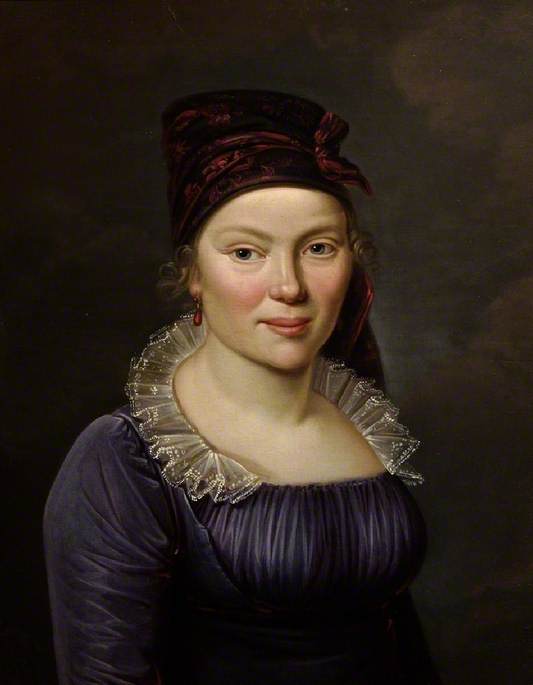
Portrait of an Unknown Lady
 61.0 x 49.0 cm
 Fitzwilliam College
 Read More
Hand Made Oil Reproduction
Hand-painted oil on canvas in your size and frame, made to order by our artists. ( Buy Print Buy Image)




































Pick from our preset sizes that match the artwork's original proportions.

You may enter your own dimensions to fit a specific frame or space. If your selected size does not match the original image's proportions, we will either crop the artwork or extend the painting with additional hand-painted elements. A digital mockup will be sent for your approval before production begins.
Please note that the on-screen preview does not reflect the actual cropping or extension. Only the mockup will accurately show the final composition.
While custom sizes are available, we recommend selecting a dimension from the predefined list to preserve the original proportions.
After order, ArtsDot.com team will email client for instructions and provide a mockup preview
Worldwide Delivery () in 3/4 weeks instead of standard 5 weeks. (27 August). No compromise on quality.

Free Worldwide Express Shipping

High-Quality Linen Canvas

Full Shipping Insurance

Customs Tax Refund Guarantee

True Color Matching Guarantee

60-Day Return Policy (Defects Only)

100% Money-Back Guarantee

Bulk Discount Offer
 Glass option is only available in size under 110 CM

Portrait of an Unknown Lady
Reproduction Medium
Reproduction Size
-


Total Price
$ 263
Related Artworks








Artist Biography
The Painter of Tranquility and Romantic Vision
George Augustus Wallis, born in the quiet surroundings of Merton, Surrey, in 1761, stands as a luminous figure in the transition from Neoclassicism to the emotive depths of Romanticism. His life was a grand odyssey across the European continent, a journey that mirrored the evolution of his brushwork from disciplined structure to atmospheric splendor. As a protégé of George Greville, the 2nd Earl of Warwick, Wallis was afforded an early and vital connection to the upper echelons of art patronage. This relationship provided not only financial stability but also an immersion in the artistic currents flowing through Warwick Castle, where he encountered the profound influence of German Romanticism through artists like Philipp Hackert. These early years laid the foundation for a career defined by a deep reverence for the sublime grandeur of the natural world.
The true metamorphosis of Wallis’s artistry occurred during his transformative travels through Italy between 1788 and 1790. Funded by the generosity of his patron, he embarked on a pilgrimage to Naples, Rome, and Sicily, immersing himself in an international community of luminaries. In the vibrant studios of Naples and the historic streets of Rome, Wallis encountered the works and methods of Joseph Anton Koch and Gottlieb Schick. These encounters acted as a catalyst, pushing him away from rigid classical conventions toward a more expressive, luminous style. His palette began to breathe with the warmth of Mediterranean light, and his landscapes acquired a palpable sense of immediacy and emotion, capturing not just the topography of a place, but its very soul.
A Legacy of Light and Landscape
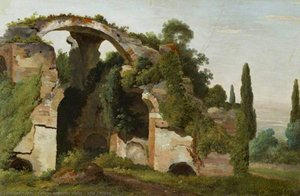
Wallis’s body of work is characterized by a remarkable versatility, ranging from monumental oil canvases that command attention to intimate watercolors that whisper of fleeting moments. His mastery of light became his signature, a technique that allowed him to render the textures of ancient ruins and lush foliage with breathtaking realism. One of his most enduring achievements is Villa Adriana, a masterpiece created in 1790 that serves as a poignant window into the Roman past. In this work, he achieves a delicate balance between meticulous historical detail and Romantic idealism, presenting the ruins not merely as decaying stone, but as a serene, timeless landscape imbued with a sense of melancholy beauty.
His ability to capture the human presence within nature is equally profound, as seen in Landscape near Rome. In this composition, the artist uses the figure of a man gazing into the distance to invite the viewer into his own state of contemplation, effectively bridging the gap between the observer and the observed. This technique of using figures to anchor the vastness of the landscape became a hallmark of his mature style. Beyond his landscapes, Wallis was also a skilled portraitist and fresco painter, particularly during his influential years teaching at the Accademia di Belle Arti in Florence. His later life, spent largely on the Continent—including periods in Spain and Germany—saw him acting as both an educator and an art dealer, further cementing his role in the broader European art market.
The historical significance of George Augustus Wallis lies in his role as a bridge between eras. He was a pioneer who helped usher in the Romantic landscape tradition by blending the structural integrity of German-influenced Neoclassicism with a new, emotive focus on atmospheric perspective and light. His life, marked by both political turbulence and artistic triumph, reflects the very essence of the 19th-century spirit: a restless search for beauty amidst the changing tides of history.
george augustus wallis
1761 - 1847
Quick Facts
- Artistic Movement Or Style: Romantic Landscape Painting
- Artists Or Movements Influenced By This Artist: ['Joseph Anton Koch']
- Artists Who Influenced This Artist: ['George Greville']
- Date Of Birth: 1761
- Date Of Death: 1847
- Full Name: George Augustus Wallis
- Nationality: English
- Notable Artworks:
- Villa Adriana
- Landscape near Rome
- Place Of Birth: Merton, Surrey