

 Preview
 Send
Send Share
Share
 Details

 Download
 Similars
 X-Ray
X-Ray Diaporama
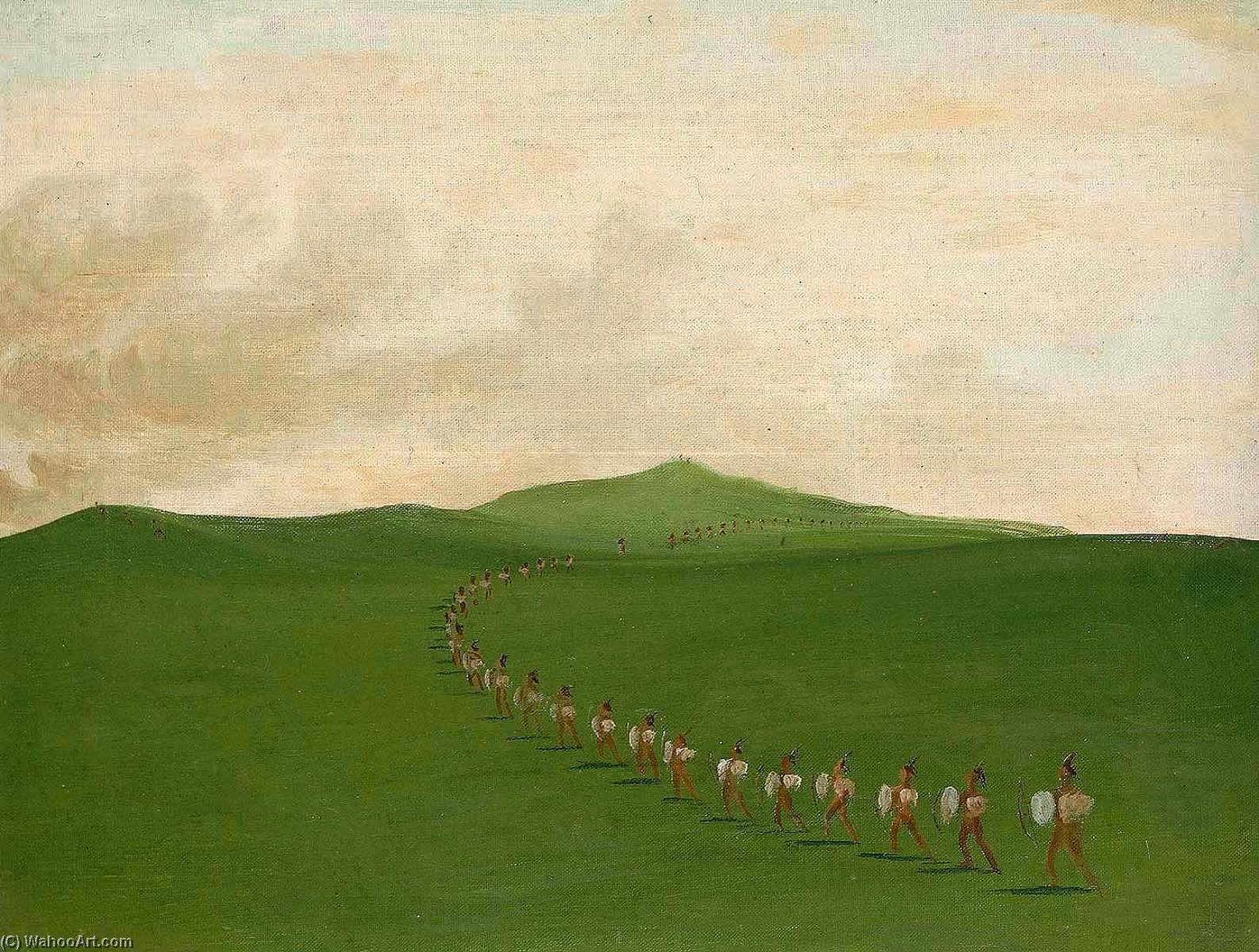
Foot War Party on the March, Upper Missouri
 Oil
Oil- WallArt
- American Realism
 1832
1832- 19th Century
 29.0 x 37.0 cm
 Read More
Purchase a high-resolution, enhanced digital image, far superior to the online preview.
Each file is meticulously prepared by our in-house specialists using advanced tools and expert manual retouching. We ensure every image has exceptional clarity, precise color accuracy, and fine detail.
The final file is delivered via email within 72 hours, optimized for immediate use in professional, editorial, and print environments. This is the same quality trusted by top-tier design studios, publishers, and galleries.
Digital Image
Download a high-resolution file for personal display, printing, and creative projects. ( Buy Print Buy Hand Made Painting)
Included in Every Digital Image Order
Expert Digital Delivery, Guaranteed
When you choose ArtsDot.com, you're not just getting an image - you're receiving a professionally enhanced digital artwork, crafted with precision and backed by a satisfaction guarantee. Here's everything that comes with your order, automatically:

Fast Email Delivery
Your high-resolution digital image file will be emailed to you within 72 hours of ordering - ready for immediate use.

AI-Enhanced Digital File
Your artwork is professionally optimized using advanced AI tools and manual editing, ensuring maximum detail, clarity, and color accuracy.

Free Lifetime Re-Delivery
Accidentally deleted or lost your file? No worries - we'll resend it to you anytime, free of charge.

No Import Fees - Ever
Enjoy your artwork instantly with zero customs, duties, or delivery fees - digital downloads are always tax-free.

Color Accuracy Guarantee
We ensure your digital image reflects the original colors as closely as possible using professional tools and color management.

60-Day Satisfaction Guarantee
If you're not satisfied with your digital image, we'll revise it or refund 100% within 60 days - no questions asked.

100% Money-Back Guarantee
Not satisfied? Get a full refund within 60 days of receiving your digital file - no questions asked.

Bulk Order Discounts
Buy 3 images, save 10% - Buy 5, save 15% - Buy 10+, save 20%. Great for creative projects, galleries, and agencies.
Collectible Description
A Journey Through Time: The Spirit of the Upper Missouri
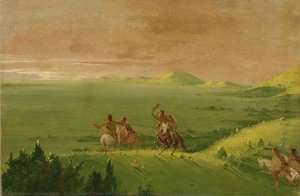
In the vast, sweeping expanse of the American frontier, few artists captured the ephemeral beauty of a vanishing world as poignantly as George Catlin. His masterpiece, Foot War Party on the March, Upper Missouri, serves as more than just a visual record; it is a window into a moment of profound movement and cultural endurance. Painted in 1832, this work transports the viewer to the rugged landscapes of the Upper Missouri, where a group of travelers traverses a verdant, grassy plain under the watchful gaze of distant mountains. The scene is alive with the rhythmic energy of a community in motion, capturing a sense of purposeful migration that feels both intimate and epic in scale.
The composition masterfully balances the individual within the collective. As the eye wanders across the canvas, one encounters figures scattered throughout the field—some clustered in shared conversation or labor, others solitary against the vastness of the horizon. This deliberate arrangement creates a dynamic sense of depth and life, suggesting that every person in this procession carries their own story, their own weight, and their own destination. The presence of an animal toward the periphery adds a touch of natural realism, grounding the human drama within the untamed ecology of the American West.
The Artistry of Documentation and Emotion
Catlin’s technique is characterized by an urgent, documentary-style realism that avoids the stiff formality often found in nineteenth-century portraiture. His brushwork conveys a palpable sense of atmosphere, capturing the light as it washes over the plains and the subtle textures of the landscape. There is a raw, honest quality to his application of color that reflects his deep-seated mission: to document the traditions and appearances of Native American tribes before they were irrevocably altered by westward expansion. This piece is not merely an observation of scenery; it is an emotional testament to resilience.
For the discerning collector or interior designer, this painting offers a profound sense of narrative depth. It possesses the rare ability to anchor a room with its historical gravity while providing a window of tranquility and exploration. The interplay between the soft, rolling hills and the determined movement of the figures evokes a feeling of nostalgia and respect for the enduring human spirit. Whether placed in a curated gallery setting or as a focal point in a sophisticated living space, Foot War Party on the March invites continuous contemplation, making it an exquisite choice for those who value art that tells a story of heritage, movement, and the timeless beauty of the natural world.
Related Artworks
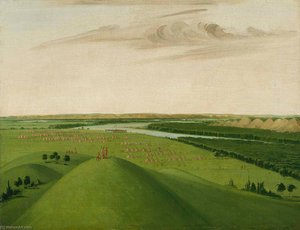
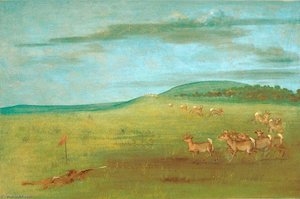
Artist Biography
Early Life and the Call of the Frontier
George Catlin, born in Wilkes-Barre, Pennsylvania, in 1796, was a man destined to become a bridge between worlds—the established American society of his time and the rapidly vanishing cultures of Native American tribes. His childhood was deeply imprinted with tales of the frontier, stories recounted by his mother, Polly Sutton, who had herself endured the harrowing experience of capture during an Indian raid. These narratives ignited within young Catlin a fascination with the West, a land perceived as both dangerous and profoundly romantic. Though initially trained in law, he discovered his true calling not within the courtroom but in capturing the essence of a way of life he feared was slipping away. He abandoned legal practice after only two years, driven by an artistic impulse and a growing conviction that the traditions and appearances of Native Americans deserved meticulous documentation for posterity. This wasn’t merely aesthetic curiosity; it was a sense of urgency, a premonition that westward expansion would irrevocably alter these cultures. His early work involved engravings depicting scenes along the Erie Canal, demonstrating his technical skill and attention to detail—qualities that would become hallmarks of his later, more ambitious projects. These initial endeavors served as a crucial foundation, honing his observational abilities and establishing his commitment to visual storytelling.Documenting a Vanishing World: The Indian Gallery
Catlin’s defining achievement was undoubtedly the creation of “The Indian Gallery,” an extraordinary collection of over 500 paintings dedicated to portraying Native American life and culture. Beginning in the 1830s, he embarked on five extensive expeditions into the American West, traveling up the Missouri River and venturing into territories inhabited by tribes such as the Mandan, Sioux, Blackfeet, and Choctaw. He wasn’t simply an observer; Catlin immersed himself within these communities, participating in ceremonies, witnessing daily life, and forging relationships with tribal leaders. His paintings are remarkable for their realism and vibrant colors, capturing not only physical likenesses but also a sense of the dignity and complexity of Native American customs. Ball-Play of the Choctaw, for example, is a dynamic depiction of a traditional game, showcasing the athleticism and communal spirit of the tribe. Similarly, his portrait of Mó-sho-la-túb-bee, He Who Puts Out and Kills, Chief of the Tribe, reveals a powerful leader with an unwavering gaze, conveying both authority and wisdom. Catlin’s style is characterized by meticulous detail, often including elaborate backgrounds that provide context for his subjects—landscapes, tipis, ceremonial objects—all rendered with a keen eye for accuracy. He sought to present Native Americans not as savage stereotypes but as individuals with rich cultural traditions and complex social structures, challenging the prevailing prejudices of his time.Challenges and Recognition: A Life Dedicated to Preservation
Despite the artistic merit and historical significance of The Indian Gallery, Catlin faced considerable challenges in gaining recognition and financial support for his work. He envisioned donating the collection to the U.S. government, hoping it would be preserved as a national treasure, but his initial proposals were repeatedly rejected. Undeterred, he took his gallery on tour, exhibiting it first in London, then Paris, and Berlin during the 1840s and 50s. These European exhibitions garnered considerable acclaim, introducing audiences to a world they had previously only known through secondhand accounts. Catlin also published several books detailing his travels and observations, including Manners, Customs, and Condition of the North American Indians (1841) and Last Rambles Amongst the Indians of the Rocky Mountains and the Andes (1868), further solidifying his reputation as a leading authority on Native American culture. However, financial difficulties continued to plague him throughout his life. In a desperate attempt to recoup some of his investment, he recreated over 400 paintings in a smaller “cartoon collection,” but even this effort failed to yield substantial returns. This period was marked by constant struggle and a poignant irony—a man dedicated to preserving a culture facing extinction found himself battling for his own survival.Legacy and Historical Significance
George Catlin died in 1872, leaving behind a legacy that continues to resonate today. While his work wasn’t fully appreciated during his lifetime, it has since been recognized as an invaluable historical record of Native American life before the sweeping changes brought about by westward expansion. His paintings offer a glimpse into cultures that were often misrepresented or ignored in mainstream narratives. Prairie Meadows Burning, with its dramatic depiction of a controlled burn and accompanying riders, captures not only the landscape but also the intimate relationship between Native Americans and their environment. Pipestone Quarry, Coteau Des Prairies illustrates the spiritual significance of this sacred site for many tribes. Catlin’s meticulous documentation provides insights into tribal customs, social structures, religious beliefs, and artistic traditions—information that would have been lost to history without his dedicated efforts. His work serves as a powerful reminder of the importance of cultural preservation and the need to challenge preconceived notions about indigenous peoples. He wasn't simply an artist; he was a chronicler, a witness, and a passionate advocate for a vanishing way of life—a legacy that continues to inspire and inform our understanding of American history and culture.Key Works
- Sham Fight, Mandan Boys (1832-1833): A lively depiction of a playful mock battle among young Mandan warriors.
- Mrs. George Catlin (Clara Bartlett Gregory) (1850): A portrait showcasing the artist’s wife, offering insight into his personal life.
- Pipestone Quarry, Coteau Des Prairies (1848): Illustrates a sacred site for many tribes and their spiritual connection to the land.
- Medicine Buffalo of the Sioux (1839): A striking portrait capturing the dignity and power of a prominent Sioux leader.
- Prairie Meadows Burning (1832): Depicts a dramatic scene of controlled burning, highlighting the relationship between Native Americans and their environment.
- Dubuque's Grave, Upper Mississippi (1836): A landscape painting capturing the serene beauty of the Upper Mississippi region with Impressionistic brushwork.
- Eagle Dance, Choctaw (1837): A vibrant portrayal of a traditional Choctaw ceremony, showcasing their rich cultural heritage.
- Little Wolf, A Famos Warrior (1844): A powerful portrait of a Native American warrior, symbolizing strength and resilience.
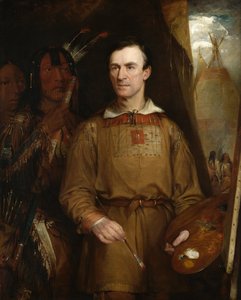
George Catlin
1796 - 1872 , United States of America
Quick Facts
- Artistic Movement Or Style: Frontier painting
- Date Of Birth: 1796
- Date Of Death: 1872
- Full Name: George Catlin
- Nationality: American
- Notable Artworks:
- Sham Fight, Mandan Boys
- Prairie Meadows Burning
- Pipestone Quarry
- Medicine Buffalo of Sioux
- Eagle Dance, Choctaw
- Place Of Birth: Wilkes-Barre, USA

