 Preview
 Send
Send Share
Share
 Details

 Download
 Similars
 X-Ray
X-Ray Diaporama
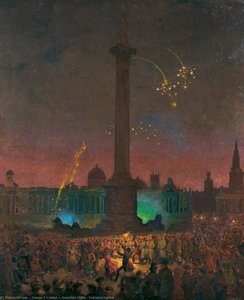
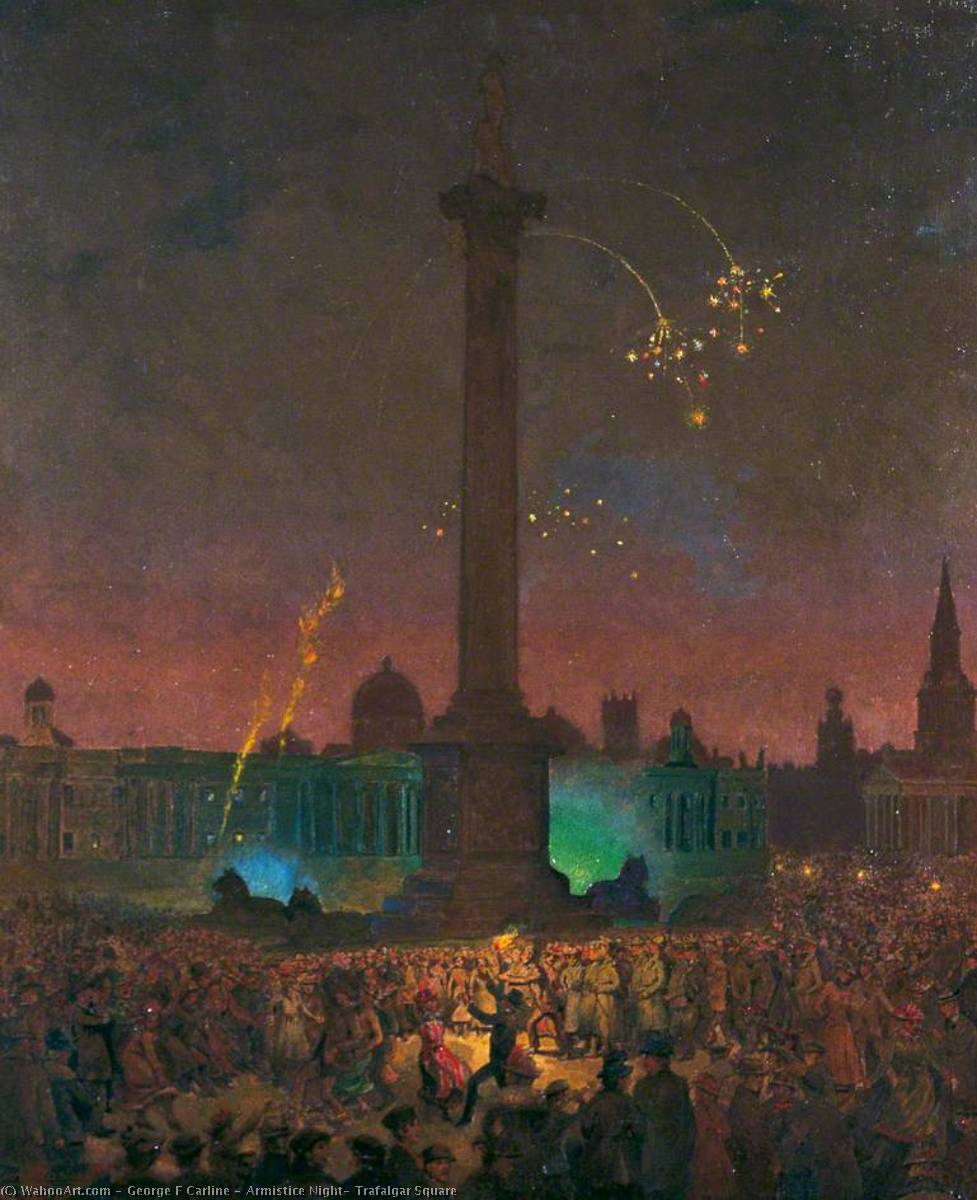
Armistice Night, Trafalgar Square
 1918
1918 76.0 x 64.0 cm
 Government Art Collection
 Read More
Giclée / Art Print
Museum-quality giclée or canvas print with fast production and flexible finish options. ( Buy Hand Made Painting Buy Image)




































Pick from our preset sizes that match the artwork's original proportions.

You may enter your own dimensions to fit a specific frame or space. If your selected size does not match the original image's proportions, we will either crop the artwork or extend the image with a mirrored or solid-fill edge. A digital mockup will be sent for your approval before production begins.
Please note that the on-screen preview does not reflect the actual cropping or extension. Only the mockup will accurately show the final composition.
While custom sizes are available, we recommend selecting a dimension from the predefined list to preserve the original proportions.
Worldwide Delivery () in 2 weeks instead of standard 4/5 weeks. (26 August)

Free Worldwide Express Shipping

High-Quality Linen Canvas

Full Shipping Insurance

Customs Tax Refund Guarantee

True Color Matching Guarantee

60-Day Return Policy (Defects Only)

100% Money-Back Guarantee

Bulk Discount Offer
 Glass option is only available in size under 110 CM

Armistice Night, Trafalgar Square
Giclée / Art Print
Reproduction Size
-


Total Price
$ 63
Related Artworks









Artist Biography
A Legacy of Light and Landscape: The Life of George Francis Carline
Born amidst the rolling vistas of Lincolnshire in 1855, George Francis Carline was a painter whose soul was deeply entwined with the English countryside. His journey from the formative years at Lincoln Grammar School to the prestigious studios of Europe reflects a life dedicated to the pursuit of aesthetic truth. Carline was not merely an observer of nature but a translator of its most delicate moments, capturing the ephemeral dance of light across fields and the quiet dignity of rural existence. His artistic lineage is equally remarkable; he stood as the patriarch of a true artistic dynasty, nurturing the talents of his children—Sydney, Richard, and Hilda—each of whom would go on to leave their own indelible marks on the canvas of art history.
The development of Carline’s technique was a sophisticated blend of rigorous classical training and an openness to the burgeoning modern movements of his era. After honing his foundational skills at the Lincoln School of Art, he sought the intellectual and creative stimulation offered by London’s Heatherley’s School of Fine Art. However, it was his travels to the great art capitals of Antwerp and Paris, specifically studying at the Académie Julian, that truly expanded his visual vocabulary. Immersed in the atmosphere of the Impressionist revolution, Carline absorbed the revolutionary approaches to color and light championed by masters such as Claude Monet and Camille Pissarro. This exposure allowed him to infuse his traditional British landscapes with a vibrant, atmospheric quality that bridged the gap between meticulous realism and emotive impressionism.
Mastery of the English Pastoral
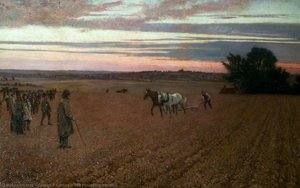
Carline’s oeuvre is celebrated for its ability to evoke a profound sense of nostalgia and tranquility. He possessed an extraordinary gift for capturing the subtle nuances of the natural world, particularly the golden, sun-drenched landscapes of his native Lincolnshire. His works often feature a harmonious interplay of warmth and texture, where meticulous brushstrokes meet expressive light. One might look upon The Ploughing Match (1892) and feel the heavy, rhythmic pulse of agricultural life, or find themselves lost in the luminous beauty of In the Garden of Hollyhocks (1890), a piece lauded for its bright and gorgeous harmony. Whether depicting the sweeping vistas of a harvest landscape or the intimate details of a rustic interior, Carline’s work remains anchored in a deep respect for the subject matter.
Beyond his landscapes, Carline demonstrated a remarkable versatility through his portraiture and illustrations. His ability to capture character was evident in his portraits of distinguished figures such as the historians Sir Charles Oman and Professor Sir Paul Vinogradoff. This skill extended into the realm of book illustration, notably his 1915 work for Andrew Lang’s Oxford, which showcased his capacity to marry narrative with visual elegance. His exhibition history further cements his status within the British art establishment; he was a frequent and respected presence at the Royal Academy, the Royal Institute of Painters in Watercolours, and the Royal Society of British Artists.
Historical Significance and Enduring Spirit
The historical significance of George Francis Carline lies in his role as a bridge between the Victorian tradition and the dawn of modernism. While his roots remained firmly planted in the Romantic sensibility of his youth, his technical execution embraced the light-filled innovations of the late 19th century. His life, which came to an unexpected end in Assisi, Italy, in 1920, was a testament to the enduring power of the landscape as a subject of profound human connection. Today, his works serve as vital windows into a bygone era of English pastoral beauty, reminding us of a time when the artist's gaze was intimately tied to the rhythms of the earth and the changing light of the seasons.
george f carline
1855 - 1920
Quick Facts
- Artistic Movement Or Style: Impressionism
- Artists Or Movements Influenced By This Artist: ['Stanley Spencer']
- Artists Who Influenced This Artist: ['Gustave Moreau']
- Date Of Birth: July 11, 1855
- Date Of Death: November 28, 1920
- Full Name: George Francis Carline
- Nationality: British
- Notable Artworks:
- In the Garden of Hollyhocks
- The Ploughing Match
- Place Of Birth: Lincoln, England