 Preview
 Send
Send Share
Share
 Details

 Download
 Similars
 X-Ray
X-Ray Diaporama
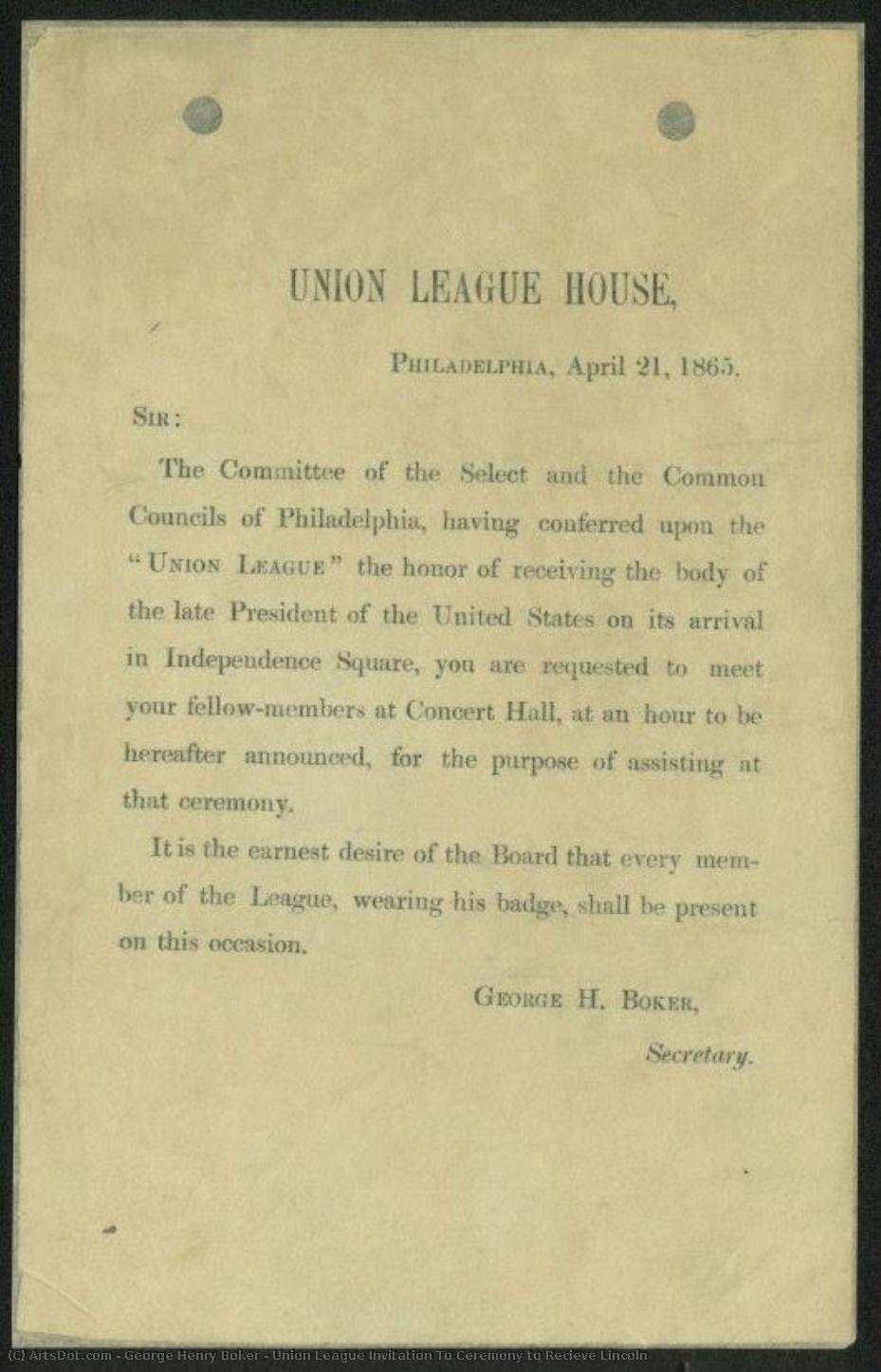
Union League Invitation To Ceremony to Recieve Lincoln


 Read More
Hand Made Oil Reproduction
Hand-painted oil on canvas in your size and frame, made to order by our artists. ( Buy Print Buy Image)




































Pick from our preset sizes that match the artwork's original proportions.

You may enter your own dimensions to fit a specific frame or space. If your selected size does not match the original image's proportions, we will either crop the artwork or extend the painting with additional hand-painted elements. A digital mockup will be sent for your approval before production begins.
Please note that the on-screen preview does not reflect the actual cropping or extension. Only the mockup will accurately show the final composition.
While custom sizes are available, we recommend selecting a dimension from the predefined list to preserve the original proportions.
After order, ArtsDot.com team will email client for instructions and provide a mockup preview
Worldwide Delivery () in 3/4 weeks instead of standard 5 weeks. (7 September). No compromise on quality.

Free Worldwide Express Shipping

High-Quality Linen Canvas

Full Shipping Insurance

Customs Tax Refund Guarantee

True Color Matching Guarantee

100-Day Return Policy (Defects Only)

100% Money-Back Guarantee

Bulk Discount Offer
 Glass option is only available in size under 110 CM

Union League Invitation To Ceremony to Recieve Lincoln
Reproduction Medium
Reproduction Size
-


Total Price
$ 263
Related Artworks





Artist Biography
A Poet Amidst the Shadows of Lincoln’s Era
Born into the refined atmosphere of Philadelphia in 1823, George Henry Boker was a man whose life unfolded against the grand and often turbulent tapestry of nineteenth-century America. The son of a prominent banker, Boker was raised in an environment of intellectual ease and cultural sophistication, a foundation that allowed his innate literary talents to flourish from a very young age. His early education, shaped by private schooling and later refined at Princeton University, instilled in him a profound devotion to the classics and the rhythmic beauty of verse. It was during his collegiate years that Boker first demonstrated his editorial prowess, helping to found the Nassau Monthly, a venture that signaled the arrival of a significant new voice in American letters.
Boker’s creative spirit was deeply rooted in the traditions of Romanticism. He drew immense inspiration from the lyrical landscapes of Wordsworth and the haunting, atmospheric depths of Coleridge, channeling these influences into poetry that sought to capture the sublime. His work often wandered through meditations on mortality and the sweeping vistas of the Pennsylvania landscape, possessing a quiet dignity that resonated with the era's fascination with nature and the human soul. While he initially pursued the study of law—a profession that would later serve him well in the corridors of international diplomacy—the irresistible pull of the written word eventually led him to abandon the courtroom for the much more evocative realms of poetry and drama.
The Stage and the State: A Multifaceted Legacy
Beyond the solitary pursuit of verse, Boker emerged as a significant figure in the American theatrical landscape. His plays, most notably Francesca da Rimini, showcased a mastery of dramatic tension and a nuanced understanding of social complexity. Through his theatrical writing, he was able to tackle the pressing issues of his day with a compassion that bridged the gap between high art and public discourse. This engagement with society was not limited to the stage; Boker was a man of action and civic duty during one of the most transformative periods in American history.
During the dark years of the Civil War, Boker’s commitment to the Union was palpable. He played a pivotal role in the founding of the Union League of Philadelphia in 1862, an organization dedicated to raising funds for the war effort and encouraging enlistment. His involvement in such progressive causes underscores a life lived at the intersection of artistic sensitivity and political responsibility. This period of Reconstruction demanded leaders who could navigate the profound societal shifts following the conflict, and Boker’s work with the League exemplified his dedication to the stability and progress of the nation.
The latter part of Boker's life saw him transition from the literary salons of Philadelphia to the grand diplomatic stages of Europe and the Near East. His intellect and refined manner made him an ideal representative for the United States, serving as Consul General to Mexico and later as a minister to both Turkey and Russia. These diplomatic missions allowed him to carry the American spirit abroad, navigating complex international relations with the same grace he brought to his poetic meter. Though his name may not echo with the same thunder as some of his contemporaries, George Henry Boker remains a vital figure whose life work reflects the profound beauty, struggle, and transformation of the nineteenth-century American experience.

george henry boker
1823 - 1890 , United States of America
Quick Facts
- Artistic Movement Or Style: Romantic poetry
- Artists Or Movements Influenced By This Artist: ['Transcendentalism']
- Artists Who Influenced This Artist: ['Henry Wadsworth Longfellow']
- Date Of Birth: October 6, 1823
- Date Of Death: January 2, 1890
- Full Name: George Henry Boker
- Nationality: American
- Notable Artworks: ['Union League Invitation']
- Place Of Birth: Philadelphia, Pennsylvania