

 Preview
 Send
Send Share
Share
 Details

 Download
 Similars
 X-Ray
X-Ray Diaporama
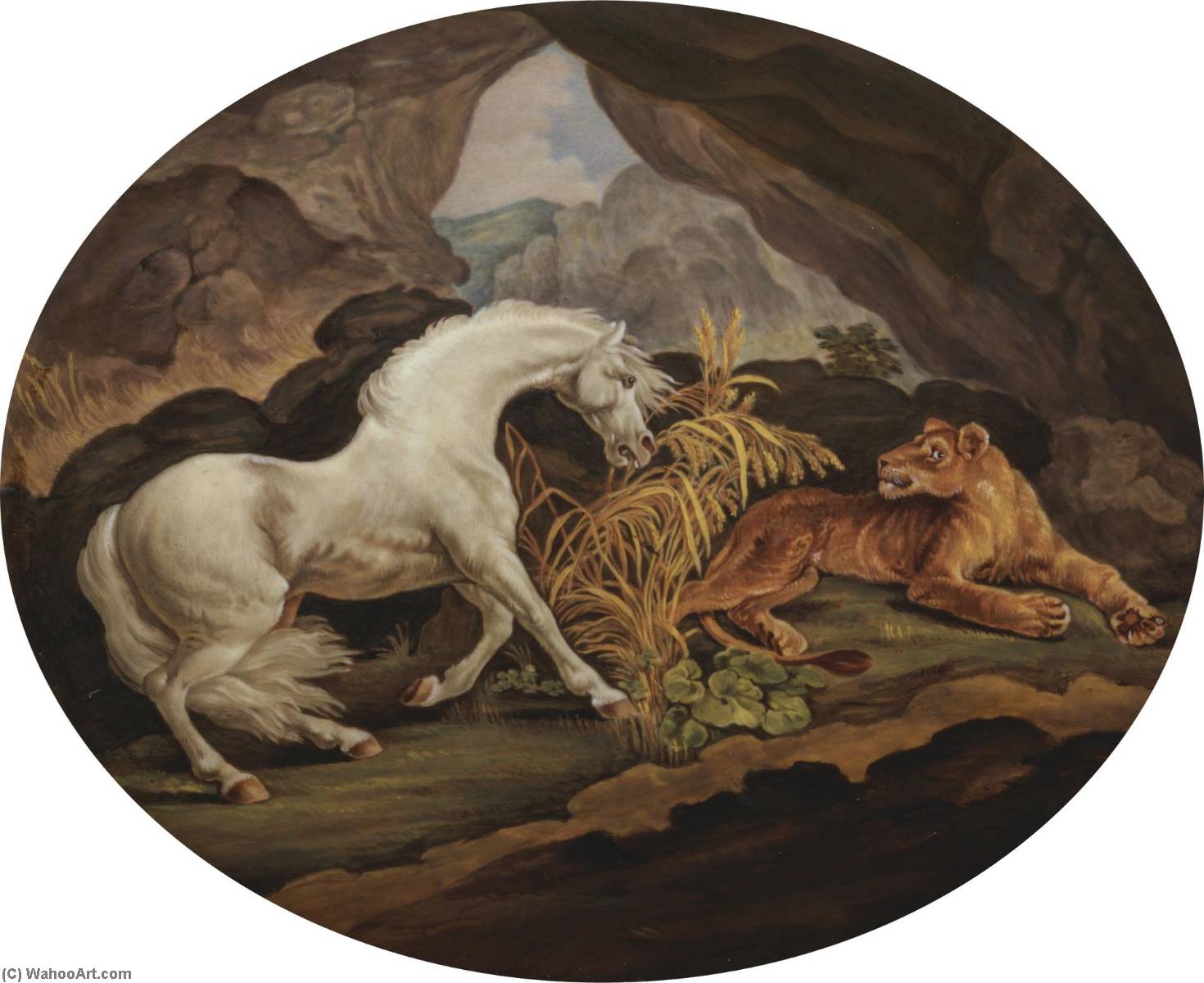
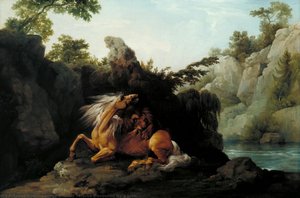
A Horse Frightened by a Lioness


 Read More
Purchase a high-resolution, enhanced digital image, far superior to the online preview.
Each file is meticulously prepared by our in-house specialists using advanced tools and expert manual retouching. We ensure every image has exceptional clarity, precise color accuracy, and fine detail.
The final file is delivered via email within 72 hours, optimized for immediate use in professional, editorial, and print environments. This is the same quality trusted by top-tier design studios, publishers, and galleries.
Digital Image
Download a high-resolution file for personal display, printing, and creative projects. ( Buy Print Buy Hand Made Painting)
Included in Every Digital Image Order
Expert Digital Delivery, Guaranteed
When you choose ArtsDot.com, you're not just getting an image - you're receiving a professionally enhanced digital artwork, crafted with precision and backed by a satisfaction guarantee. Here's everything that comes with your order, automatically:

Fast Email Delivery
Your high-resolution digital image file will be emailed to you within 72 hours of ordering - ready for immediate use.

AI-Enhanced Digital File
Your artwork is professionally optimized using advanced AI tools and manual editing, ensuring maximum detail, clarity, and color accuracy.

Free Lifetime Re-Delivery
Accidentally deleted or lost your file? No worries - we'll resend it to you anytime, free of charge.

No Import Fees - Ever
Enjoy your artwork instantly with zero customs, duties, or delivery fees - digital downloads are always tax-free.

Color Accuracy Guarantee
We ensure your digital image reflects the original colors as closely as possible using professional tools and color management.

60-Day Satisfaction Guarantee
If you're not satisfied with your digital image, we'll revise it or refund 100% within 60 days - no questions asked.

100% Money-Back Guarantee
Not satisfied? Get a full refund within 60 days of receiving your digital file - no questions asked.

Bulk Order Discounts
Buy 3 images, save 10% - Buy 5, save 15% - Buy 10+, save 20%. Great for creative projects, galleries, and agencies.
Collectible Description
George Stubbs’s “A Horse Frightened by a Lion”: A Study in Romantic Tension
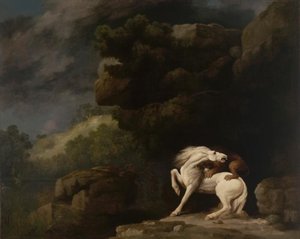
George Stubbs's "A Horse Frightened by a Lion," painted around 1770, isn’t merely a depiction of an animal encounter; it’s a carefully constructed tableau brimming with symbolic weight and embodying the nascent spirit of Romanticism. This arresting image, housed in the Walker Art Gallery in Liverpool, immediately commands attention through its dynamic composition – a white stallion, frozen mid-leap, radiating palpable terror against the looming silhouette of a lion poised to strike. Stubbs, a master of anatomical precision honed through years of dissecting horses and studying animal anatomy, elevates this scene beyond simple observation, transforming it into a profound meditation on fear, power, and the precarious balance between predator and prey.
The painting’s genesis lies in a confluence of artistic currents. Stubbs, already recognized for his groundbreaking depictions of equine subjects – notably “Whistlejacket,” another iconic image exploring animal emotion – was deeply influenced by the philosophical ideas circulating at the time. Edmund Burke's "Philosophical Enquiry into the Origin of Our Ideas of the Sublime and Beautiful," published in 1756, provided a theoretical framework for understanding experiences that evoke awe and terror. Burke argued that these powerful emotions—the sublime—arise from confronting objects or situations perceived as threatening or overwhelming, triggering a heightened state of awareness. “A Horse Frightened by a Lion” perfectly embodies this concept; the horse’s frantic posture, its wide eyes reflecting an almost human-like terror, and the lion's predatory stillness create a scene ripe with dramatic tension.
The Anatomy of Emotion: Technique and Composition
Stubbs’s technical mastery is immediately evident in the incredibly detailed rendering of both animals. The stallion’s musculature is meticulously depicted, conveying the sheer force of its leap while simultaneously capturing the vulnerability of its posture. Notice how Stubbs uses light and shadow to sculpt the forms, emphasizing the horse's frantic movement and creating a sense of depth within the composition. The lion, rendered with a controlled restraint, possesses an inherent menace – its powerful build and focused gaze suggesting imminent action. The background, shrouded in shadow, further amplifies the drama, drawing the viewer’s eye directly to the central conflict.
Furthermore, Stubbs employed a technique of layering—a characteristic of his style—to achieve this effect. He began with a charcoal underdrawing, meticulously blocking in the composition and establishing the key elements before applying paint. This method allowed him to build up the image gradually, adding detail and refining the forms as he progressed. The use of impasto – thick application of paint – particularly noticeable on the horse’s mane and tail, adds texture and dynamism to the scene, further enhancing its emotional impact.
Symbolism and Context: Beyond the Animal Encounter
While superficially a study in animal behavior, “A Horse Frightened by a Lion” carries deeper symbolic resonance. The white horse, traditionally associated with royalty and nobility, represents the established order – the Hanoverian monarchy under George III. The lion, a potent symbol of England itself, embodies aggression and the threat to that order. The painting can be interpreted as an allegory for the political tensions of the era, suggesting a looming conflict between the crown and its adversaries. Interestingly, Stubbs’s own family background was rooted in Jacobite sympathies – supporters of the exiled Stuart dynasty – adding another layer of potential meaning to the work.
The painting's creation coincided with a shift in artistic sensibilities, moving away from the rigid formality of Neoclassicism towards the expressive individualism and emotional intensity characteristic of Romanticism. Stubbs’s willingness to depict animals not as idealized subjects but as beings capable of experiencing fear and vulnerability was revolutionary at the time, paving the way for future generations of animal artists.
A Legacy of Dramatic Animal Art
“A Horse Frightened by a Lion” remains a powerful testament to George Stubbs’s artistic genius. It's a painting that continues to resonate with viewers today, not just for its technical brilliance but also for its profound exploration of human emotion and the primal forces of nature. Reproductions capture only a fraction of the original’s impact, yet they offer an accessible way to appreciate this pivotal work in the history of art – a timeless depiction of fear, power, and the enduring allure of the animal world.
Related Artworks
Artist Biography
early life and training
george stubbs, a renowned english painter, was born on august 25, 1724, in liverpool, united kingdom. his early life was marked by a sparse record of his activities until the age of 35, with most information sourced from ozias humphry's memoirs, based on conversations with stubbs in 1794. stubbs began his artistic journey at the age of 15, initially working under his father, a currier or leather-dresser. he later approached hamlet winstanley, a lancashire painter and engraver, for a brief apprenticeship. this short stint allowed him to study the collection at knowsley hall.artistic development and notable works
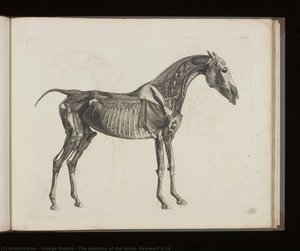
stubbs's passion for anatomy led him to move to york in 1744, where he studied under surgeon charles atkinson at york county hospital. one of his earliest surviving works is a set of illustrations for john burton's textbook on midwifery, published in 1751. in 1756, stubbs rented a farmhouse in lincolnshire and spent 18 months dissecting horses, assisted by his common-law wife, mary spencer. this led to the publication of the anatomy of the horse in 1766, with original drawings now housed at the royal academy. stubbs's work was soon recognized by leading aristocratic patrons, including the 3rd duke of richmond, who commissioned three large pictures in 1759. this marked the beginning of his successful career, with works produced for several dukes and lords, culminating in the purchase of a house in marylebone, london.legacy and notable paintings
stubbs's most famous work, whistlejacket, a painting of a prancing horse commissioned by the 2nd marquess of rockingham, is now housed at the national gallery in london. this and two other paintings for rockingham break with convention, featuring plain backgrounds.- whistlejacket, a thoroughbred race horse rising on his hind legs, showcases stubbs's unparalleled skill in capturing the essence of horses.
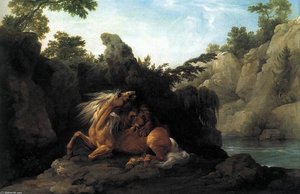
- stubbs's series of paintings on a lion attacking a horse are early examples of the romantic movement, demonstrating his influence on 18th-century art.
- view stubbs's artwork at https://ArtsDot.com/@/george_stubbs
- explore the national gallery in london's collection, featuring stubbs's notable works, at /en/art/show/art-8xyffg-en/
- learn more about stubbs's life and work on wikipedia at https://en.wikipedia.org/wiki/george_stubbs
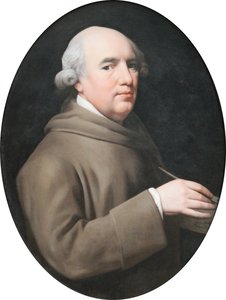
George Stubbs
1724 - 1806 , United Kingdom
Quick Facts
- Artistic Movement Or Style: Romanticism, Equine Art
- Artists Or Movements Influenced By This Artist: ['Joshua Reynolds']
- Artists Who Influenced This Artist: ['Hamlet Winstanley']
- Date Of Birth: August 25, 1724
- Date Of Death: July 10, 1806
- Full Name: George Stubbs
- Nationality: British
- Notable Artworks:
- Whistlejacket
- Lion & Horse
- A Lion and Tiger
- Place Of Birth: Liverpool, UK

