 Preview
 Send
Send Share
Share
 Details

 Download
 Similars
 X-Ray
X-Ray Diaporama
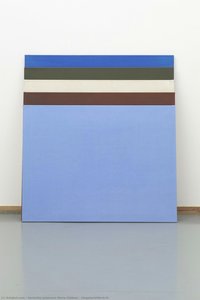
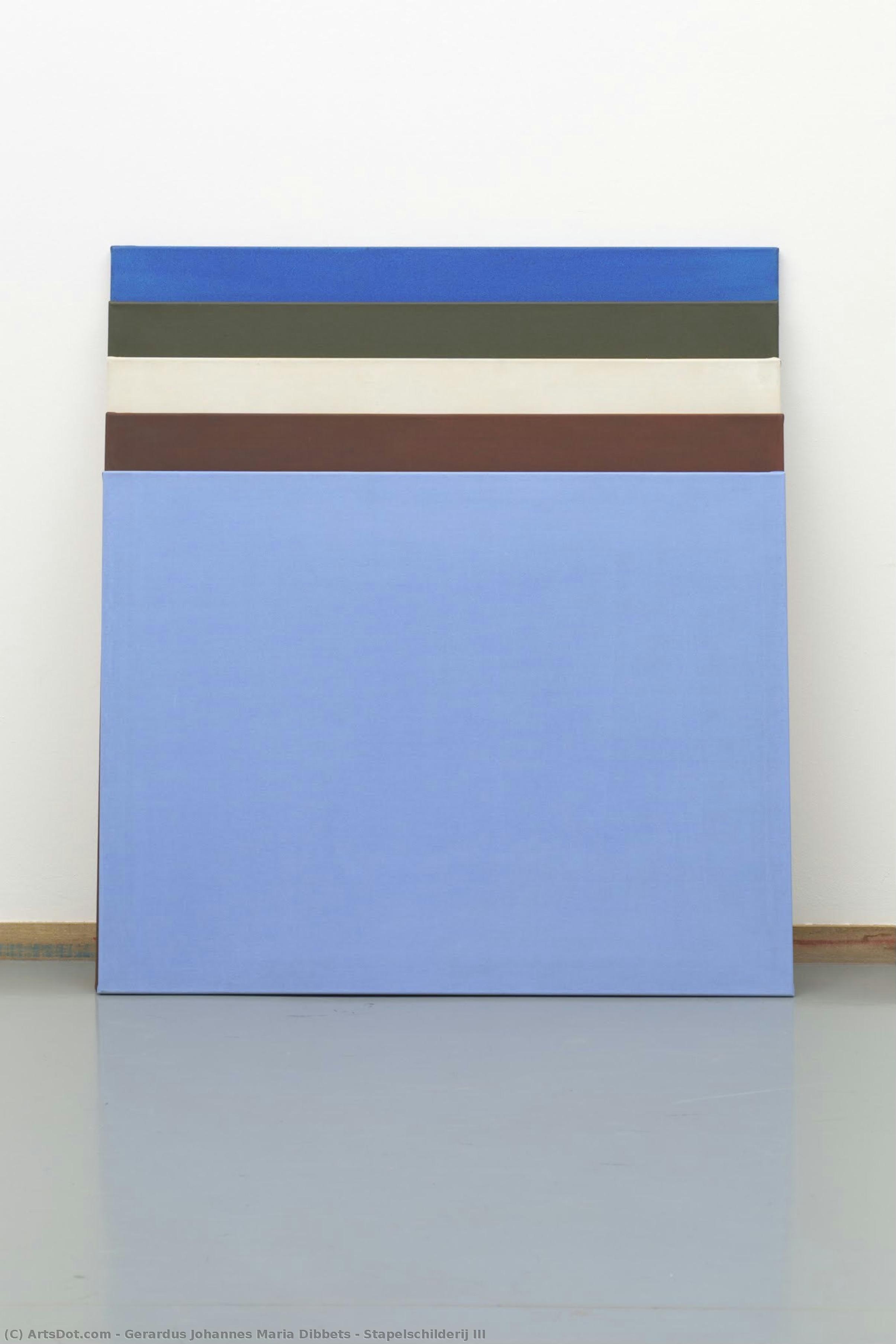
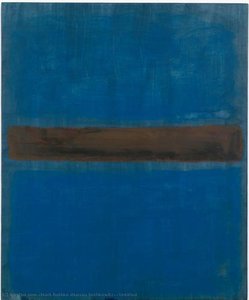
Stapelschilderij III
 130.0 x 120.0 cm
 Bonnefanten Museum
 Read More
Hand Made Oil Reproduction
Hand-painted oil on canvas in your size and frame, made to order by our artists. ( Buy Print Buy Image)




































Pick from our preset sizes that match the artwork's original proportions.

You may enter your own dimensions to fit a specific frame or space. If your selected size does not match the original image's proportions, we will either crop the artwork or extend the painting with additional hand-painted elements. A digital mockup will be sent for your approval before production begins.
Please note that the on-screen preview does not reflect the actual cropping or extension. Only the mockup will accurately show the final composition.
While custom sizes are available, we recommend selecting a dimension from the predefined list to preserve the original proportions.
After order, ArtsDot.com team will email client for instructions and provide a mockup preview
Worldwide Delivery () in 3/4 weeks instead of standard 5 weeks. (23 August). No compromise on quality.

Free Worldwide Express Shipping

High-Quality Linen Canvas

Full Shipping Insurance

Customs Tax Refund Guarantee

True Color Matching Guarantee

60-Day Return Policy (Defects Only)

100% Money-Back Guarantee

Bulk Discount Offer
 Glass option is only available in size under 110 CM

Stapelschilderij III
Reproduction Medium
Reproduction Size
-


Total Price
$ 263
Artwork Description
Related Artworks








Artist Biography
The Architect of Perception: The Visionary World of Jan Dibbets
In the quiet landscape of Wortel, Netherlands, a journey began that would eventually redefine how we perceive the very fabric of reality. Born on May 9, 1941, Jan Dibbets emerged not merely as an artist, but as a cartographer of the unseen, a man capable of mapping the delicate intersection where mathematical precision meets the organic unpredictability of nature. His early years were rooted in the tactile traditions of painting, studying under Jan Gregoor at the Eindhoven Academy. This foundational period instilled in him a profound respect for composition and detail, yet even then, a restless intellect was at work, seeking a way to move beyond the mere representation of objects toward a deeper investigation of space itself.
The late 1960s served as a transformative crucible for Dibbets. As the art world shifted away from the expressive gestures of traditional painting toward the cerebral rigors of conceptualism, Dibbets underwent a radical metamorphosis. By 1967, he made the decisive choice to abandon the brush in favor of the lens, a transition that allowed him to utilize photography not as a tool for documentation, but as an instrument of intervention. This period was marked by a fascinating experimentation with form; his works from this era, such as his Stapelschilderij series, saw him piling monochrome canvases against walls or on floors, effectively stripping the painting of its role as a window onto the world and reimagining it as a physical, sculptural object in its own right.
Geometry in the Wild: The Convergence of Land Art and Mathematics
Dibbets’s artistic evolution was deeply enriched by his encounters with the pioneers of the Land Art movement. Engaging with the works and philosophies of figures like Richard Long, he began to see the natural environment not as a static backdrop, but as a dynamic participant in a geometric dialogue. This influence breathed life into his practice, encouraging him to seek out the hidden structures embedded within the earth and sky. His work became a sophisticated dance between the organic and the artificial, where the wildness of a landscape could be momentarily tamed or highlighted through the application of mathematical logic.
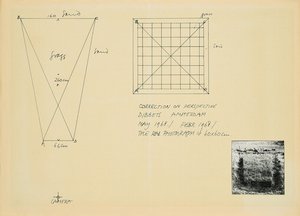
The pinnacle of this exploration arrived with his groundbreaking perspective corrections. These were not mere photographs, but carefully engineered optical illusions achieved by rotating images to compensate for natural distortions. Through these interventions, Dibbets could force the viewer’s eye to recognize a perfect square or a precise line within a seemingly irregular terrain. This technique challenged the very nature of photographic truth, suggesting that what we see is often a construction of our own biological limitations. His participation in the 1972 Venice Biennale served as his international arrival, presenting a vision where the camera acts as a bridge between human perception and the mathematical truths of the universe.
A Lasting Legacy of Conceptual Depth
The historical significance of Jan Dibbets lies in his ability to make the abstract tangible. His oeuvre remains a testament to the power of conceptual thought, proving that art can be both intellectually rigorous and visually arresting. Whether through the minimalist exploration of space seen in works like Bonnefanten/Saenredam or the intricate structural studies found in his Structure Piece series, Dibbets consistently pushed the boundaries of what a medium could achieve. He transformed the act of looking into an act of discovery, inviting us to question the stability of our visual world.
Today, his influence persists in the way contemporary artists approach the relationship between technology and nature. His legacy is found in every image that asks us to look twice, to doubt our first impressions, and to find the hidden geometry within the chaos of existence. Through his meticulous blend of mathematics and photography, Jan Dibbets has left an indelible mark on the history of 20th-century art, ensuring that the dialogue between the human mind and the natural world continues to resonate with profound clarity.
gerardus johannes maria dibbets
1941 - , Netherlands
Quick Facts
- Artistic Movement Or Style: Conceptual Art; Land Art
- Artists Or Movements Influenced By This Artist: ['Minimalism']
- Artists Who Influenced This Artist: ['Richard Long']
- Date Of Birth: May 9, 1941
- Full Name: Jan Dibbets
- Nationality: Dutch
- Notable Artworks:
- The Fallen Easel
- 2000’ Shadow
- Place Of Birth: Wortel, Netherlands