Preview
 Send
Send Share
Share
 Details

 Download
 Similars
 X-Ray
X-Ray Diaporama
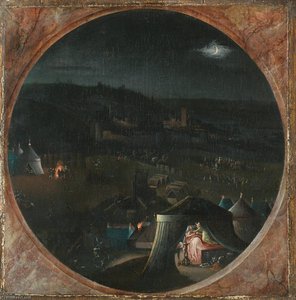
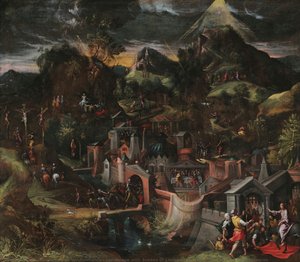
The Assyrian camp at night, with Judith beheading Holofernes in his tent
 1593
1593 25.0 x 25.0 cm
 Read More
Giclée / Art Print
Museum-quality giclée or canvas print with fast production and flexible finish options. ( Buy Hand Made Painting Buy Image)




































Pick from our preset sizes that match the artwork's original proportions.

You may enter your own dimensions to fit a specific frame or space. If your selected size does not match the original image's proportions, we will either crop the artwork or extend the image with a mirrored or solid-fill edge. A digital mockup will be sent for your approval before production begins.
Please note that the on-screen preview does not reflect the actual cropping or extension. Only the mockup will accurately show the final composition.
While custom sizes are available, we recommend selecting a dimension from the predefined list to preserve the original proportions.
Worldwide Delivery () in 2 weeks instead of standard 4/5 weeks. (28 August)

Free Worldwide Express Shipping

High-Quality Linen Canvas

Full Shipping Insurance

Customs Tax Refund Guarantee

True Color Matching Guarantee

60-Day Return Policy (Defects Only)

100% Money-Back Guarantee

Bulk Discount Offer
 Glass option is only available in size under 110 CM

The Assyrian camp at night, with Judith beheading Holofernes in his tent
Giclée / Art Print
Reproduction Size
-


Total Price
$ 63
Related Artworks







Artist Biography
Gillis Coignet the Elder
Gillis Coignet (I), born around 1540 in Amsterdam, Netherlands, stands as a pivotal figure within the Dutch Golden Age artistic landscape. While biographical details remain somewhat elusive – largely due to the fragmented nature of archival records – his legacy persists through an impressive oeuvre characterized by meticulous detail and profound psychological insight, particularly evident in his portraiture.
Coignet’s formative years coincided with a period of unprecedented cultural flourishing in Amsterdam, fueled by burgeoning trade routes and intellectual ferment. The city served as a magnet for artists from across Europe, fostering a dynamic exchange of ideas and techniques. His early training likely encompassed the traditions of Flemish Mannerism, absorbing influences from masters like Anthony van Dyck and Rubens – artists whose stylistic innovations profoundly shaped the artistic sensibilities of their time.
- Notable Works: Coignet’s output includes numerous portraits depicting nobility and civic dignitaries, showcasing his mastery of chiaroscuro—the dramatic interplay between light and shadow—a technique championed by Caravaggio. Among his most celebrated paintings are depictions of Willem van Rosenburgh, Pieter Pauwelrecht, and Jan Wolleghem, each imbued with a remarkable sensitivity to capturing the sitter’s character and inner life.
- Technique: Coignet's distinctive style is distinguished by its meticulous attention to anatomical accuracy combined with expressive brushwork. He employed a layered glazing technique—applying thin translucent washes of pigment over subsequent layers—to achieve luminous surfaces and subtle tonal gradations, resulting in paintings that possess an ethereal quality.
- Influences: Beyond Flemish Mannerism, Coignet’s artistic vision was undoubtedly shaped by humanist ideals prevalent during the Renaissance. The emphasis on observation and rational analysis—characteristic of humanist scholarship—mirrored itself in his approach to portraiture, striving to represent not merely physical likeness but also psychological essence.
- Historical Significance: Coignet’s contribution to Dutch art history lies in his embodiment of the Golden Age's preoccupation with realism and psychological depth. He exemplifies the artistic ambition to transcend mere representation, aiming instead to convey profound truths about human nature—a pursuit that aligns seamlessly with the broader intellectual currents shaping European culture.
Despite the paucity of biographical information, Coignet’s enduring reputation testifies to the power of his art. His portraits continue to captivate viewers today, offering glimpses into the lives and aspirations of individuals who inhabited a transformative era—a testament to Gillis Coignet (I)’s indelible mark upon the annals of Dutch artistic achievement.

Quick Facts
- Artistic Movement Or Style: Dutch Golden Age
- Artists Or Movements Influenced By This Artist: ['Baroque']
- Artists Who Influenced This Artist:
- Jan Steen
- Pieter Bruegel the Elder
- Full Name: Gillis Coignet
- Nationality: Dutch
- Notable Artworks:
- The Visitation
- Saint Jerome in His Study
- Place Of Birth: Amsterdam, Netherlands