

 Preview
 Send
Send Share
Share
 Details

 Download
 Similars
 X-Ray
X-Ray Diaporama
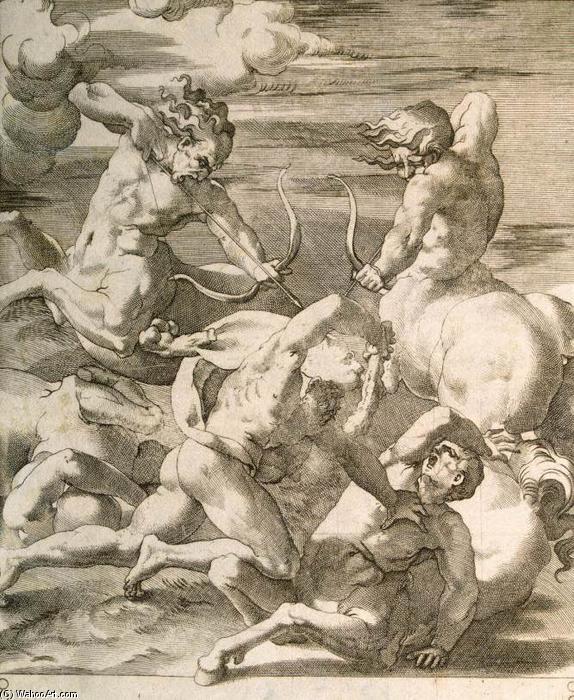
Battle between Hercules and Centaurs
 1526
1526 222.0 x 184.0 cm
 Hermitage Museum
 Read More
Purchase a high-resolution, enhanced digital image, far superior to the online preview.
Each file is meticulously prepared by our in-house specialists using advanced tools and expert manual retouching. We ensure every image has exceptional clarity, precise color accuracy, and fine detail.
The final file is delivered via email within 72 hours, optimized for immediate use in professional, editorial, and print environments. This is the same quality trusted by top-tier design studios, publishers, and galleries.
Digital Image
Download a high-resolution file for personal display, printing, and creative projects. ( Buy Print Buy Hand Made Painting)
Included in Every Digital Image Order
Expert Digital Delivery, Guaranteed
When you choose ArtsDot.com, you're not just getting an image - you're receiving a professionally enhanced digital artwork, crafted with precision and backed by a satisfaction guarantee. Here's everything that comes with your order, automatically:

Fast Email Delivery
Your high-resolution digital image file will be emailed to you within 72 hours of ordering - ready for immediate use.

AI-Enhanced Digital File
Your artwork is professionally optimized using advanced AI tools and manual editing, ensuring maximum detail, clarity, and color accuracy.

Free Lifetime Re-Delivery
Accidentally deleted or lost your file? No worries - we'll resend it to you anytime, free of charge.

No Import Fees - Ever
Enjoy your artwork instantly with zero customs, duties, or delivery fees - digital downloads are always tax-free.

Color Accuracy Guarantee
We ensure your digital image reflects the original colors as closely as possible using professional tools and color management.

60-Day Satisfaction Guarantee
If you're not satisfied with your digital image, we'll revise it or refund 100% within 60 days - no questions asked.

100% Money-Back Guarantee
Not satisfied? Get a full refund within 60 days of receiving your digital file - no questions asked.

Bulk Order Discounts
Buy 3 images, save 10% - Buy 5, save 15% - Buy 10+, save 20%. Great for creative projects, galleries, and agencies.
Collectible Description
Composition and Technique
The engraving measures 222 x 184 cm and is characterized by its exceptional composition and technique. The scene depicts Hercules standing centrally, wielding his club and wearing a lion's skin as a cloak. He is surrounded by centaurs, creatures with the upper body of humans and the lower body of horses, which are scattered around him in various poses. The use of light and shadow adds depth to the scene, highlighting the contours of the figures. Key elements of the painting include:- The muscular form of Hercules, emphasizing his strength and power
- The detailed expressions on the faces of the centaurs, conveying a mix of fear and aggression
- The minimalistic background, which helps to focus attention on the action between Hercules and the centaurs
Artistic Significance
The Battle between Hercules and Centaurs is a significant work in the history of art, demonstrating Giovanni Jacopo Caraglio's mastery of engraving techniques. The painting can be viewed on the ArtsDot.com website, which offers handmade oil painting reproductions of famous artworks. For more information on the artist and his works, visit the ArtsDot.com artists page.The Battle between Hercules and Centaurs is a captivating piece that showcases the artistic skill of Giovanni Jacopo Caraglio. Its composition, technique, and attention to detail make it a standout work in the world of art. To learn more about this painting and other famous artworks, visit the ArtsDot.com website.
Related Artworks









Artist Biography
The Master of the Burin: The Life and Legacy of Giovanni Jacopo Caraglio
In the vibrant, transformative era of the High Renaissance and the emerging Mannerist style, few artists bridged the gap between delicate craftsmanship and monumental visual storytelling as effectively as Giovanni Jacorp Caraglio. Born around 1500 in the storied cities of Verona or Parma, Caraglio’s early identity was forged in the meticulous world of the goldsmith. This foundational training in metalwork bestowed upon him a precision of line and an intimate understanding of texture that would later define his revolutionary approach to printmaking. As he transitioned from the delicate artistry of precious metals to the broader canvas of engraving, he became a pivotal figure in the dissemination of Italian Renaissance ideals across the European continent.
Caraglio’s ascent within the artistic hierarchy was inextricably linked to the great masters of Rome. His period of study under Marcantonio Raimondi—the legendary printmaker who had mastered the art of translating painterly compositions into reproducible engravings—served as a profound intellectual and technical crucible. Under Raimondi's guidance, Caraglio absorbed the principles of disegno, learning to use the burin not merely to copy, but to interpret. This period of Roman patronage saw him collaborating with titans such as Rosso Fiorentino and Giulio Romano. Through these partnerships, Caraglio breathed life into complex mythological narratives, most notably in his celebrated print suites like The Labours of Hercules. His work during this era was characterized by a sophisticated Mannerist tension, where muscular anatomy and dramatic, swirling compositions began to push the boundaries of classical balance.
Innovation Through Movement and Light
The trajectory of Caraglio’s career was dramatically altered by the political upheavals of the 16th century, specifically the Sack of Rome in 1527. Seeking refuge in Venice, a city that served as a global crossroads for commerce and culture, Caraglio entered a new phase of artistic evolution. The Venetian influence, with its emphasis on atmosphere and tonal richness, allowed him to refine his technique beyond the rigid outlines of his earlier Roman works. He began to master the interplay of light and shadow, using fine hatching and cross-hatching to create a sense of three-dimensional volume that felt almost sculptural.
One of his most enduring achievements remains the Battle between Hercules and Centaurs (1526). In this breathtaking engraving, one can witness the full breadth of his talent. The central figure of Hercules, draped in the lion's skin, stands as a pillar of strength amidst a chaotic whirlwind of centaur adversaries. Caraglio’s ability to capture the raw, kinetic energy of the struggle—the tension in a straining limb, the fearful expression on a creature's face, and the dramatic chiaroscuro that illuminates the battlefield—demonstrates why he was considered a master of his medium. His work did not merely document myth; it dramatized it, making the heroic and the monstrous palpable to a wide audience of collectors.
A Legacy Beyond Borders
As his career progressed, Caraglio’s influence traveled far beyond the Italian peninsula. His journey eventually led him to the opulent courts of Poland, where he served as a court goldsmith. This final chapter of his life in Krakow underscores the versatility of an artist who could navigate both the high-stakes world of royal patronage and the gritty, technical demands of the print shop. He remained a vital link in the chain of artistic transmission, ensuring that the stylistic innovations of the Italian Renaissance reached the far corners of Europe.
The historical significance of Giovanni Jacopo Caraglio lies in his role as a transformative reproductive printmaker. While many of his contemporaries focused on the literal reproduction of paintings, Caraglio utilized the medium to expand upon them. His contributions can be summarized through several key artistic pillars:
- Technical Synthesis: The seamless integration of goldsmithing precision with the expressive potential of large-scale engraving.
- Stylistic Bridge: Acting as a vital conduit between the balanced classicism of the High Renaissance and the elongated, dramatic tension of Mannerism.
- Narrative Depth: Elevating mythological subjects through dynamic compositions that emphasized movement, emotion, and anatomical prowess.
- Cultural Diffusion: Facilitating the spread of Italian aesthetic values to Venice and eventually the Polish courts, enriching the broader European visual vocabulary.
Today, Caraglio is remembered not just as a craftsman, but as an architect of the image, whose etched lines continue to pulse with the energy of a bygone era of artistic discovery.
giovanni jacopo caraglio
1500 - 1565 , Italy
Quick Facts
- Artistic Movement Or Style: Mannerism
- Artists Or Movements Influenced By This Artist:
- Parmigianino
- Giulio Romano
- Artists Who Influenced This Artist:
- Marcantonio Raimondi
- Rosso Fiorentino
- Date Of Death: 1565
- Full Name: Jacopo Caraglio
- Nationality: Italian
- Notable Artworks:
- Battle between Hercules and Centaurs
- San Giovanni dei Fiorentini
- Place Of Birth: Verona, Italy

