

![Tromba A Fuoco, Ossia A Vapore. In [giovanni Fabbroni], Dell — Giovanni Valentino Mattia Fabbroni](/media/artworks/images-full/bd/9a/bd9a0c83c0bd2e5f51ec59d3c90668d1.jpg)
 Preview
 Send
Send Share
Share
 Details

 Download
 Similars
 X-Ray
X-Ray Diaporama
Tromba a fuoco, ossia a vapore. In [Giovanni Fabbroni], Dell


 Read More
Hand Made Oil Reproduction
Hand-painted oil on canvas in your size and frame, made to order by our artists. ( Buy Print Buy Image)




































Pick from our preset sizes that match the artwork's original proportions.

You may enter your own dimensions to fit a specific frame or space. If your selected size does not match the original image's proportions, we will either crop the artwork or extend the painting with additional hand-painted elements. A digital mockup will be sent for your approval before production begins.
Please note that the on-screen preview does not reflect the actual cropping or extension. Only the mockup will accurately show the final composition.
While custom sizes are available, we recommend selecting a dimension from the predefined list to preserve the original proportions.
After order, ArtsDot.com team will email client for instructions and provide a mockup preview
Worldwide Delivery () in 3/4 weeks instead of standard 5 weeks. (30 August). No compromise on quality.

Free Worldwide Express Shipping

High-Quality Linen Canvas

Full Shipping Insurance

Customs Tax Refund Guarantee

True Color Matching Guarantee

60-Day Return Policy (Defects Only)

100% Money-Back Guarantee

Bulk Discount Offer
 Glass option is only available in size under 110 CM

Tromba a fuoco, ossia a vapore. In [Giovanni Fabbroni], Dell
Reproduction Medium
Reproduction Size
-


Total Price
$ 263
Related Artworks







Artist Biography
Giovanni Valentino Mattia Fabbroni: A Life Dedicated to Science and Reform
Giovanni Valentino Mattia Fabbroni (1752-1822) was a multifaceted Italian figure—a naturalist, economist, agronomist, and chemist whose contributions spanned numerous fields. Born in Florence, Italy, he embodied the spirit of Enlightenment inquiry and played a crucial role in shaping intellectual and practical advancements during his time.
Early Life and Education
Fabbroni was born into a family that fostered intellectual curiosity. His mother, Rosalinda Werner, hailed from Heidelberg, exposing him to diverse cultural influences early in life. While specific details of his formal education remain scarce, it’s clear he possessed a keen aptitude for scientific observation and analytical thought.
Collaboration and Early Work
In 1775, Fabbroni began a significant collaboration with Felice Fontana, contributing to the establishment of the Natural History Museum in Florence (Museo di Fisica e Storia Naturale di Firenze). This partnership marked the beginning of his dedicated pursuit of natural sciences. From 1777 to 1778, he penned Reflexions sur l'état actuel de l'agricolture, a work that profoundly impacted farming practices in Tuscany. His insights into agricultural reform demonstrated a commitment to practical solutions based on scientific understanding.
Membership and Influence
Fabbroni’s growing reputation led to his membership in the prestigious Accademia dei Georgofili in 1783. This association further solidified his position within Florentine society as a champion of economic liberalism and agrarian reform. He became a staunch supporter of Leopold II, advocating for policies that promoted progress and innovation.
Scholarly Pursuits
Throughout his career, Fabbroni continued to produce scholarly works, including Dell'antracite o carbone di cava detto volgarmente carbone fossile (1790), demonstrating his broad range of scientific interests. He wasn’t confined to a single discipline but actively explored various areas of knowledge.
The Napoleonic Era and Metric System
During the Napoleonic era, Fabbroni's influence extended to the realm of standardization. He was instrumental in developing and introducing the metric system to Italy, recognizing its potential for streamlining commerce and scientific measurement. His work on electrochemistry, particularly his research into Volta’s pile (the first electrical battery), further showcased his commitment to cutting-edge science.
Legacy and Historical Significance
Giovanni Valentino Mattia Fabbroni died in Pisa in 1822 at the age of 70. His legacy lies not only in his specific scientific contributions but also in his dedication to applying knowledge for practical benefit. He was a true polymath, bridging the gap between theoretical inquiry and real-world application.
Key Achievements
- Establishment of the Natural History Museum in Florence
- Authoring Reflexions sur l'état actuel de l'agricolture, impacting Tuscan agriculture.
- Promotion of economic liberalism and agrarian reform
- Introduction of the metric system to Italy
- Research into electrochemistry and Volta’s pile
Fabbroni’s work exemplifies the Enlightenment ideal of using reason and observation to improve society. He remains a significant figure in Italian history, representing a period of intellectual ferment and progressive reform.
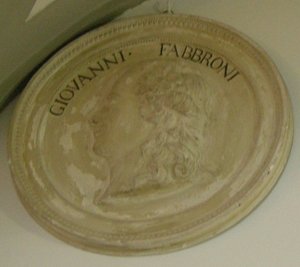
giovanni valentino mattia fabbroni
1752 - 1822 , Italy
Quick Facts
- Birth Date: 1752
- Birth Place: Florence, Italy
- Death Date: 1822
- Movement: Naturalism, Economic Liberalism
- Name: Giovanni Valentino Mattia Fabbroni
- Nationality: Italian
- Notable Works:
- Reflexions sur l'état actuel de l'agricolture
- Dell'antracite o carbone di cava detto volgarmente carbone fossile
- Dei mezzi che si usano per estrarre l'Antracite dalle cave: […] argano mosso per mezzo d'acqua
- Tromba a fuoco, ossia a vapore. In [Giovanni Fabbroni], Dell
![Dei mezzi che si usano per estrarre l’Antracite dalle cave: […] argano mosso per mezzo d’acqua](/media/artworks/images-thumb/72/aa/72aa3208bbd0460a50f2e850f51e34c4.jpg)
![Tromba a fuoco, ossia a vapore. In [Giovanni Fabbroni], Dell](/media/artworks/images-thumb/55/e9/55e99084ae89b95c1c88762acb475baf.jpg)

