 Preview
 Send
Send Share
Share
 Details

 Download
 Similars
 X-Ray
X-Ray Diaporama
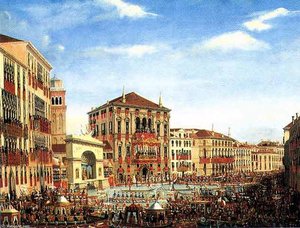
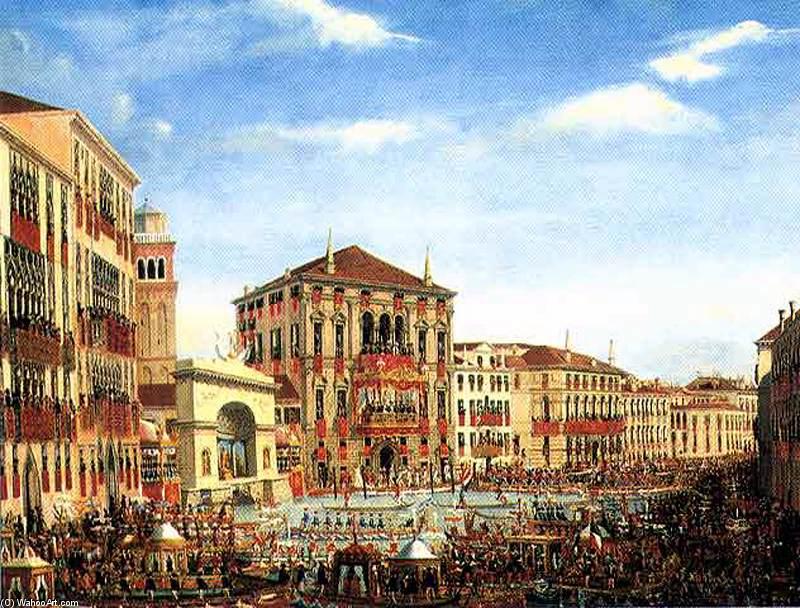
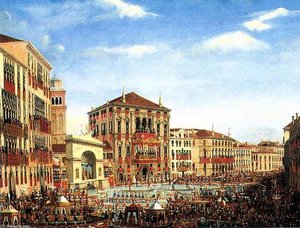
Napoleon I Presiding over a Regatta in Venice in 1807


 Read More
Giclée / Art Print
Museum-quality giclée or canvas print with fast production and flexible finish options. ( Buy Hand Made Painting Buy Image)




































Pick from our preset sizes that match the artwork's original proportions.

You may enter your own dimensions to fit a specific frame or space. If your selected size does not match the original image's proportions, we will either crop the artwork or extend the image with a mirrored or solid-fill edge. A digital mockup will be sent for your approval before production begins.
Please note that the on-screen preview does not reflect the actual cropping or extension. Only the mockup will accurately show the final composition.
While custom sizes are available, we recommend selecting a dimension from the predefined list to preserve the original proportions.
Worldwide Delivery () in 2 weeks instead of standard 4/5 weeks. (26 August)

Free Worldwide Express Shipping

High-Quality Linen Canvas

Full Shipping Insurance

Customs Tax Refund Guarantee

True Color Matching Guarantee

60-Day Return Policy (Defects Only)

100% Money-Back Guarantee

Bulk Discount Offer
 Glass option is only available in size under 110 CM

Napoleon I Presiding over a Regatta in Venice in 1807
Giclée / Art Print
Reproduction Size
-


Total Price
$ 63
Related Artworks









Artist Biography
The Master of Venetian Light and Perspective
In the golden twilight of the eighteenth century, as the Republic of Venice transitioned through eras of profound political change, there emerged a painter whose brush captured the very soul of the city’s architectural splendor. Giuseppe Borsato (1771–1849) was not merely an observer of Venice, but a chronicler of its enduring elegance. Born into a family where the craft of ornamental painting was a lived reality, Borsato possessed an innate understanding of how light dances across marble and how shadow settles within the grand corridors of power. His journey began in the hallowed halls of the Accademia di Belle Arti, where he sought the rigorous discipline of perspective under the guidance of the esteemed Agostino Mengozzi-Colonna. This training provided him with more than just technical skill; it gifted him a mathematical precision that allowed him to render the complex vistas of Venice with an almost architectural truth.
Borsato’s artistry was a delicate tapestry woven from various stylistic threads. While his vedute—those sweeping, panoramic views of the Venetian cityscape—often echoed the luminous clarity of Canaletto, he infused them with a contemporary sensibility that moved beyond mere documentation. He drew inspiration from the atmospheric nuances of Vincenzo Chilone and embraced the burgeoning Neoclassical movement, blending classical rigor with a romantic appreciation for the ephemeral qualities of light. His mastery of watercolor allowed him to capture the subtle, shimmering reflections on the lagoon, creating works that felt less like static images and perhaps more like captured moments of breath and tide.
A Legacy Carved in Stone and Fresco
Beyond the intimate scale of his panoramic views, Borsato’s influence extended into the very fabric of Venice’s most sacred and secular institutions. He was a painter of grand spaces, an artist capable of transforming ceilings and walls into immersive theatrical environments. His career was marked by a remarkable ability to collaborate, turning large-scale architectural projects into unified works of art. One cannot speak of his legacy without mentioning the Teatro La Fenice, where, alongside his student Francesco Bagnara, he decorated the Royal Box in 1807. This role as a set designer and decorator for one of the world's most famous opera houses allowed him to merge the boundaries between fine art and theatrical spectacle, creating environments that were as much about drama as they were about decoration.
His hand can be found tracing the history of Venetian grandeur in several of its most prestigious landmarks:
- St. Mark's Basilica: Where his decorative prowess contributed to the spiritual and visual majesty of the city's heart.
- Santa Maria Gloriosa dei Frari: A testament to his ability to navigate the solemnity of religious interiors.
- Palazzo Zabarella: A monumental collaboration in 1818 alongside luminaries such as Francesco Hayez and Giovanni Carlo Bevilacqua, showcasing his role in the intellectual and artistic renovation of Venetian nobility.
- The Onigo Theater: An early triumph in Treviso that signaled his rising importance as a decorator of public spaces.
Ultimately, Giuseppe Borsato remains a vital figure in the narrative of Italian Neoclassicism. He was an artist who understood that to paint Venice was to paint a dream of permanence amidst constant change. Whether through the precise lines of a perspective drawing or the sweeping, emotive strokes of a fresco, his work continues to invite us into a vanished world of opulence, reminding us of a time when art and architecture breathed together in perfect, luminous harmony.
Giuseppe Borsato
1771 - 1849 , Italy
Quick Facts
- Artistic Movement Or Style: Vedute Painting
- Artists Or Movements Influenced By This Artist: ['Baroque']
- Artists Who Influenced This Artist:
- Agostino Mengozzi-Colonna
- Vincenzo Chilone
- Date Of Birth: 1771
- Full Name: Giuseppe Borsato
- Nationality: Italian
- Notable Artworks:
- Commemoration of Canova in the Scuola Grande della Carit
- Napoleon I Presiding over a Regatta in Venice
- Place Of Birth: Venice, Italy