 Preview
 Send
Send Share
Share
 Details

 Download
 Similars
 X-Ray
X-Ray Diaporama
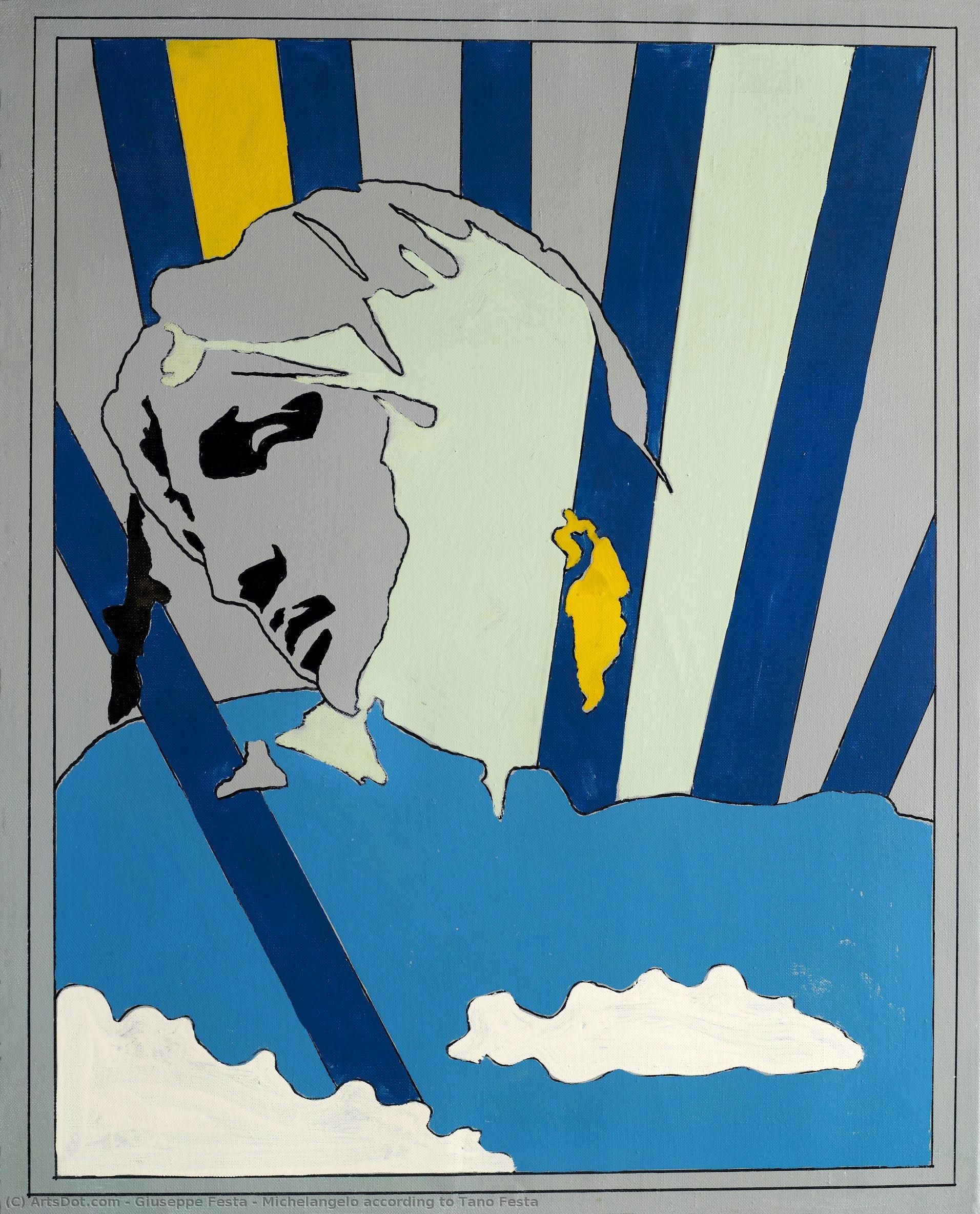
Michelangelo according to Tano Festa
 Pop Art
 65.0 x 81.0 cm
 Read More
Hand Made Oil Reproduction
Hand-painted oil on canvas in your size and frame, made to order by our artists. ( Buy Print Buy Image)




































Pick from our preset sizes that match the artwork's original proportions.

You may enter your own dimensions to fit a specific frame or space. If your selected size does not match the original image's proportions, we will either crop the artwork or extend the painting with additional hand-painted elements. A digital mockup will be sent for your approval before production begins.
Please note that the on-screen preview does not reflect the actual cropping or extension. Only the mockup will accurately show the final composition.
While custom sizes are available, we recommend selecting a dimension from the predefined list to preserve the original proportions.
After order, ArtsDot.com team will email client for instructions and provide a mockup preview
Worldwide Delivery () in 3/4 weeks instead of standard 5 weeks. (27 August). No compromise on quality.

Free Worldwide Express Shipping

High-Quality Linen Canvas

Full Shipping Insurance

Customs Tax Refund Guarantee

True Color Matching Guarantee

60-Day Return Policy (Defects Only)

100% Money-Back Guarantee

Bulk Discount Offer
 Glass option is only available in size under 110 CM

Michelangelo according to Tano Festa
Reproduction Medium
Reproduction Size
-


Total Price
$ 263
Related Artworks


Artist Biography
Georg Baselitz: A Life Sculpted in Inversion
Born Hans-Georg Kern in Deutschbaselitz, a small village in the Upper Lusatia region of Germany, on January 23, 1938, Georg Baselitz’s life was inextricably linked to the landscape and history of his birthplace – a place scarred by the devastation of World War II. This formative experience, coupled with a deep-seated questioning of established order, profoundly shaped his artistic vision, leading him to develop a uniquely arresting style characterized by upside-down figures and a deliberate disruption of traditional representation. Baselitz’s early years were marked by displacement and hardship, witnessing the dismantling of his community and grappling with the lingering trauma of conflict – themes that would repeatedly surface throughout his oeuvre, serving as an underlying current in his work.
Baselitz's artistic journey began modestly, fueled by a fascination with art he encountered during his youth. A pivotal moment occurred when he discovered a reproduction of Louis-Ferdinand von Rayski’s *Wermsdorfer Wald* hanging in the assembly hall of his local school. The painting’s realistic depiction and masterful use of light and shadow captivated him, sparking an interest in figurative art that would prove to be enduring. He also found inspiration in the writings of Jakob Böhme, a 16th-century German mystic whose philosophical explorations resonated with Baselitz's own questioning spirit. Despite initial rejection from the Kunstakademie in Dresden, he persevered and enrolled at the Hochschule für Bildende und Angewandte Kunst in East Berlin, where he honed his skills under influential teachers.
The Rise of Neo-Expressionism and the Inverted Image
Baselitz’s artistic trajectory took a dramatic turn in 1969 when, seeking to break free from the constraints of representational art – which he felt was overly reliant on content and narrative – he began painting his subjects upside down. This seemingly radical decision wasn't merely stylistic; it represented a fundamental shift in his approach to painting. He described this act as an attempt to “overcome the representational, content-driven character” of his earlier work, aiming instead to emphasize the "artifice of painting" itself. This deliberate inversion was not simply a visual trick but a profound statement about the nature of art and its relationship to reality.
Influenced by a diverse range of sources – including Soviet era illustration art, the Mannerist period, and African sculpture – Baselitz developed his own distinctive artistic language. He drew heavily from the stark simplicity and directness of Russian posters, the elongated figures and dynamic compositions of Mannerism, and the expressive power of African masks and sculptures. These disparate influences coalesced into a highly personal style characterized by simplified forms, gestural brushstrokes, and a sense of raw emotion. His early works often featured portraits and landscapes rendered in a deliberately naive manner, reflecting his desire to strip away artifice and connect directly with the viewer.
Technique and Style: A Language of Gesture
Baselitz’s technique is instantly recognizable. He typically paints on large-scale canvases using oil paint applied with broad, gestural brushstrokes. The figures in his paintings are often simplified to their essential forms, reduced to a series of lines and planes that suggest rather than define. The upside-down orientation is consistent throughout his body of work, creating a sense of disorientation and challenging the viewer’s perception. This deliberate inversion forces us to reconsider our assumptions about representation and to engage with the painting on an entirely new level.
Furthermore, Baselitz continues to invert all his paintings, a practice that has become the most defining feature of his work. This seemingly obsessive act underscores his commitment to disrupting established conventions and questioning the nature of art itself. It’s a visual manifestation of his broader philosophical concerns – a rejection of order, a celebration of naiveté, and a persistent interrogation of reality.
Legacy and Recognition
Despite initial skepticism from the art establishment, Baselitz's work gained increasing recognition throughout the 1970s and 80s. He exhibited extensively in Europe and America, establishing himself as a leading figure in the Neo-Expressionist movement. His paintings are now held in major museums worldwide, including the Tate Modern in London, the Museum of Modern Art in New York, and the Centre Pompidou in Paris. Baselitz’s influence extends beyond his own work, inspiring generations of artists to challenge conventional notions of representation and explore new ways of seeing and creating.
Baselitz's legacy lies not only in his distinctive visual style but also in his willingness to question established norms and to embrace a radical approach to artmaking. He remains a vital and influential figure, whose work continues to provoke, challenge, and inspire viewers today. His life’s journey—from the scarred landscape of his childhood to the international acclaim he has achieved—is a testament to the power of artistic vision and the enduring relevance of questioning the world around us.

giuseppe festa
1938 - 1988 , Italy
Quick Facts
- Artistic Movement Or Style: Neo-Expressionism
- Artists Or Movements Influenced By This Artist: ['Gerhard Richter']
- Artists Who Influenced This Artist:
- Soviet illustration art
- Mannerist period
- African sculptures
- Date Of Birth: January 23, 1938
- Full Name: Georg Baselitz
- Nationality: German
- Notable Artworks:
- Where is the Yellow Milkjug?
- Mrs Bird?
- Place Of Birth: Deutschbaselitz, Germany
Related Articles
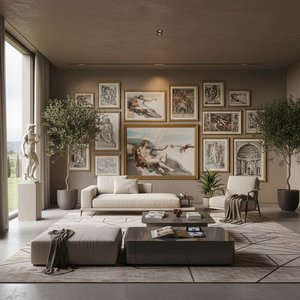
Michelangelo's Masterpieces: Explore 25 Iconic Artworks for Your Home | ArtsDot
Journey through Michelangelo's 25 greatest artworks – from David’s strength to the Sistine Chapel’s beauty. Explore Renaissance masterpieces, art history & find museum-quality reproductions for your home at ArtsDot.com.

Slate Blue Masterpieces: 10 Iconic Paintings & Timeless Home Decor Ideas
Immerse yourself in the captivating world of slate blue! Explore 10 iconic paintings by Monet, Van Gogh & Renoir. Discover their stories, techniques & find museum-quality art reproductions for your home at .
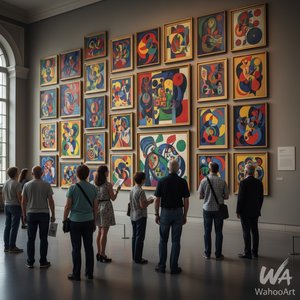
Kandinsky's Masterpieces: 25 Paintings That Define Abstract Art | ArtsDot
Journey through Wassily Kandinsky's 25 most iconic abstract paintings. Explore his revolutionary use of color, form & spiritual expressionism. Find museum-quality Kandinsky reproductions and elevate your home decor with ArtsDot.com. Discover all masterpieces on ArtsDot.com!
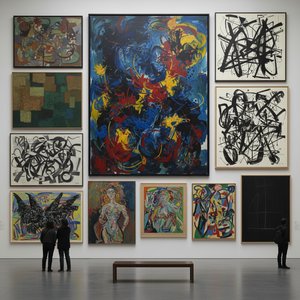
Abstract Expressionism's 10 Defining Masterpieces |
Explore 10 defining Abstract Expressionism masterpieces by Pollock, Rothko & de Kooning. Discover the stories behind these iconic paintings and find museum-quality art reproductions to elevate your home decor on .

Geometric Abstraction's 10 Defining Masterpieces | Art for Your Home - ArtsDot
Explore 10 defining masterpieces of Geometric Abstraction! Discover Kandinsky, Mondrian & Malevich’s iconic works. Find museum-quality art reproductions and curated decor ideas to elevate your home at ArtsDot.com.