

![Graneros Iii [graineries Iii] — Gonzalo Fonseca Mora](/media/artworks/images-full/0e/13/0e1369021fee0ef4835bf1e107ffb897.jpg)
 Preview
 Send
Send Share
Share
 Details

 Download
 Similars
 X-Ray
X-Ray Diaporama
Graneros III [Graineries III]

 Read More
Giclée / Art Print
Museum-quality giclée or canvas print with fast production and flexible finish options. ( Buy Hand Made Painting Buy Image)




































Pick from our preset sizes that match the artwork's original proportions.

You may enter your own dimensions to fit a specific frame or space. If your selected size does not match the original image's proportions, we will either crop the artwork or extend the image with a mirrored or solid-fill edge. A digital mockup will be sent for your approval before production begins.
Please note that the on-screen preview does not reflect the actual cropping or extension. Only the mockup will accurately show the final composition.
While custom sizes are available, we recommend selecting a dimension from the predefined list to preserve the original proportions.
Worldwide Delivery () in 2 weeks instead of standard 4/5 weeks. (27 August)

Free Worldwide Express Shipping

High-Quality Linen Canvas

Full Shipping Insurance

Customs Tax Refund Guarantee

True Color Matching Guarantee

60-Day Return Policy (Defects Only)

100% Money-Back Guarantee

Bulk Discount Offer
 Glass option is only available in size under 110 CM

Graneros III [Graineries III]
Giclée / Art Print
Reproduction Size
-


Total Price
$ 63
Related Artworks




Artist Biography
The Architect of Ancient Echoes
Gonzalo Fonseca Mora was far more than a sculptor; he was a builder of worlds, an artist who used the permanence of stone to bridge the vast chasm between antiquity and modernity. Born in Montevideo, Uruguay, in 1922, Fonseca’s early life was marked by a profound sense of movement and discovery. His childhood travels through Europe exposed him to the weight of history, the grandeur of archaeological ruins, and the silent stories told by ancient civilizations. This early immersion in the remnants of the past would later become the bedrock of his creative identity. Though he initially sought to shape space through the disciplined lens of architecture at the Universidad de la República Oriental del Uruguay, the call of the visual arts proved irresistible. In 1942, he abandoned his architectural blueprints to join the legendary Taller Torres-García, a decision that would pivot his trajectory from the structural logic of buildings to the symbolic power of Universal Constructivism.
Under the mentorship of Joaquín Torres-García, Fonseca entered a realm where art was not merely decoration but a universal language composed of geometric symbols and cosmic order. This period of intense formation instilled in him a lifelong commitment to abstraction, yet his version of abstraction would always remain tethered to the earth and its histories. As he traveled through South America, exploring the profound legacies of pre-Columb and Andean traditions, Fonseca began to synthesize the rigid geometry of Constructivism with the organic, ritualistic forms of ancient cultures. His work became a dialogue between the mathematical precision of the modern era and the primal, spiritual essence of the ancestral world.
Stone, Symbol, and the Sculptural Narrative
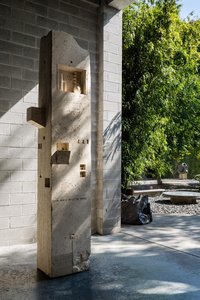
The true mastery of Fonseca lay in his ability to breathe life into the inanimate. He possessed an uncanny ability to manipulate stone—primarily granite and travertine—transforming raw, heavy masses into intricate, labyrinthine structures that felt as though they had been unearthed rather than carved. His technique was a meticulous process of subtraction, where he liberated shapes from the rock, creating works that featured both pristine, smooth surfaces and rugged, chipped alcoves. These sculptures often resembled miniature, imagined cities or archaeological sites, complete with tiny windows, stairways, and hidden chambers. By utilizing found architectural fragments and stone from abandoned quarries, he imbued his pieces with a sense of "found history," making the viewer feel like an explorer discovering a lost civilization.
His artistic vision was characterized by a playful yet profound complexity. To look upon a Fonseca sculpture is to enter a dreamscape where time is non-linear. His works often functioned as architectural fantasies, synthesizing the structural logic of ancient dwellings with a sense of mystery and enigma. There is a certain melancholy in his work—a probing sense of dislocation that resonates with the experience of the immigrant or the wanderer. Through his hands, stone became a medium for storytelling, capable of rendering the past as a physical, tactile place that one could almost inhabit.
A Legacy Carved in Time
As his career progressed, Fonseca’s influence expanded far beyond the borders of Uruguay. His move to New York in 1958 and his later residence in Seravezza, Italy—a town famed for its marble quarries—allowed him to engage with a global artistic dialogue. He achieved significant international recognition, notably through a Guggenheim Fellowship and his representation of Uruguay at the 1990 Venice Biennale. His ability to scale his vision was equally remarkable; while many remember him for his intimate, symbolic stone pieces, he also produced monumental works, such as the concrete tower Torre for the 1968 Mexico City Olympics, proving that his mastery of form could command even the most massive public stages.
The historical significance of Gonzalo Fonseca Mora lies in his unique position at the intersection of several worlds: the ancient and the modern, the South American and the global, the architectural and the sculptural. He did not merely replicate the past; he reimagined it through a contemporary lens, creating a visual vocabulary that remains as enigmatic and vital today as when it was first carved. His legacy survives in every textured crevice of his stone works, reminding us that art has the power to reconstruct the lost fragments of our collective human memory.
gonzalo fonseca mora
1922 - 1997 , Uruguay
Quick Facts
- Artistic Movement Or Style: Universal Constructivism
- Artists Or Movements Influenced By This Artist: ['Hastings Museum']
- Artists Who Influenced This Artist: ['Joaquín Torres-García']
- Date Of Birth: 1922 Montevideo Uruguay
- Date Of Death: 1997
- Full Name: Gonzalo Fonseca Mora
- Nationality: Uruguayan
- Notable Artworks: ['Graneros III']
- Place Of Birth: Montevideo Uruguay
![Graneros III [Graineries III]](/media/artworks/images-thumb/2d/5d/2d5d265296da0fcb151aadcd2b9a0d59.jpg)

