 Preview
 Send
Send Share
Share
 Details

 Download
 Similars
 X-Ray
X-Ray Diaporama
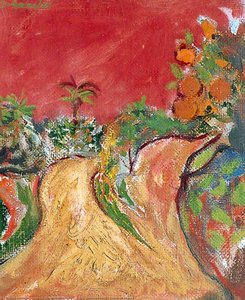
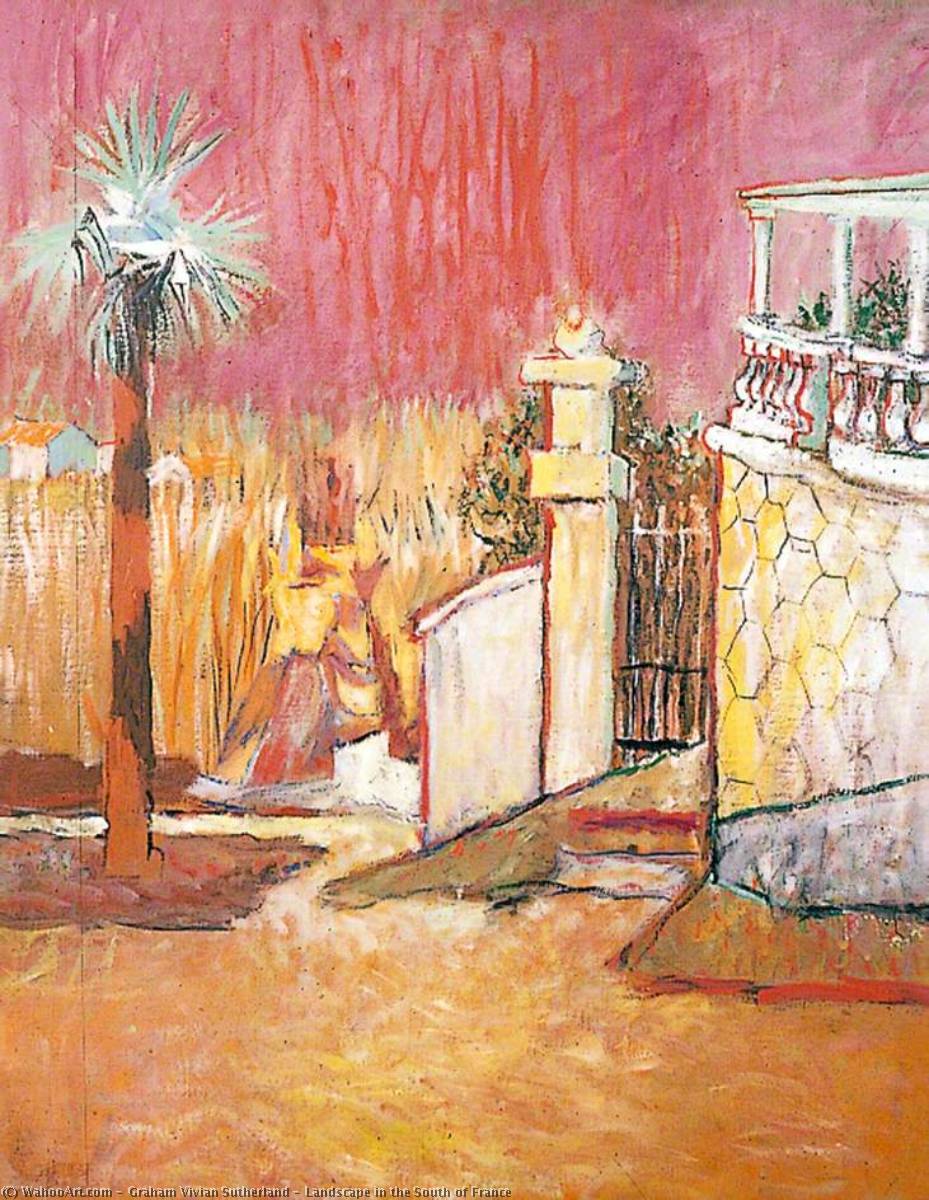
Landscape in the South of France
 Oil
Oil- WallArt
- Surrealism
 1950
1950- Modern
 90.0 x 70.0 cm
 Pallant House Gallery
 Read More
Giclée / Art Print
Museum-quality giclée or canvas print with fast production and flexible finish options. ( Buy Hand Made Painting Buy Image)




P118B $10

P118H $10

P118W $10

P438Z $10

P508JH $12

P508YH $12

P805H $10

P805Z $10

P919BZ $10

P919G $10

P919XJ $10

P959ZH $10

P968JZ $12

W106C $8

W218G $10

W218JH $8

W218Y $10

W307PJ $10

W316G $10

W316PJ $8

W316Y $10

W398PJ $8

W4111J $10

W500HY $15

W500JH $15

W692G $12

W849H $8

W940BG $15

W953PJ $8




Pick from our preset sizes that match the artwork's original proportions.

You may enter your own dimensions to fit a specific frame or space. If your selected size does not match the original image's proportions, we will either crop the artwork or extend the image with a mirrored or solid-fill edge. A digital mockup will be sent for your approval before production begins.
Please note that the on-screen preview does not reflect the actual cropping or extension. Only the mockup will accurately show the final composition.
While custom sizes are available, we recommend selecting a dimension from the predefined list to preserve the original proportions.
Worldwide Delivery () in 2 weeks instead of standard 4/5 weeks. (2 September)

Free Worldwide Express Shipping

High-Quality Linen Canvas

Full Shipping Insurance

Customs Tax Refund Guarantee

True Color Matching Guarantee

60-Day Return Policy (Defects Only)

100% Money-Back Guarantee

Bulk Discount Offer
 Glass option is only available in size under 110 CM

Landscape in the South of France
Giclée / Art Print
Reproduction Size
-


Total Price
$ 63
A Serene Vision of Provençal Splendor
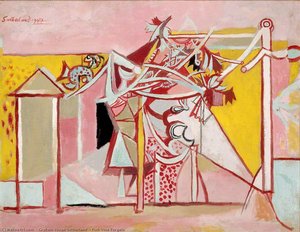
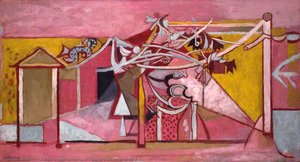
In the quiet moments of contemplation, few scenes capture the soul as tenderly as Landscape in the South of France. Painted in 1950 by the master of British Modernism, Graham Vivian Sutherland, this work serves as a breathtaking window into a world where nature and humanity exist in perfect, rhythmic harmony. The composition is anchored by a magnificent, sprawling tree that stands as a silent sentinel before a charming house topped with a warm, red-tiled roof. This central motif creates a sense of grounded stability, inviting the viewer to step into a pastoral dreamscape where time seems to slow to the gentle pace of the Mediterranean breeze.
The scene is far from a lonely wilderness; instead, it is imbued with a soft, lived-in vitality. Scattered throughout the landscape are figures that breathe life into the canvas, their presence suggesting a shared moment of peace and community. A dog wanders near the left periphery, adding an element of spontaneous, everyday charm that grounds the more poetic elements of the painting. For the discerning collector or interior designer, this piece offers more than just a depiction of scenery; it provides a narrative of tranquility, making it an ideal centerpiece for spaces designed for relaxation and reflection.
Mastery of Light and Modernist Texture
Sutherland was renowned for his ability to bridge the gap between traditional English landscape sensibilities and the avant-garde energy of European Surrealism and Expressionism. In this particular work, we see a masterful application of technique that emphasizes texture and light. The artist utilizes a palette that celebrates the sun-drenched warmth of the South of France, using subtle shifts in tone to define the architecture of the house and the organic complexity of the foliage. The interplay between the structured lines of the fence and bench against the fluid, natural forms of the trees demonstrates his sophisticated command over composition.
The emotional impact of the painting lies in its ability to evoke a sense of "nostalgic presence." While the brushwork retains a modern sensibility, there is an undeniable warmth that resonates with anyone who has sought solace in the beauty of the natural world. The way the light seems to filter through the leaves and rest upon the red roof creates a luminous quality that can transform the atmosphere of any room. For those looking to invest in a high-quality reproduction, this artwork offers a timeless elegance, bringing the sun-soaked serenity of 1950s France into the contemporary home.
An Invitation to Harmony
Beyond its aesthetic beauty, Landscape in the South of France acts as a symbolic bridge between the wildness of nature and the comfort of civilization. The house and the garden elements—the fence, the bench, the human figures—represent the safety and order of domestic life, while the large tree and the surrounding landscape represent the enduring, untamed spirit of the earth. It is a painting of balance, making it an exquisite choice for decorating sophisticated interiors that require a touch of warmth without sacrificing intellectual depth.
Whether displayed in a sunlit gallery or as a focal point in a private study, this reproduction allows the legacy of Graham Sutherland to live on. It invites the viewer to pause, to breathe, and to rediscover the profound peace found in the simple, harmonious coexistence of man and nature. To own such a piece is to possess a fragment of a golden era of landscape painting, a permanent invitation to wander through the sun-drenched fields of the French countryside.
Related Artworks
Artist Biography
The Visionary Landscapes of Graham Vivian Sutherland
Graham Vivian Sutherland, a titan of British Modernism, possessed the rare ability to transform the familiar contours of the natural world into something profoundly unsettling and deeply spiritual. Born in Streatham, London, in 1903, Sutherland’s journey was one of constant metamorphosis. While his early years were shaped by a classical education at Epsom College, his true calling emerged far from the legal circles of his family. His initial foray into the technical world of an apprenticeship at the Midland Railway Locomotive Works provided a foundation of precision that would later manifest in his intricate printmaking and textured oil paintings. As he transitioned to Goldsmiths' School of Art, Sutherland began to move away from traditional representation, finding himself drawn to the evocative power of engraving and etching.
The artist’s early aesthetic was deeply rooted in the romanticism of Samuel Palmer, yet he refused to remain anchored to the past. Instead, Sutherland acted as a bridge between the English pastoral tradition and the radical energy of European avant-garde movements. By absorbing the dreamlike logic of Surrealism and the raw emotionality of Expressionism, he developed a visual language that could capture both the physical landscape and the psychological state. His early prints, characterized by a sense of mystery and organic form, laid the groundwork for a career defined by an obsession with the "strangeness" of nature—a theme that would become his most enduring legacy.
Nature’s Shadow and the War Years
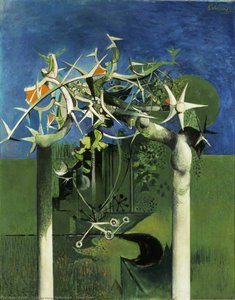
The 1940s marked a pivotal era in Sutherland's development, as his focus shifted from the delicate medium of printmaking to the visceral, impasto textures of oil painting. It was during this period that the rugged, windswept landscapes of Pembrokeshire became his primary muse. In works such as Thorn Tree, one can witness the artist’s mastery in blending botanical reality with surrealist distortion. He did not merely paint trees; he painted the tension, the struggle, and the skeletal architecture of life itself. This period saw him move toward a more abstract, yet deeply symbolic, way of seeing, where thorns, roots, and twisted branches served as metaphors for human vulnerability and resilience.
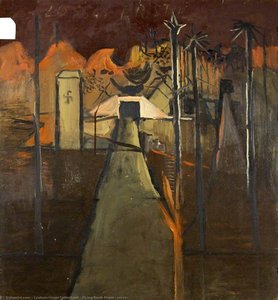
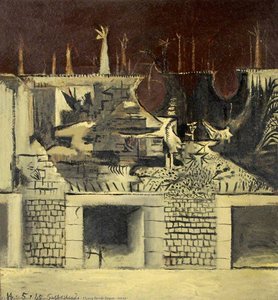
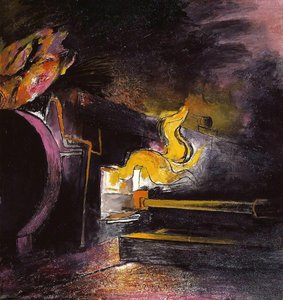
The Second World War brought a different, more somber dimension to his work. Serving as an official war artist, Sutherland turned his gaze toward the industrial and often haunting scenes of the British home front. His paintings from this era, such as Flying Bomb Depot The Caverns, are masterclasses in atmosphere. Through heavy textures and a palette that evokes both decay and dread, he captured the eerie desolation of wartime interiors. These works were not merely documentation; they were psychological portraits of an era marked by anxiety and the looming presence of destruction, reflecting the fractured reality of a world at war.
A Legacy of Symbolism and Grandeur
In the post-war years, Sutherland’s work ascended to new heights of spiritual and public significance. He began to integrate religious symbolism with his organic motifs, creating a powerful synthesis of the sacred and the natural. This culminated in one of his most monumental achievements: the design of the massive central tapestry for the new Coventry Cathedral, titled Christ in Glory in the Tetramorph. This work, which utilized his ability to manipulate form and color on a grand scale, stands as a testament to his role in the cultural reconstruction of post-war Britain.
Throughout his prolific career, Sutherland’s versatility allowed him to leave an indelible mark across multiple disciplines:
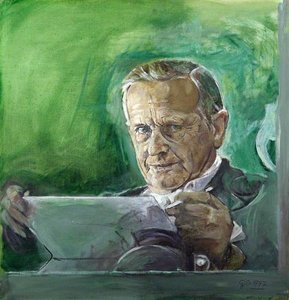
- Portraiture: His ability to capture the psychological depth of public figures, such as his dignified and melancholic Somerset Maugham.
- Printmaking: A lifelong dedication to the precision of etching and engraving that informed his sense of line and structure.
- Decorative Arts: His contributions to tapestry design and glass art, bringing modern abstraction into the realm of functional beauty.
Ultimately, Graham Sutherland remains a cornerstone of 20th-century art because he dared to look beneath the surface of the landscape. He found the surreal within the real and the divine within the organic. His legacy is not just found in museums, but in the way we perceive the hidden, often jagged, beauty of the world around us—a world where every thorn holds a story and every shadow contains a mystery.
Graham Vivian Sutherland
1903 - 1980 , United Kingdom
Quick Facts
- Artistic Movement Or Style: Surrealism
- Artists Or Movements Influenced By This Artist: ['Paul Nash']
- Artists Who Influenced This Artist:
- Samuel Palmer
- F.L. Griggs
- Date Of Birth: August 24, 1903
- Date Of Death: February 17, 1980
- Full Name: Graham Vivian Sutherland
- Nationality: British
- Notable Artworks:
- Flying Bomb Depot
- Entrance to a Lane
- Place Of Birth: London, England
Related Articles

John Constable's Masterpieces: Explore 25 Iconic Landscapes for Your Home
Journey through John Constable's 25 most celebrated landscapes. Explore Romanticism, Dedham Vale & his masterful use of light in iconic paintings like 'Hay Wain'. Find museum-quality art reproductions and elevate your home decor on ArtsDot.com.

Hokusai's Masterpieces: 25 Iconic Prints & Paintings for Art Lovers | ArtsDot
Journey through Katsushika Hokusai’s 25 most iconic artworks, including *The Great Wave*. Explore the ukiyo-e master's history, style & timeless Japanese woodblock prints. Find museum-quality reproductions for your home at ArtsDot.com.

Romantic Landscapes: 10 Masterpieces for Your Home | ArtsDot
Journey through 10 Romantic landscape masterpieces by Friedrich, Turner & Cole. Explore emotional art, sublime nature scenes & iconic 19th-century paintings. Find museum-quality reproductions for your home at ArtsDot.com – discover the full collection online!

Evocations of Place: A Historical Journey Through Landscape Art
Explore the rich history of landscape art with ArtsDot. Discover renowned artists, movements like Impressionism & Romanticism, and expert guidance for collecting timeless pieces. Find your perfect serene escape today!

Crimson Threads of Narrative: Exploring Symbolism & Representation in Artworks Featuring the Red Dress
Explore the rich symbolism of the red dress in art history! From ancient power displays to iconic portraits like Cézanne’s 'Madame Cezanne', discover the cultural and artistic significance behind this captivating color. Expert analysis & insights.